Department of General Surgery, Zhongnan Hospital of Wuhan University, Wuhan, 430071, Hubei, People's Republic of China.
Department of Urology, Renmin Hospital of Wuhan University, Hubei, China.
J Exp Clin Cancer Res. 2019 Nov 8;38(1):458. doi: 10.1186/s13046-019-1444-0.
Hepatocellular carcinoma (HCC) still remains a dominating medical challenge in early diagnosis and clinical therapy. Centromere protein M (CENPM) has been proved to be over-expressed in HCC tissues, but carcinogenic mechanism of CENPM contributing to liver cancer is poorly understood.
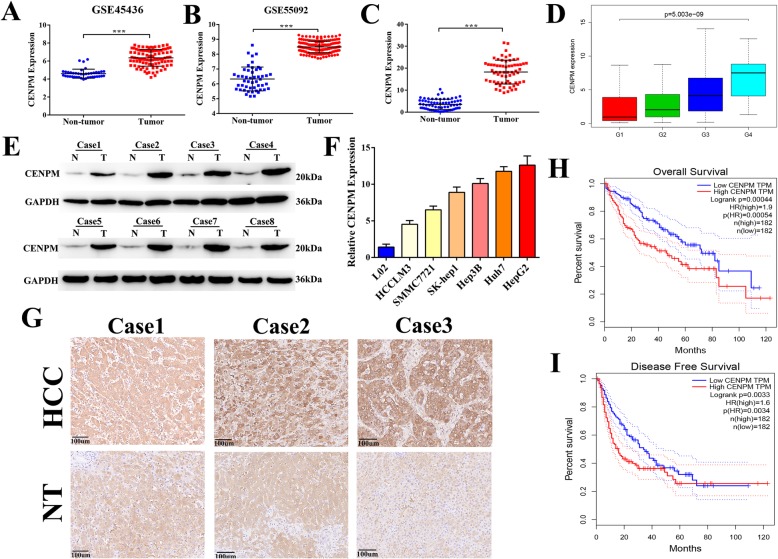
In this study, we first explored mRNA and protein levels of CENPM in HCC samples, matching adjacent non-tumor tissues and six hepatoma cell lines by polymerase chain reaction (PCR), western blotting and immunohistochemistry (IHC). Clinical data of HCC patients downloaded from The Cancer Genome Atlas (TCGA) were also analyzed. The character of CENPM concerned with HCC progression through several functional experimentations in vitro and in vivo was researched. Bioinformatics was carried out to further discover biological functions of CENPM.
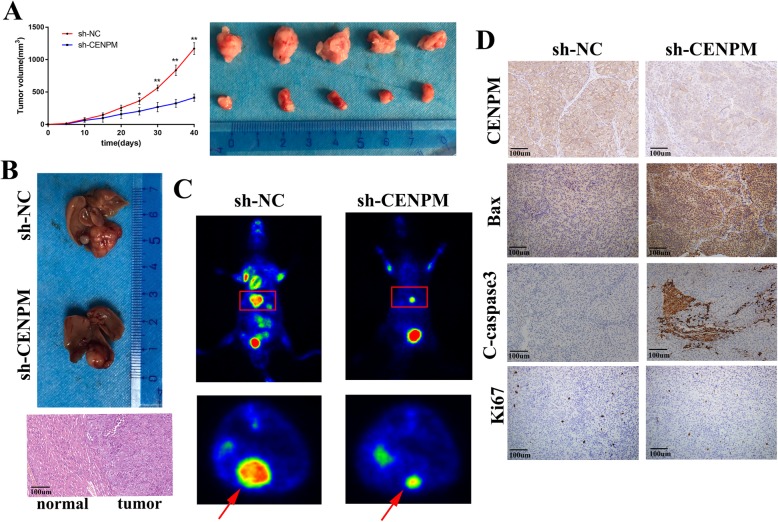
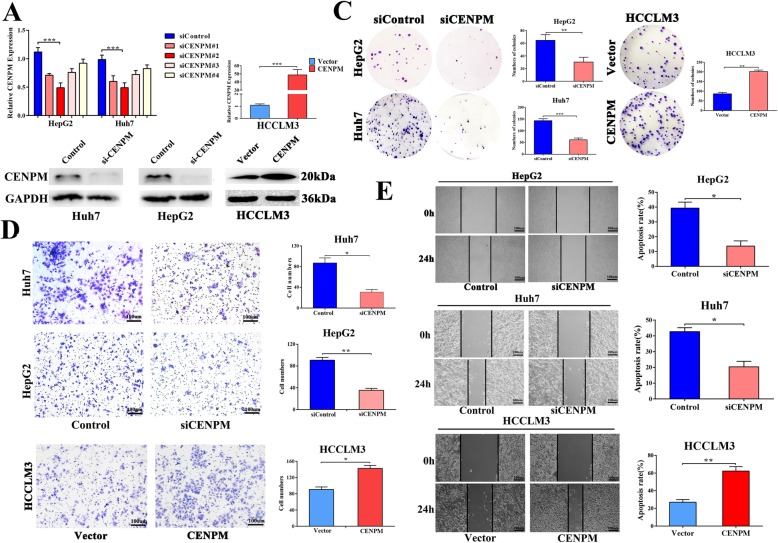
CENPM was positively up-regulated in HCC and connected with a poor prognosis. Silencing CENPM repressed cell proliferation in vivo and in vitro, and knock-down CENPM inhibited cell migration and invasion. Additionally, depletion of CENPM can promote cell apoptosis and arrested cell cycle. Furthermore, single-gene gene set enrichment analysis (GSEA) analysis indicated that CENPM was linked to the P53 signaling pathway and cell cycle pathway, and our research supported this prediction. Finally, we also found that miR-1270 was a negative regulator and participated in post-transcriptional regulation of CENPM, and hepatitis B virus X protein (HBx) can promote hepatocellular carcinoma by suppressing miR1270.
CENPM was closely associated with HCC progression and it could be considered as a new possible biomarker along with a therapeutic target for HCC.
肝细胞癌(HCC)在早期诊断和临床治疗方面仍然是一个主要的医学挑战。着丝粒蛋白 M(CENPM)已被证明在 HCC 组织中过度表达,但 CENPM 促进肝癌的致癌机制尚不清楚。
在这项研究中,我们首先通过聚合酶链反应(PCR)、蛋白质印迹和免疫组织化学(IHC)探索了 HCC 样本中 CENPM 的 mRNA 和蛋白水平,与相邻非肿瘤组织和六种肝癌细胞系进行了匹配。还分析了从癌症基因组图谱(TCGA)下载的 HCC 患者的临床数据。通过体外和体内的几种功能实验研究了与 HCC 进展相关的 CENPM 特征。进行了生物信息学以进一步发现 CENPM 的生物学功能。
CENPM 在 HCC 中呈阳性上调,并与预后不良相关。沉默 CENPM 抑制体内和体外细胞增殖,敲低 CENPM 抑制细胞迁移和侵袭。此外,CENPM 的耗竭可促进细胞凋亡并阻断细胞周期。此外,单基因基因集富集分析(GSEA)分析表明 CENPM 与 P53 信号通路和细胞周期通路相关,我们的研究支持了这一预测。最后,我们还发现 miR-1270 是一个负调节剂,参与 CENPM 的转录后调节,乙型肝炎病毒 X 蛋白(HBx)可以通过抑制 miR1270 促进肝癌。
CENPM 与 HCC 进展密切相关,可作为 HCC 的新的潜在生物标志物和治疗靶点。