Jin Hui, Yu Zhen, Navarengom Keron, Liu Yangtengyu, Dmitrieva Natalia, Hsu Amy P, Schwartzbeck Robin, Cudrici Cornelia, Ferrante Elisa A, Yang Dan, Holland Steven M, Freeman Alexandra F, Boehm Manfred, Chen Guibin
Translational Vascular Medicine Branch, National Heart, Lung, and Blood Institute, National Institutes of Health, Bethesda, MD 20892, USA; Current address: Department of Hematology, The First Affiliated Hospital of Nanjing Medical University, Jiangsu Province Hospital, Nanjing 210029, China; Key Laboratory of Hematology of Nanjing Medical University, Nanjing 210029, China.
Translational Vascular Medicine Branch, National Heart, Lung, and Blood Institute, National Institutes of Health, Bethesda, MD 20892, USA; Current address: State Key Laboratory of Experimental Hematology, Institute of Hematology and Blood Diseases Hospital, Chinese Academy of Medical Science and Peking Union Medical College, Tianjin 300020, China.
Stem Cell Res. 2019 Dec;41:101586. doi: 10.1016/j.scr.2019.101586. Epub 2019 Oct 17.
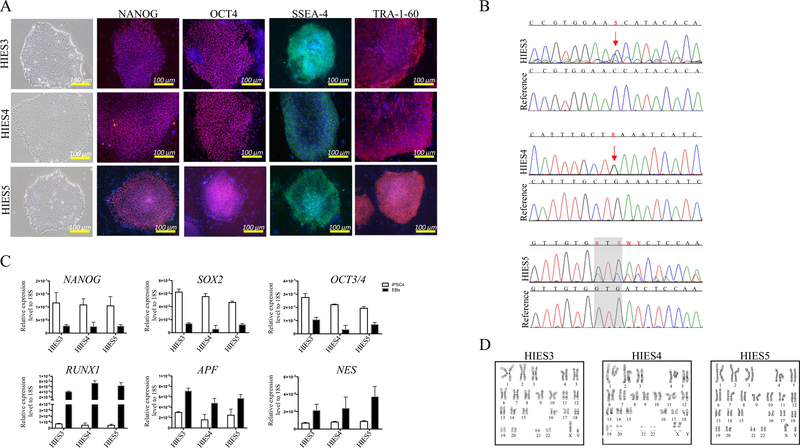
Autosomal dominant Hyper IgE syndrome (AD-HIES), a rare immune deficiency affecting fewer than one per million people, is caused by heterozygous deleterious mutations in STAT3. STAT3 signaling plays crucial roles in basic cellular functions affecting broad aspects of cellular homeostasis. Accordingly, in addition to immunological deficits, patients experience severe multisystem non-immunological features. Human induced pluripotent stem cells (hiPSC) are well established as in vivo disease models for various human pathologies. We describe the generation of iPSC from three AD-HIES patients. These iPSCs express pluripotency markers, differentiate into three germ layers, have normal karyotype and similar genome identity to parental cells.
常染色体显性高免疫球蛋白E综合征(AD-HIES)是一种罕见的免疫缺陷病,发病率低于百万分之一,由信号转导与转录激活因子3(STAT3)的杂合有害突变引起。STAT3信号传导在影响细胞内稳态广泛方面的基本细胞功能中起关键作用。因此,除了免疫缺陷外,患者还会出现严重的多系统非免疫特征。人类诱导多能干细胞(hiPSC)已被广泛确立为各种人类疾病的体内疾病模型。我们描述了从三名AD-HIES患者中生成诱导多能干细胞的过程。这些诱导多能干细胞表达多能性标志物,分化为三个胚层,具有正常的核型,并且与亲代细胞具有相似的基因组同一性。