Thomas Maryse E, Guercio Gerson D, Drudik Kristina M, de Villers-Sidani Étienne
Montreal Neurological Institute, McGill University, Montreal, QC, Canada.
Centre for Research on Brain, Language and Music, Montreal, QC, Canada.
Front Syst Neurosci. 2019 Oct 23;13:55. doi: 10.3389/fnsys.2019.00055. eCollection 2019.
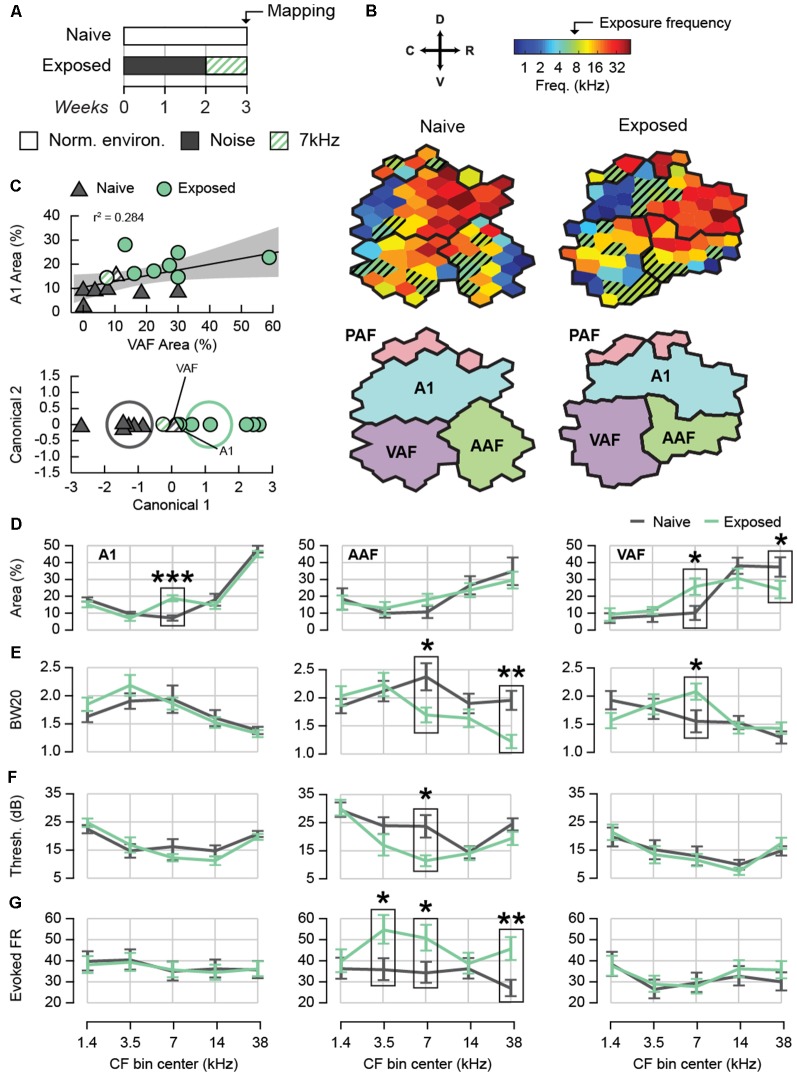
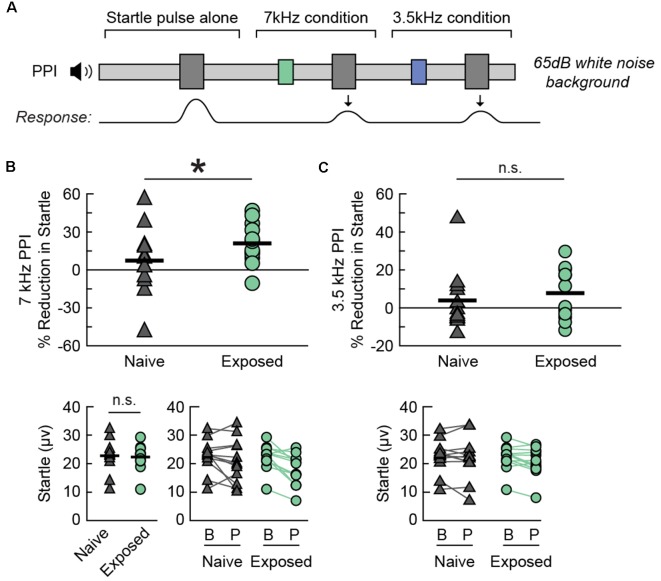
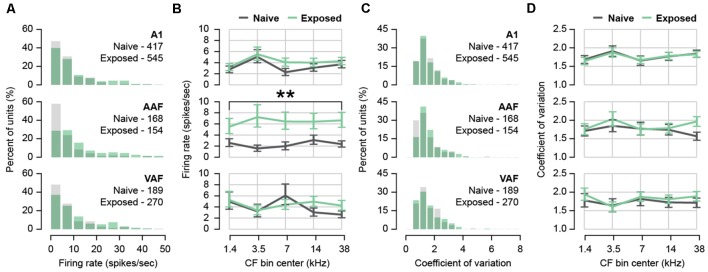
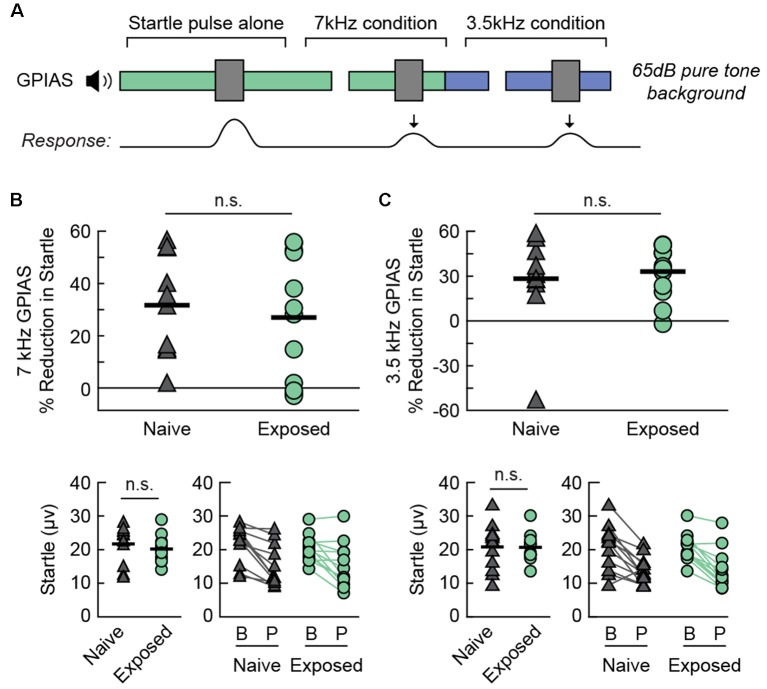
Manipulations that enhance neuroplasticity may inadvertently create opportunities for maladaptation. We have previously used passive exposures to non-traumatic white noise to open windows of plasticity in the adult rat auditory cortex and induce frequency-specific functional reorganizations of the tonotopic map. However, similar reorganizations in the central auditory pathway are thought to contribute to the generation of hearing disorders such as tinnitus and hyperacusis. Here, we investigate whether noise-induced reorganizations are accompanied by electrophysiological or behavioral evidence of tinnitus or hyperacusis in adult Long-Evans rats. We used a 2-week passive exposure to moderate-intensity (70 dB SPL) broadband white noise to reopen a critical period for spectral tuning such that a second 1-week exposure to 7 kHz tone pips produced an expansion of the 7 kHz frequency region in the primary auditory cortex (A1). We demonstrate for the first time that this expansion also takes place in the ventral auditory field (VAF). Sound exposure also led to spontaneous and sound-evoked hyperactivity in the anterior auditory field (AAF). Rats were assessed for behavioral evidence of tinnitus or hyperacusis using gap and tone prepulse inhibition of the acoustic startle response. We found that sound exposure did not affect gap-prepulse inhibition. However, sound exposure led to an improvement in prepulse inhibition when the prepulse was a 7 kHz tone, showing that exposed rats had enhanced sensorimotor gating for the exposure frequency. Together, our electrophysiological and behavioral results provide evidence of hyperacusis but not tinnitus in sound-exposed animals. Our findings demonstrate that periods of prolonged noise exposure may open windows of plasticity that can also be understood as windows of vulnerability, potentially increasing the likelihood for maladaptive plasticity to take place.
增强神经可塑性的操作可能会无意间为适应不良创造机会。我们之前曾利用被动暴露于非创伤性白噪声来打开成年大鼠听觉皮层的可塑性窗口,并诱导声调图谱的频率特异性功能重组。然而,中枢听觉通路中类似的重组被认为会导致耳鸣和听觉过敏等听力障碍的产生。在此,我们研究噪声诱导的重组是否伴随着成年朗-埃文斯大鼠耳鸣或听觉过敏的电生理或行为证据。我们使用为期2周的被动暴露于中等强度(70 dB SPL)宽带白噪声的方法来重新开启一个频谱调谐的关键期,使得第二次为期1周的暴露于7 kHz纯音短声会在初级听觉皮层(A1)中产生7 kHz频率区域的扩展。我们首次证明这种扩展也发生在腹侧听觉场(VAF)。声音暴露还导致前听觉场(AAF)出现自发性和声音诱发的活动亢进。使用声学惊吓反应的间隔和音调前脉冲抑制来评估大鼠耳鸣或听觉过敏的行为证据。我们发现声音暴露不影响间隔前脉冲抑制。然而,当预脉冲为7 kHz音调时,声音暴露导致前脉冲抑制得到改善,表明暴露的大鼠对暴露频率的感觉运动门控增强。总之,我们的电生理和行为结果提供了声音暴露动物存在听觉过敏而非耳鸣的证据。我们的研究结果表明,长时间的噪声暴露期可能会打开可塑性窗口,而这些窗口也可被理解为脆弱性窗口,可能会增加发生适应不良可塑性的可能性。