Department of Psychology, University of Jyväskylä, P.O. Box 35, 40014, Jyvaskyla, Finland.
Niilo Mäki Institute, P.O. Box 35, 40014, Jyvaskyla, Finland.
Eur Child Adolesc Psychiatry. 2020 Sep;29(9):1237-1249. doi: 10.1007/s00787-019-01437-y. Epub 2019 Nov 11.
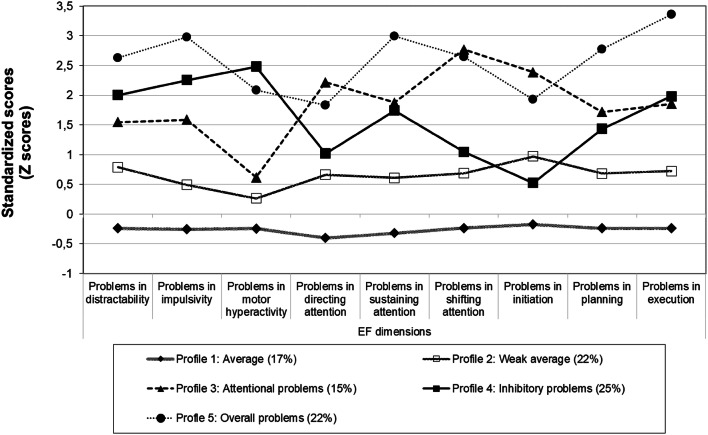
The aim of the present study was to investigate associations between internalizing and externalizing symptoms and deficits in executive functions (EF) as well as to examine the overall heterogeneity of EFs in a sample of preschool children attending a psychiatric clinic (n = 171). First, based on cut-off points signifying clinical levels of impairment on the parent-completed Child Behavior Checklist (CBCL), children were assigned into groups of internalizing, externalizing, combined or mild symptoms and compared to a reference group (n = 667) with regard to day care teacher ratings of EFs on the Attention and Executive Function Rating Inventory-Preschool (ATTEX-P). Second, latent profile analysis (LPA) was employed to identify distinct subgroups of children representing different EF profiles with unique strengths and weaknesses in EFs. The first set of analyses indicated that all symptom groups had more difficulties in EFs than the reference group did, and the internalizing group had less inhibition-related problems than the other symptom groups did. Using LPA, five EF profiles were identified: average, weak average, attentional problems, inhibitory problems, and overall problems. The EF profiles were significantly associated with gender, maternal education level, and psychiatric symptom type. Overall, the findings suggest that the comparison of means of internalizing and externalizing groups mainly captures the fairly obvious differences in inhibition-related domains among young psychiatric outpatient children, whereas the person-oriented approach, based on individual differences, identifies heterogeneity related to attentional functions, planning, and initiating one's action. The variability in EF difficulties suggests that a comprehensive evaluation of a child's EF profile is important regardless of the type of psychiatric symptoms the child presents with.
本研究旨在探究内化和外化症状与执行功能(EF)缺陷之间的关系,并检查在参加精神病诊所的学龄前儿童样本中 EF 的整体异质性(n=171)。首先,基于表示父母完成的儿童行为检查表(CBCL)上临床损伤水平的截止点,将儿童分为内化、外化、合并或轻度症状组,并与参考组(n=667)进行比较,比较标准是日托教师在注意力和执行功能评定量表-学龄前(ATTEX-P)上对 EF 的评定。其次,采用潜在剖面分析(LPA)来识别具有独特 EF 优势和劣势的不同 EF 模式的不同儿童亚组。第一组分析表明,所有症状组的 EF 都比参考组困难,内化组的抑制相关问题比其他症状组少。使用 LPA,确定了五个 EF 模式:平均、较弱平均、注意力问题、抑制问题和整体问题。EF 模式与性别、母亲教育水平和精神症状类型显著相关。总体而言,研究结果表明,内化和外化组之间的均值比较主要捕捉了年轻精神科门诊儿童在抑制相关领域的相当明显的差异,而基于个体差异的面向个体的方法则确定了与注意力功能、计划和启动自己的行动相关的异质性。EF 困难的可变性表明,无论儿童表现出何种类型的精神症状,对儿童 EF 模式的全面评估都很重要。