Department of Internal Medicine, Medical University of Graz, Graz, Austria.
Birmingham Acute Care Research Group, University Hospitals Birmingham NHS Foundation Trust, Birmingham, UK.
BMJ Open. 2019 Nov 12;9(11):e031083. doi: 10.1136/bmjopen-2019-031083.
Observational studies have demonstrated an association between vitamin D deficiency and increased risk of morbidity and mortality in critically ill patients. Cohort studies and pilot trials have suggested promising beneficial effects of vitamin D replacement in the critical ill, at least in patients with severe vitamin D deficiency. As vitamin D is a simple, low-cost and safe intervention, it has potential to improve survival in critically ill patients.
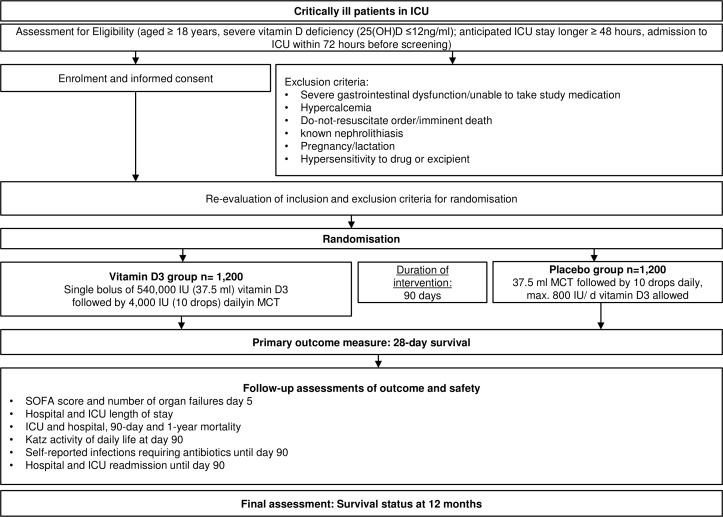
In this randomised, placebo-controlled, double-blind, multicentre, international trial, 2400 adult patients with severe vitamin D deficiency (25-hydroxyvitamin D≤12 ng/mL) will be randomised in a 1:1 ratio by www.randomizer.at to receive a loading dose of 540 000 IU cholecalciferol within 72 hours after intensive care unit (ICU) admission, followed by 4000 IU daily for 90 days or placebo. Hypercalcaemia may occur as a side effect, but is monitored by regular checks of the calcium level. The primary outcome is all-cause mortality at 28 days after randomisation. Secondary outcomes are: ICU, hospital, 90-day and 1-year mortality; hospital and ICU length of stay, change in organ dysfunction on day 5 as measured by Sequential Organ Function Assessment (SOFA) score, number of organ failures; hospital and ICU readmission until day 90; discharge destination, self-reported infections requiring antibiotics until day 90 and health-related quality of life. Recruitment status is ongoing.
National ethical approval was obtained by the Ethics Committee of the University of Graz for Austria, Erasme University Brussels (Belgium) and University Hospital Frankfurt (Germany), and will further be gained according to individual national processes. On completion, results will be published in a peer-reviewed scientific journal. The study findings will be presented at national and international meetings with abstracts online.
NCT03188796, EudraCT-No: 2016-002460-13.
观察性研究表明,维生素 D 缺乏与危重症患者发病率和死亡率升高有关。队列研究和试点试验表明,在危重症患者中补充维生素 D 有可喜的有益作用,至少在严重维生素 D 缺乏的患者中如此。由于维生素 D 是一种简单、低成本且安全的干预措施,因此有可能改善危重症患者的生存率。
在这项随机、安慰剂对照、双盲、多中心、国际性试验中,将 2400 名严重维生素 D 缺乏(25-羟维生素 D≤12ng/mL)的成年患者通过 www.randomizer.at 以 1:1 的比例随机分组,在入住重症监护病房(ICU)后 72 小时内接受 540000IU 胆钙化醇负荷剂量,随后每天接受 4000IU 治疗 90 天或安慰剂。高钙血症可能是一种副作用,但通过定期检查血钙水平进行监测。主要结局是随机分组后 28 天的全因死亡率。次要结局包括:ICU、医院、90 天和 1 年死亡率;医院和 ICU 住院时间、第 5 天通过序贯器官衰竭评估(SOFA)评分测量的器官功能障碍变化、器官衰竭数量;医院和 ICU 再入院至第 90 天;出院去向、直至第 90 天的自我报告感染需要抗生素以及健康相关生活质量。目前正在招募患者。
奥地利格拉茨大学伦理委员会、布鲁塞尔伊拉斯谟大学(比利时)和法兰克福大学医院(德国)已获得国家伦理批准,根据各国的具体程序,还将进一步获得批准。试验完成后,结果将在同行评议的科学期刊上发表。研究结果将在全国和国际会议上以在线摘要的形式呈现。
NCT03188796,EudraCT-No:2016-002460-13。