Singh Gopal K, Kim Isaac E, Girmay Mehrete, Perry Chrisp, Daus Gem P, Vedamuthu Ivy P, De Los Reyes Andrew A, Ramey Christine T, Martin Elijah K, Allender Michelle
Office of Health Equity, Health Resources and Services Administration, U.S. Department of Health and Human Services, 5600 Fishers Lane, Rockville, Maryland 20857, USA.
Warren Alpert Medical School of Brown University, 222 Richmond Street, Providence, Rhode Island 02903, USA.
Int J MCH AIDS. 2019;8(2):89-100. doi: 10.21106/ijma.284. Epub 2019 Aug 8.
Dramatic increases in opioid and drug overdose mortality have occurred in the United States (US) over the past two decades. To address this national public health crisis and identify gaps in the literature, we analyzed recent empirical trends in US drug overdose mortality by key social determinants and conducted a selective review of the recent literature on the magnitude of the opioid crisis facing different racial/ethnic, socioeconomic, and rural-urban segments of the US population.
We used the 1999-2017 mortality data from the US National Vital Statistics System to analyze trends in drug overdose mortality by race/ethnicity, age, and geographic area. Log-linear regression was used to model mortality trends. Using various key words and their combinations, we searched PubMed and Google Scholar for select peer-reviewed journal articles and government reports published on the opioid epidemic between 2010 and 2018.
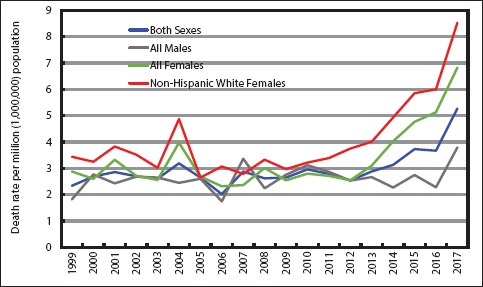
Our original analysis and review indicate marked increases in drug overdose mortality overall and by race/ethnicity and geographic regions, with adolescents and young adults experiencing steep increases in mortality between 1999 and 2017. Our selective search yielded 405 articles, of which 39 publications were selected for detailed review. Suicide mortality from drug overdose among teens aged 12-19 increased consistently between 2009 and 2017, particularly among teen girls. The rise of efficient global supply chains has increased opioid prescription use and undoubtedly contributed to the opioid epidemic. Many other important contributing factors to the epidemic include lack of education and economic opportunities, poor working conditions, and low social capital in disadvantaged communities.
Our analysis and review indicate substantial disparities in drug overdoses and related mortality, pain management, and treatment outcomes according to social determinants. Increases in drug overdoses and resultant mortality are not only unique to the US, but have also been observed in other industrialized countries. Healthcare systems, community leaders, and policymakers addressing the opioid epidemic should focus on upstream structural factors including education, economic opportunity, social cohesion, racial/ethnic disadvantage, geographic isolation, and life satisfaction.
在过去二十年中,美国阿片类药物和药物过量致死率急剧上升。为应对这一全国性公共卫生危机并找出文献中的空白,我们按关键社会决定因素分析了美国药物过量致死率的近期实证趋势,并对近期有关美国不同种族/族裔、社会经济和城乡人口群体所面临的阿片类药物危机严重程度的文献进行了选择性综述。
我们使用了美国国家生命统计系统1999 - 2017年的死亡率数据,按种族/族裔、年龄和地理区域分析药物过量致死率趋势。采用对数线性回归对死亡率趋势进行建模。我们使用各种关键词及其组合,在PubMed和谷歌学术上搜索了2010年至2018年期间发表的关于阿片类药物流行的精选同行评审期刊文章和政府报告。
我们最初的分析和综述表明,总体上以及按种族/族裔和地理区域划分,药物过量致死率显著上升,1999年至2017年期间青少年和年轻人的死亡率急剧上升。我们的选择性搜索产生了405篇文章,其中39篇被选作详细综述。2009年至2017年期间,12 - 19岁青少年因药物过量导致的自杀死亡率持续上升,尤其是少女。高效全球供应链的兴起增加了阿片类药物的处方使用,无疑助长了阿片类药物流行。该流行的许多其他重要促成因素包括教育和经济机会匮乏、工作条件差以及弱势社区社会资本低。
我们的分析和综述表明,根据社会决定因素,药物过量及相关死亡率、疼痛管理和治疗结果存在巨大差异。药物过量及由此导致的死亡率上升不仅在美国存在,在其他工业化国家也有观察到。应对阿片类药物流行的医疗保健系统、社区领袖和政策制定者应关注上游结构因素,包括教育、经济机会、社会凝聚力、种族/族裔劣势、地理隔离和生活满意度。