University of Iowa, Iowa City, and St. Ambrose University, Davenport, Iowa.
University of Iowa, Iowa City.
Arthritis Rheumatol. 2020 May;72(5):824-836. doi: 10.1002/art.41170. Epub 2020 Mar 18.
Fibromyalgia (FM) is characterized by pain and fatigue, particularly during physical activity. Transcutaneous electrical nerve stimulation (TENS) activates endogenous pain inhibitory mechanisms. This study was undertaken to investigate if using TENS during activity would improve movement-evoked pain and other patient-reported outcomes in women with FM.
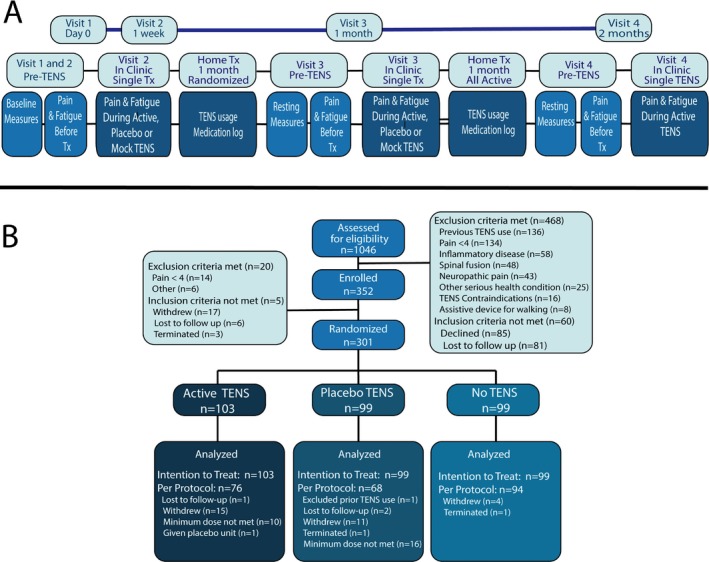
Participants were randomly assigned to receive active TENS (n = 103), placebo TENS (n = 99), or no TENS (n = 99) and instructed to use it at home during activity 2 hours each day for 4 weeks. TENS was applied to the lumbar and cervicothoracic regions using a modulated frequency (2-125 Hz) at the highest tolerable intensity. Participants rated movement-evoked pain (primary outcome measure) and fatigue on an 11-point scale before and during application of TENS. The primary outcome measure and secondary patient-reported outcomes were assessed at baseline (time of randomization) and at 4 weeks.
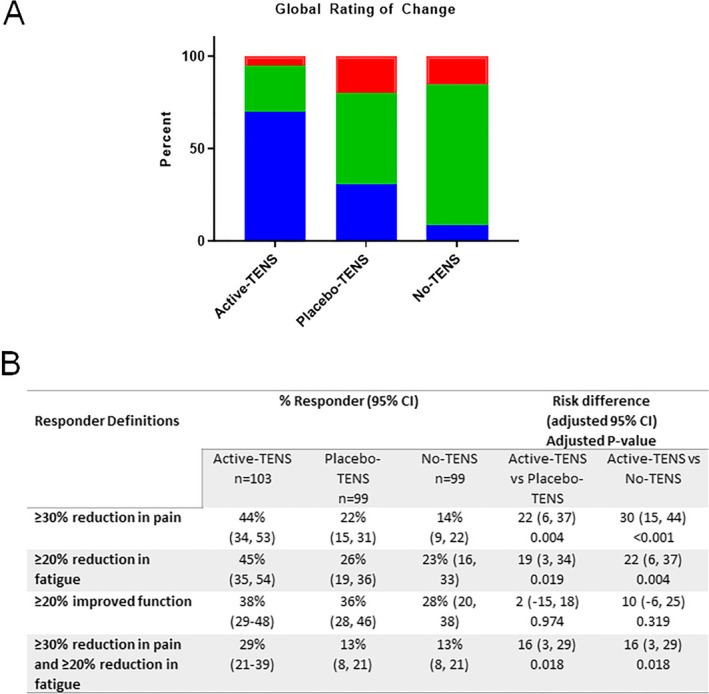
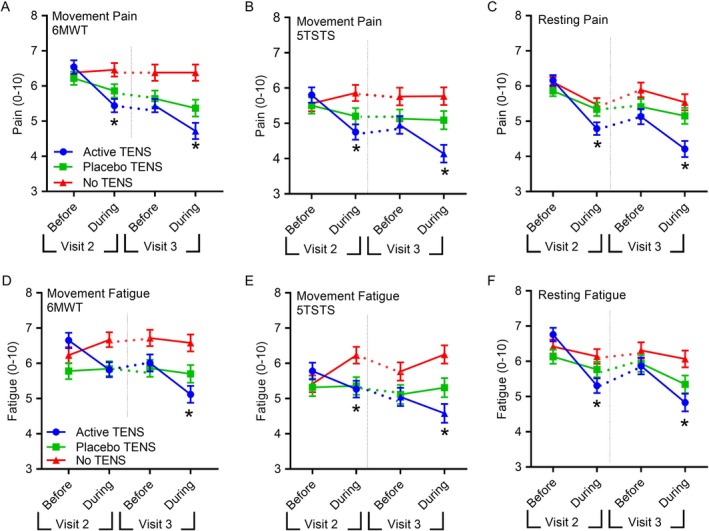
After 4 weeks, a greater reduction in movement-evoked pain was reported in the active TENS group versus the placebo TENS group (group mean difference -1.0 [95% confidence interval -1.8, -0.2]; P = 0.008) and versus the no TENS group (group mean difference -1.8 [95% confidence interval -2.6, -1.0]; P < 0.0001). A reduction in movement-evoked fatigue was also reported in the active TENS group versus the placebo TENS group (group mean difference -1.4 [95% confidence interval -2.4, -0.4]; P = 0.001) and versus the no TENS group (group mean difference -1.9 [95% confidence interval -2.9, -0.9]; P = <0.0001). A greater percentage of the patients in the active TENS group reported improvement on the global impression of change compared to the placebo TENS group (70% versus 31%; P < 0.0001) and the no TENS group (9%; P < 0.0001). There were no TENS-related serious adverse events, and <5% of participants experienced minor adverse events from TENS.
Among women who had FM and were on a stable medication regimen, 4 weeks of active TENS use compared to placebo TENS or no TENS resulted in a significant improvement in movement-evoked pain and other clinical outcomes. Further research is needed to examine effectiveness in a real-world setting to establish the clinical importance of these findings.
纤维肌痛(FM)的特征是疼痛和疲劳,尤其是在体力活动时。经皮神经电刺激(TENS)激活内源性疼痛抑制机制。本研究旨在探讨在 FM 女性进行活动时使用 TENS 是否会改善运动诱发的疼痛和其他患者报告的结果。
参与者被随机分配接受主动 TENS(n=103)、安慰剂 TENS(n=99)或无 TENS(n=99),并被指示在活动期间每天在家中使用 TENS 2 小时,持续 4 周。TENS 使用调制频率(2-125 Hz)在最高耐受强度下应用于腰椎和颈胸区。参与者在使用 TENS 之前和期间使用 11 分制评估运动诱发的疼痛(主要结局测量)和疲劳。主要结局测量和次要患者报告的结果在基线(随机化时)和 4 周时进行评估。
4 周后,与安慰剂 TENS 组(组间平均差异 -1.0 [95%置信区间 -1.8,-0.2];P=0.008)和无 TENS 组(组间平均差异 -1.8 [95%置信区间 -2.6,-1.0];P<0.0001)相比,主动 TENS 组报告的运动诱发疼痛减少更大。与安慰剂 TENS 组(组间平均差异 -1.4 [95%置信区间 -2.4,-0.4];P=0.001)和无 TENS 组(组间平均差异 -1.9 [95%置信区间 -2.9,-0.9];P<0.0001)相比,主动 TENS 组报告的运动诱发疲劳也减少。与安慰剂 TENS 组(70%对 31%;P<0.0001)和无 TENS 组(9%;P<0.0001)相比,主动 TENS 组中有更大比例的患者报告总体变化印象改善。无 TENS 相关严重不良事件,<5%的参与者经历了 TENS 的轻微不良事件。
在稳定药物治疗方案的 FM 女性中,与安慰剂 TENS 或无 TENS 相比,主动 TENS 使用 4 周可显著改善运动诱发的疼痛和其他临床结局。需要进一步研究以在现实环境中检查有效性,以确定这些发现的临床重要性。