Tongji Medical College of Huangzhong University of Science and Technology, Hankou City, China.
Department of Ultrasound, Affiliated Hospital of Zunyi Medical University, Zunyi, China.
J Clin Lab Anal. 2020 Apr;34(4):e23111. doi: 10.1002/jcla.23111. Epub 2019 Nov 19.
Thrombophilia is becoming a more frequently reported disorder these years. Hereditary protein S deficiency is one of the anticoagulant deficiencies that eventually results in thrombophilia.
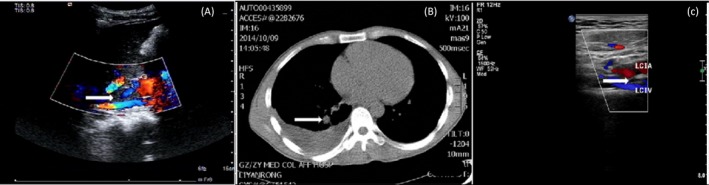
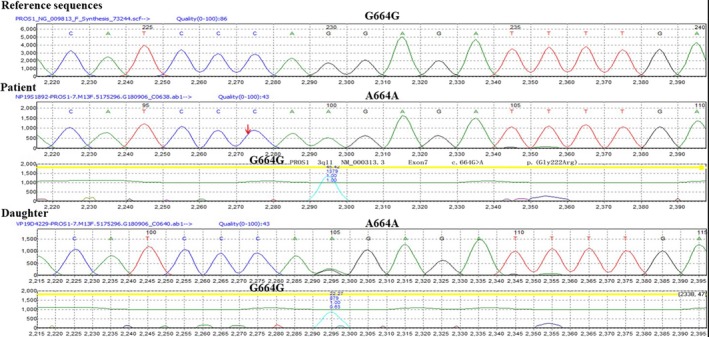
A 24-year-old male patient was suffering from unexplained thrombosis for the second time with a family history of deep venous thrombosis. Screening tests for anticoagulant proteins found the activity of protein S markedly lowered (5.0%). The patient was discharged after anticoagulation treatment. Four years later, the review still showed the activity of protein S in his plasma decreased (16.0%). Molecular genetic analysis revealed him homozygous for a missense mutation, c.664G>A, in the exon7 of PROS1. The mutation discovered here is the first mutation affecting the codon 222 of PROS1. This mutation results in the replacement of the glycine at the codon 222 of protein S with arginine, leading to a reduction of protein S function.
The finding of this mutation may help with the understanding of the mechanism of protein S deficiency, especially in the Chinese population.
近年来,血栓形成倾向症变得越来越常见。遗传性蛋白 S 缺乏症是导致血栓形成倾向症的抗凝剂缺乏症之一。
一位 24 岁男性患者因不明原因的第二次血栓形成而住院,有深静脉血栓形成的家族史。抗凝蛋白筛查试验发现蛋白 S 活性显著降低(5.0%)。患者接受抗凝治疗后出院。四年后,复查仍显示其血浆中蛋白 S 活性降低(16.0%)。分子遗传学分析显示他在 PROS1 的外显子 7 中纯合子发生了 c.664G>A 错义突变。此处发现的突变是第一个影响 PROS1 第 222 密码子的突变。该突变导致蛋白 S 第 222 位密码子的甘氨酸被精氨酸取代,从而降低蛋白 S 的功能。
该突变的发现可能有助于理解蛋白 S 缺乏症的机制,特别是在中国人群中。