Department of Biological Psychology, Vrije Universiteit Amsterdam, 1081 BT Amsterdam, The Netherlands.
Amsterdam Public Health Research Institute, 1081 BT Amsterdam, The Netherlands.
Nutrients. 2019 Nov 17;11(11):2804. doi: 10.3390/nu11112804.
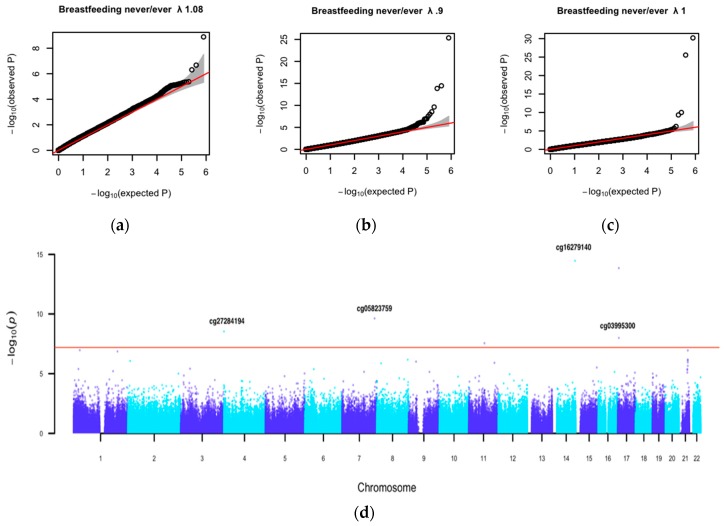
Breastfeeding has long-term benefits for children that may be mediated via the epigenome. This pathway has been hypothesized, but the number of empirical studies in humans is small and mostly done by using peripheral blood as the DNA source. We performed an epigenome-wide association study (EWAS) in buccal cells collected around age nine (mean = 9.5) from 1006 twins recruited by the Netherlands Twin Register (NTR). An age-stratified analysis examined if effects attenuate with age (median split at 10 years; = 517, mean age = 7.9; = 489, mean age = 11.2). We performed replication analyses in two independent cohorts from the NTR (buccal cells) and the Avon Longitudinal Study of Parents and Children (ALSPAC) (peripheral blood), and we tested loci previously associated with breastfeeding in epigenetic studies. Genome-wide DNA methylation was assessed with the Illumina Infinium MethylationEPIC BeadChip (Illumina, San Diego, CA, USA) in the NTR and with the HumanMethylation450 Bead Chip in the ALSPAC. The duration of breastfeeding was dichotomized ('never' vs. 'ever'). In the total sample, no robustly associated epigenome-wide significant CpGs were identified (α = 6.34 × 10). In the sub-group of children younger than 10 years, four significant CpGs were associated with breastfeeding after adjusting for child and maternal characteristics. In children older than 10 years, methylation differences at these CpGs were smaller and non-significant. The findings did not replicate in the NTR sample ( = 98; mean age = 7.5 years), and no nearby sites were associated with breastfeeding in the ALSPAC study ( = 938; mean age = 7.4). Of the CpG sites previously reported in the literature, three were associated with breastfeeding in children younger than 10 years, thus showing that these CpGs are associated with breastfeeding in buccal and blood cells. Our study is the first to show that breastfeeding is associated with epigenetic variation in buccal cells in children. Further studies are needed to investigate if methylation differences at these loci are caused by breastfeeding or by other unmeasured confounders, as well as what mechanism drives changes in associations with age.
母乳喂养对儿童有长期益处,这种益处可能通过表观基因组来介导。该途径已被提出假设,但人类的实证研究数量较少,且大多使用外周血作为 DNA 来源。我们对荷兰双胞胎登记处(NTR)招募的 1006 对双胞胎,在其 9 岁左右(平均 9.5 岁)时采集的口腔细胞进行了全基因组关联研究(EWAS)。年龄分层分析检验了这些影响是否随年龄减弱(中位数 10 岁时的年龄分割; = 517,平均年龄 = 7.9; = 489,平均年龄 = 11.2)。我们在 NTR 的两个独立队列(口腔细胞)和雅芳纵向父母与子女研究(ALSPAC)(外周血)中进行了复制分析,并测试了先前在表观遗传研究中与母乳喂养相关的基因座。在 NTR 中,我们使用 Illumina Infinium MethylationEPIC BeadChip(Illumina,圣地亚哥,CA,美国)评估全基因组 DNA 甲基化,在 ALSPAC 中,我们使用 HumanMethylation450 Bead Chip 评估全基因组 DNA 甲基化。母乳喂养的持续时间分为“从不”和“曾经”。在总样本中,没有发现与全基因组显著相关的 CpG(α = 6.34×10)。在年龄小于 10 岁的儿童亚组中,调整了儿童和母亲的特征后,有 4 个 CpG 与母乳喂养相关。在年龄大于 10 岁的儿童中,这些 CpG 的甲基化差异较小且无统计学意义。在 NTR 样本中未发现复制( = 98;平均年龄 = 7.5 岁),在 ALSPAC 研究中,也没有附近的位点与母乳喂养相关( = 938;平均年龄 = 7.4)。文献中报道的三个 CpG 位点与年龄小于 10 岁的儿童的母乳喂养有关,这表明这些 CpG 与口腔和血液细胞中的母乳喂养有关。我们的研究首次表明,母乳喂养与儿童口腔细胞的表观遗传变化有关。需要进一步的研究来调查这些基因座上的甲基化差异是否是由母乳喂养或其他未测量的混杂因素引起的,以及是什么机制驱动了与年龄相关的关联变化。