Department of Radiotherapy, The Second Hospital of Jilin University, Changchun, Jilin 130041, P.R. China.
Department of Thoracic Oncosurgery, Jilin Province Tumor Hospital, Changchun, Jilin 130012, P.R. China.
Int J Mol Med. 2020 Jan;45(1):33-44. doi: 10.3892/ijmm.2019.4396. Epub 2019 Nov 4.
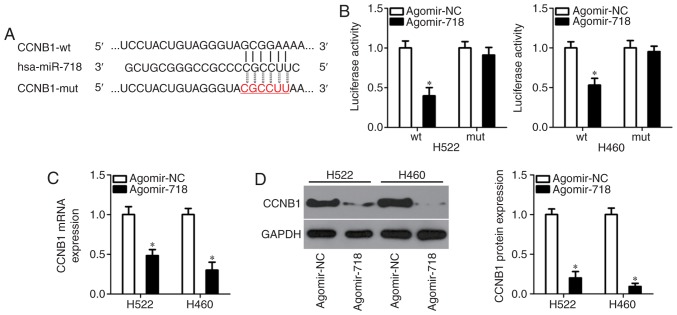
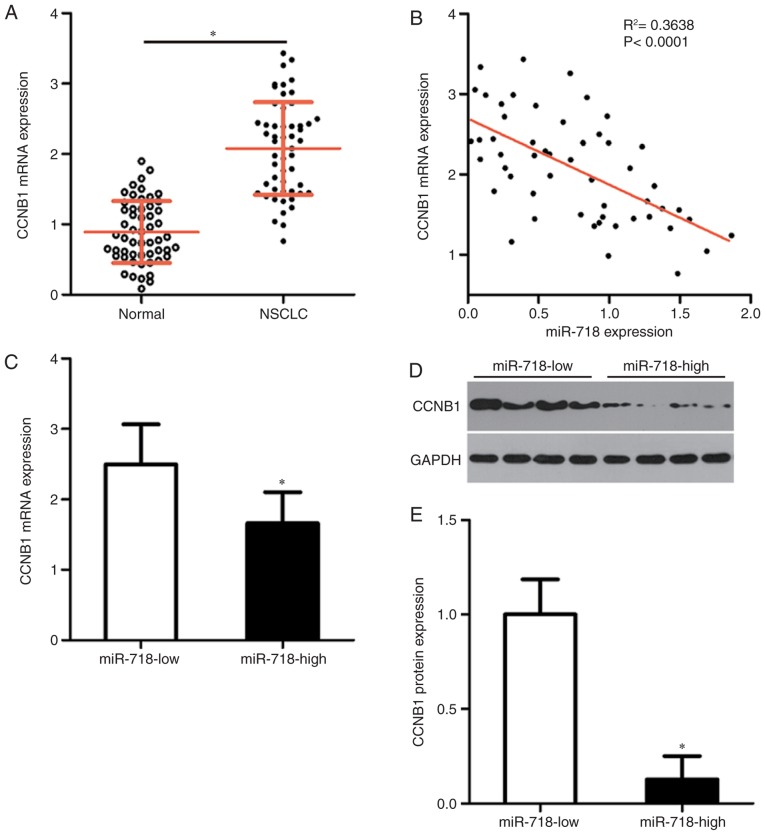
MicroRNA‑718 (miR‑718) serves crucial roles in tumorigenesis and in the progression of a number of cancers. However, the expression profile, specific functions and mechanisms of action of miR‑718 in non‑small cell lung cancer (NSCLC) are still elusive. The aims of the present study were to quantify the expression of miR‑718, determine its biological roles and elucidate the molecular mechanisms responsible for its activities in NSCLC cells. Reverse transcription‑quantitative PCR was carried out to assess miR‑718 expression in NSCLC tissue samples and cell lines. The Cell Counting Kit‑8 assay, flow cytometry, cell migration and invasion assays, and a tumor xenograft experiment were performed to evaluate the effects of miR‑718 overexpression on the malignant biological behaviors of NSCLC cells. miR‑718 expression was demonstrated to be significantly decreased in NSCLC tissue samples and cell lines. This reduced expression was significantly associated with tumor, node, metastasis stage, tumor size, lymph node metastasis and poor overall survival among patients with NSCLC. Exogenous miR‑718 expression suppressed NSCLC cell proliferation, migration and invasion, and promoted apoptosis in vitro; whereas it hindered tumor growth in vivo. Experiments to elucidate the mechanisms involved revealed that miR‑718 functions by directly targeting cyclin B1 (CCNB1) mRNA. CCNB1 expression was found to be upregulated in NSCLC and inversely correlated with miR‑718 levels. CCNB1 depletion had effects similar to those of miR‑718 overexpression in NSCLC cells. Furthermore, restoration of CCNB1 expression attenuated the tumor‑suppressive effects of miR‑718 overexpression in NSCLC cells. These results indicated that miR‑718 suppressed NSCLC progression in vitro and in vivo by directly targeting CCNB1 mRNA, which may indicate a potential target for the diagnosis and treatment of this fatal disease.
微小 RNA-718(miR-718)在肿瘤发生和多种癌症的进展中发挥着至关重要的作用。然而,miR-718 在非小细胞肺癌(NSCLC)中的表达谱、具体功能和作用机制仍不清楚。本研究旨在定量检测 miR-718 的表达,确定其生物学功能,并阐明其在 NSCLC 细胞中发挥作用的分子机制。采用逆转录-定量 PCR 检测 NSCLC 组织样本和细胞系中 miR-718 的表达。通过细胞计数试剂盒-8 检测、流式细胞术、细胞迁移和侵袭实验以及肿瘤异种移植实验来评估 miR-718 过表达对 NSCLC 细胞恶性生物学行为的影响。结果表明,miR-718 在 NSCLC 组织样本和细胞系中表达明显下调。这种下调表达与 NSCLC 患者的肿瘤、淋巴结、转移分期、肿瘤大小、淋巴结转移和总体生存不良显著相关。外源性 miR-718 表达抑制 NSCLC 细胞的增殖、迁移和侵袭,并促进体外细胞凋亡;而在体内则抑制肿瘤生长。阐明相关机制的实验表明,miR-718 通过直接靶向细胞周期蛋白 B1(CCNB1)mRNA 发挥作用。CCNB1 在 NSCLC 中表达上调,与 miR-718 水平呈负相关。CCNB1 缺失在 NSCLC 细胞中具有与 miR-718 过表达相似的作用。此外,CCNB1 表达的恢复减弱了 miR-718 过表达对 NSCLC 细胞的肿瘤抑制作用。这些结果表明,miR-718 通过直接靶向 CCNB1 mRNA 抑制 NSCLC 的体外和体内进展,这可能为这种致命疾病的诊断和治疗提供潜在靶点。