Department of Clinical Laboratory, Qilu Hospital of Shandong University, Jinan, Shandong 250012, P.R. China.
Department of Gynecology, Qilu Hospital of Shandong University, Jinan, Shandong 250012, P.R. China.
Oncol Rep. 2020 Jan;43(1):121-132. doi: 10.3892/or.2019.7396. Epub 2019 Oct 31.
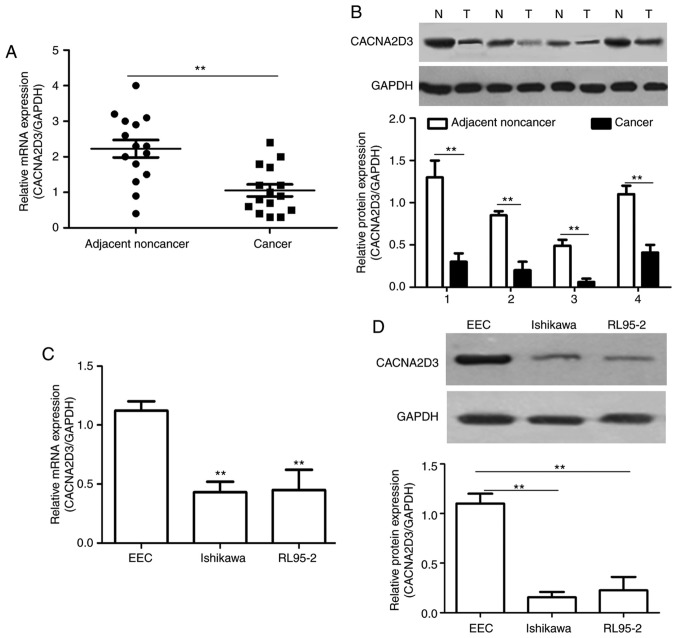
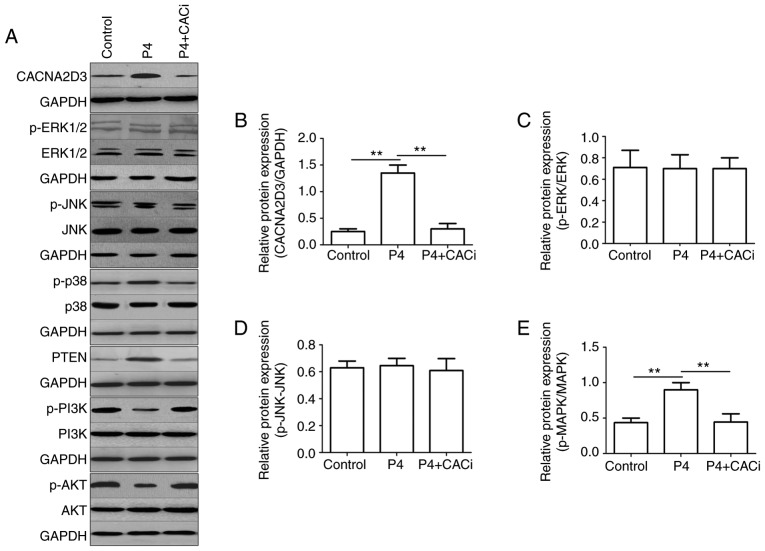
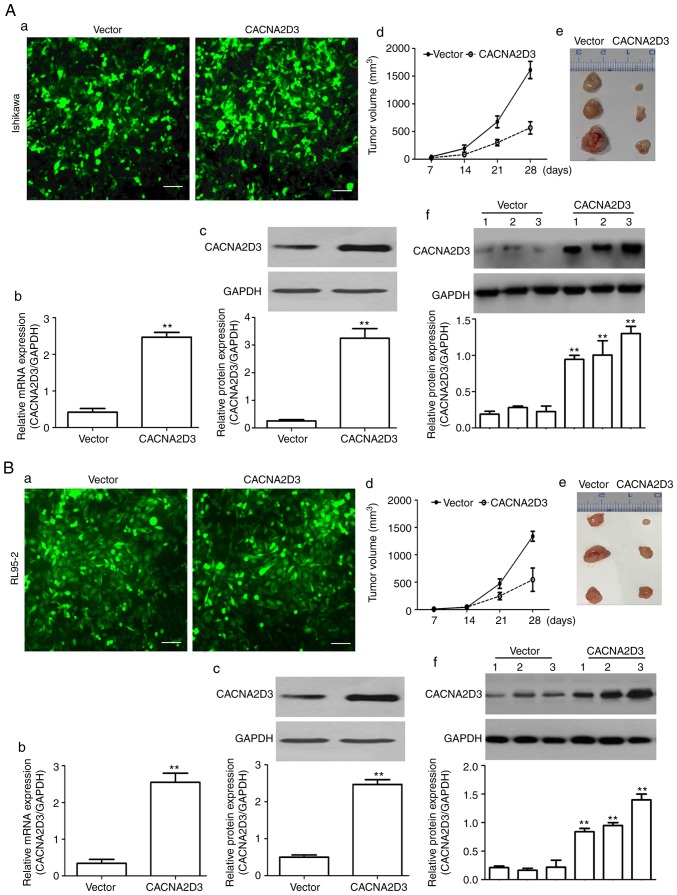
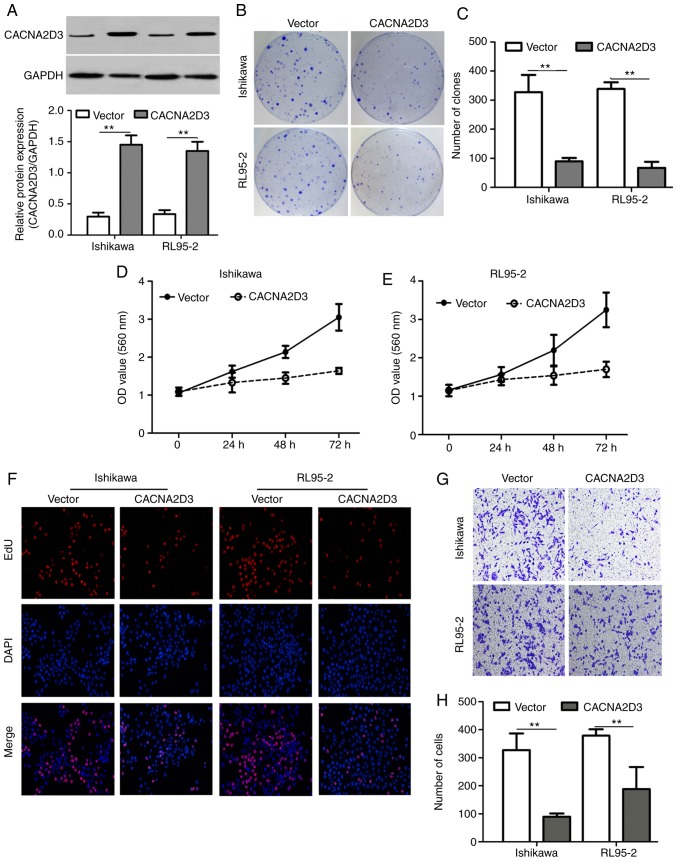
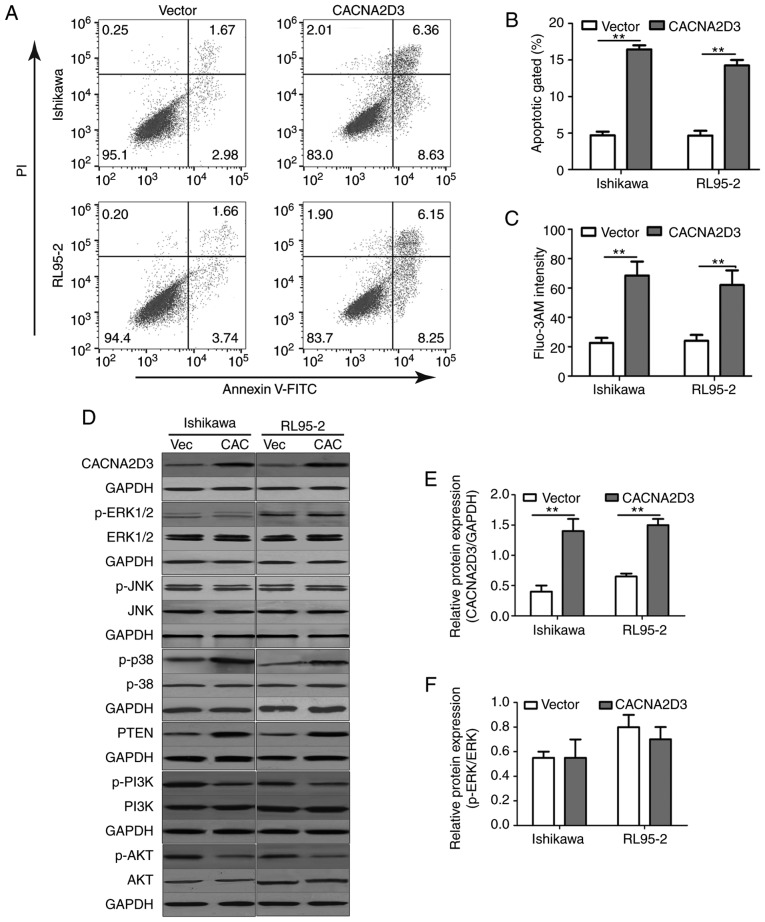
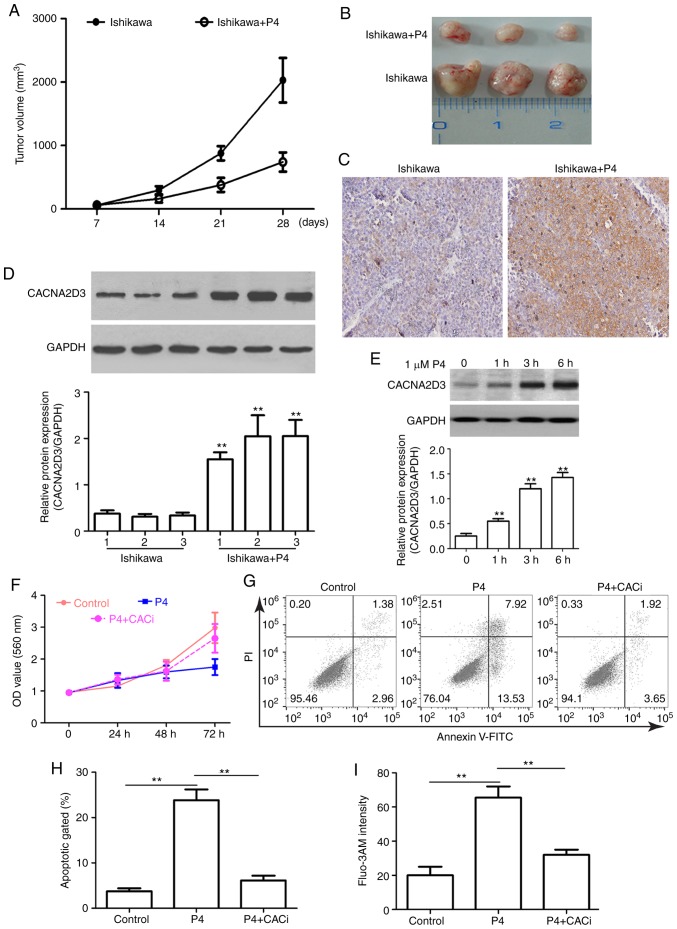
Endometrial cancer (EC) is one of the most common malignant gynecological tumors in women. The main treatments for EC (surgery, chemotherapy and radiation therapy) produce significant side effects. Thus, it is urgent to identify promising therapeutic targets and prognostic markers. CACNA2D3, as a member of the calcium channel regulatory α2δ subunit family, is reported to exert a tumor suppressive effect in numerous cancers. However, the function of CACNA2D3 in EC is not well known. In the present study, CACNA2D3 was lowly expressed in EC tissues and cells. The overexpression of CACNA2D3 via lentiviral particle injection significantly blocked the tumor growth in an in vivo xenograft model. In vitro, the overexpression of CACNA2D3 markedly inhibited cell proliferation and migration, and promoted cell apoptosis and calcium influx. These data revealed that CACNA2D3 functions as a tumor suppressor in EC. It was also revealed that the addition of progesterone (P4) blocked tumor growth in Ishikawa‑injected nude mice. P4 induced the expression of CACNA2D3 in vivo and in vitro, and the silencing of CACNA2D3 affected P4‑inhibited cell proliferation and P4‑induced cell apoptosis and calcium influx. In Ishikawa cells, P4 enhanced the expression of phosphorylated (p)‑p38 MAPK and PTEN, but blocked the levels of p‑PI3K and p‑AKT. The knockdown of CACNA2D3 blocked the function of P4. These data revealed that P4 promoted cell apoptosis via the activation of the CACNA2D3/Ca2+/p38 MAPK pathway, and blocked cell proliferation via suppression of the PI3K/AKT pathway. Collectively, these findings indicated the antitumor role of CACNA2D3 in EC, and revealed the mechanism of P4 inhibition of EC progression, which provided a new target for EC therapy and new evidence for P4 in EC therapy.
子宫内膜癌 (EC) 是女性最常见的恶性妇科肿瘤之一。EC 的主要治疗方法(手术、化疗和放疗)会产生显著的副作用。因此,迫切需要确定有前途的治疗靶点和预后标志物。CACNA2D3 作为钙通道调节α2δ亚基家族的成员,据报道在许多癌症中发挥肿瘤抑制作用。然而,CACNA2D3 在 EC 中的功能尚不清楚。在本研究中,CACNA2D3 在 EC 组织和细胞中低表达。通过慢病毒粒子注射过表达 CACNA2D3 可显著阻断体内异种移植模型中的肿瘤生长。体外,过表达 CACNA2D3 可显著抑制细胞增殖和迁移,促进细胞凋亡和钙内流。这些数据表明 CACNA2D3 在 EC 中起肿瘤抑制作用。还发现孕激素 (P4) 的添加可阻断在 Ishikawa 注射裸鼠中的肿瘤生长。P4 在体内和体外诱导 CACNA2D3 的表达,沉默 CACNA2D3 会影响 P4 抑制的细胞增殖和 P4 诱导的细胞凋亡和钙内流。在 Ishikawa 细胞中,P4 增强了磷酸化 (p)-p38 MAPK 和 PTEN 的表达,但阻断了 p-PI3K 和 p-AKT 的水平。CACNA2D3 的敲低阻断了 P4 的功能。这些数据表明 P4 通过激活 CACNA2D3/Ca2+/p38 MAPK 通路促进细胞凋亡,并通过抑制 PI3K/AKT 通路抑制细胞增殖。总之,这些发现表明 CACNA2D3 在 EC 中具有抗肿瘤作用,并揭示了 P4 抑制 EC 进展的机制,为 EC 治疗提供了新的靶点,并为 P4 在 EC 治疗中的应用提供了新的证据。