Du Zonglei, Bian Weishi, Wu Shanxia, Gao Bingfeng, Sun Yanfang, Kang Zhenxing, Zhang Xianchao
Department of Cardiovascular Medicine, Zouchen People's Hospital, Zouchen, China.
Department of Cardiovascular Medicine, The Third People's Hospital of Linyi, Linyi, China.
Arch Med Sci. 2019 Oct;15(6):1381-1387. doi: 10.5114/aoms.2018.80013. Epub 2018 Nov 29.
The aim of the study was to evaluate the effects of blood pressure (BP) goals on cardiovascular outcomes in hypertensive patients.
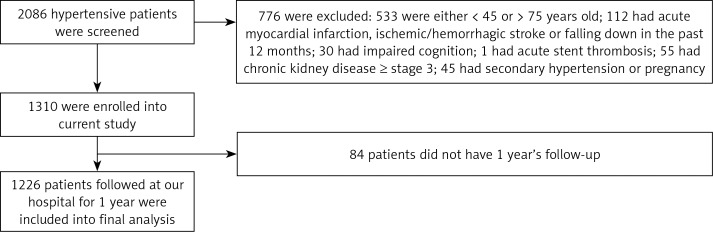
Primary hypertensive patients were retrospectively enrolled from outpatient clinics. The demographics, comorbidities, laboratory parameters and glomerular filtration rate (GFR) were collected. All participants were followed for 1 year. Cardiovascular outcomes included composite of all-cause mortality, non-fatal myocardial infarction, and non-fatal ischemic stroke/transient ischemic attack. Adverse event was defined as falling down and GFR decrease at follow-up.
A total of 1226 patients were included. Based on therapeutic BP goals, participants were divided into low (< 130/80 mm Hg) and high (< 140/90 mm Hg) therapeutic goal groups and an uncontrolled hypertension (≥ 140/90 mm Hg) group. Compared to the low therapeutic goal group, patients in the uncontrolled group were older and more likely to be smokers, have longer duration of hypertension, diabetes mellitus, lower GFR and higher prevalent ischemic stroke ( < 0.05). Patients in the uncontrolled hypertension group had higher incidence of composite endpoints than low and high therapeutic goal groups. Two cases of falling down were observed in the low therapeutic goal group and no significant changes in GFR were observed. With adjustment for confounding factors, the uncontrolled hypertension group had higher risk of composite endpoints compared to low and high therapeutic goal groups, and these benefits were more prominent in the low versus high therapeutic goal group.
In hypertension patients, when compared to uncontrolled hypertension patients, low therapeutic BP goal is associated with better cardiovascular outcomes than high therapeutic BP goal.
本研究的目的是评估血压(BP)目标对高血压患者心血管结局的影响。
从门诊回顾性纳入原发性高血压患者。收集人口统计学、合并症、实验室参数和肾小球滤过率(GFR)。所有参与者随访1年。心血管结局包括全因死亡率、非致命性心肌梗死和非致命性缺血性中风/短暂性脑缺血发作的复合终点。不良事件定义为随访时跌倒和GFR下降。
共纳入1226例患者。根据治疗血压目标,参与者被分为低(<130/80 mmHg)和高(<140/90 mmHg)治疗目标组以及未控制高血压(≥140/90 mmHg)组。与低治疗目标组相比,未控制组患者年龄更大,更可能是吸烟者,高血压病程更长,患有糖尿病,GFR更低,缺血性中风患病率更高(<0.05)。未控制高血压组的复合终点发生率高于低和高治疗目标组。低治疗目标组观察到2例跌倒,未观察到GFR有显著变化。校正混杂因素后,与低和高治疗目标组相比,未控制高血压组复合终点风险更高,且这些益处在低治疗目标组与高治疗目标组相比时更为突出。
在高血压患者中,与未控制高血压患者相比,低治疗血压目标比高治疗血压目标与更好的心血管结局相关。