Key Lab of Health Technology Assessment, National Health Commission, School of Public Health, Fudan University, Shanghai, 200032, People's Republic of China.
Department of Health Management, School of Management, Hainan Medical University, Hainan, 571199, People's Republic of China.
BMC Health Serv Res. 2019 Nov 21;19(1):858. doi: 10.1186/s12913-019-4609-9.
The reform of county-level public hospitals is a breakthrough in the new era of healthcare reform in China and has attracted considerable attention since 2012. Continuous and efficient operations of hospital are primary concerns of this reform. To ensure the effectiveness of county-based intervention reform measures in Chongqing, it is significant to understand how hospital and county characteristics are associated with county-level public hospital efficiency due to significant development differences between counties. This study identifies the trajectory of hospital efficiency over time and determinants. It will also provide preliminary references for advancing reform.
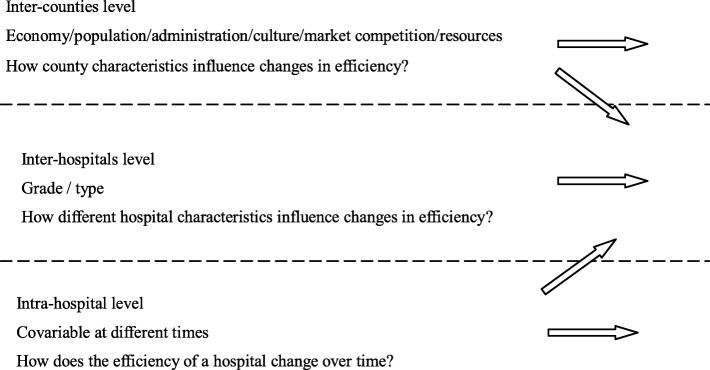
This study employs data from the Chongqing Regional Health Information Platform, Chongqing Health and Family Planning Statistical Yearbook, and Chongqing Statistical Yearbook for 2012-2016. A three-level growth model is used to estimate the efficiency growth trajectories within the contexts of hospitals and counties.
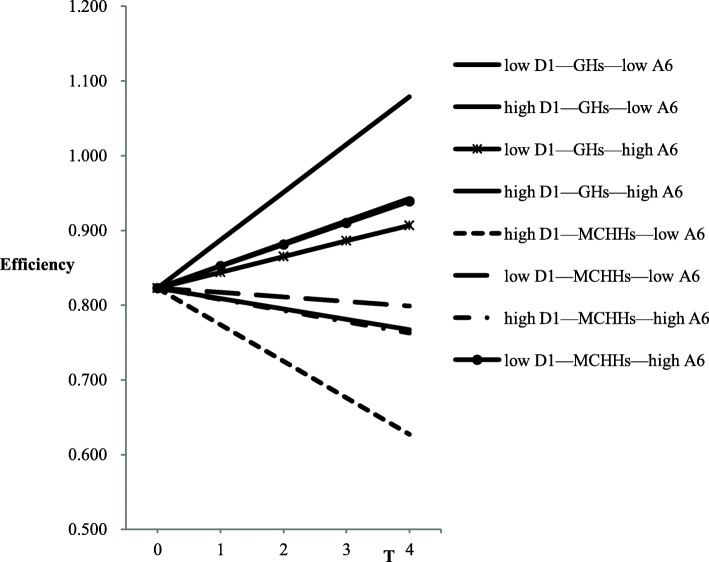
The intra-hospital level factors that affect the initial efficiency include government financial assistance, daily charge per bed, total assets turnover, number of hospital healthcare technicians, and medical costs per 100-yuan medical income. Inter-hospital variance is explained by hospital type. Inter-county level factors affecting the growth rate include the number of healthcare technicians per 1000 people and population density of the county. The interaction effect of the number of hospital healthcare technicians, hospital type, and number of healthcare technicians per 1000 people on hospital efficiency growth is significant.
This study identifies determinants that contribute to efficiency changes in public county-hospitals over time by using a three-level growth model. The differences in efficiency are associated with intra-hospital, inter-hospital, and inter-county characteristics in Chongqing, which provides useful insight into government decision-making and the progress of reform. The stability and reasonable increase in the number of healthcare technicians in a county are the key factors that improve the efficiency. Further reform should focus on maternal and child healthcare hospitals for increasing investment and implementing government compensation.
县级公立医院改革是中国新时代医疗改革的突破口,自 2012 年以来受到了相当大的关注。医院的持续高效运营是此次改革的首要关注点。为确保重庆县级干预改革措施的有效性,了解医院和县级特征与县级公立医院效率之间的关系具有重要意义,因为各县之间存在显著的发展差异。本研究确定了医院效率随时间的变化轨迹和决定因素,为推进改革提供了初步参考。
本研究使用了 2012-2016 年重庆市区域卫生信息平台、重庆市卫生和计划生育统计年鉴和重庆市统计年鉴的数据。采用三级增长模型,在医院和县级层面上估计效率增长轨迹。
影响初始效率的院内因素包括政府财政补助、每床日收费、总资产周转率、医院医护人员数量和百元医疗收入医疗成本。医院类型解释了医院间的差异。影响增长率的县际因素包括每千人口医护人员数量和县城人口密度。医院医护人员数量、医院类型和每千人口医护人员数量对医院效率增长的交互效应显著。
本研究通过使用三级增长模型,确定了影响县级公立医院随时间变化的效率变化的决定因素。效率的差异与重庆的院内、院间和县际特征有关,这为政府决策和改革进展提供了有用的见解。县城医护人员数量的稳定合理增长是提高效率的关键因素。进一步的改革应侧重于妇幼保健医院,加大投入,实施政府补偿。