Department of Clinical Pharmacology Oncology, Genentech Inc., South San Francisco, CA, 94080, USA.
Clinical Pharmacology, Modeling and Simulation, Genentech/Roche, Marseille, France.
J Immunother Cancer. 2019 Nov 21;7(1):314. doi: 10.1186/s40425-019-0791-x.
The iMATRIX-atezolizumab study was a phase I/II, multicenter, open-label study designed to assess the safety and pharmacokinetics of atezolizumab in pediatric and young adult patients. We describe the pharmacokinetics (PK), exposure-safety, and immunogenicity of atezolizumab in pediatric and young adults with metastatic solid tumors or hematologic malignancies enrolled in this study.
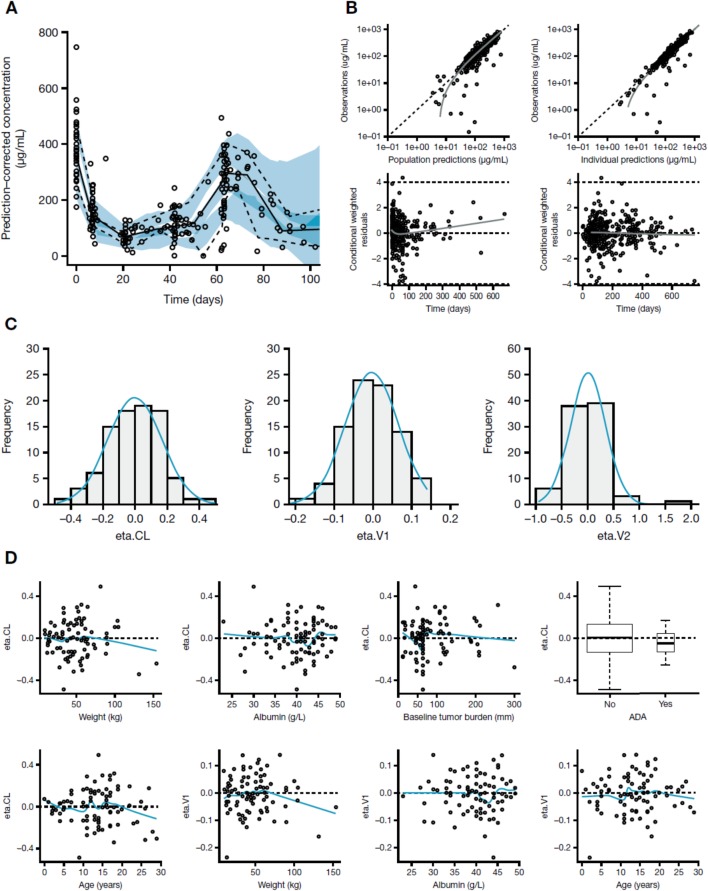
Patients aged < 18 years (n = 69) received a weight-adjusted dose of atezolizumab (15 mg/kg every 3 weeks [q3w]; maximum 1200 mg); those aged ≥ 18 years (n = 18) received a flat dose (1200 mg q3w). A prior two-compartment intravenous infusion input adult population-PK (popPK) model of atezolizumab was used as a basis to model pediatric data.
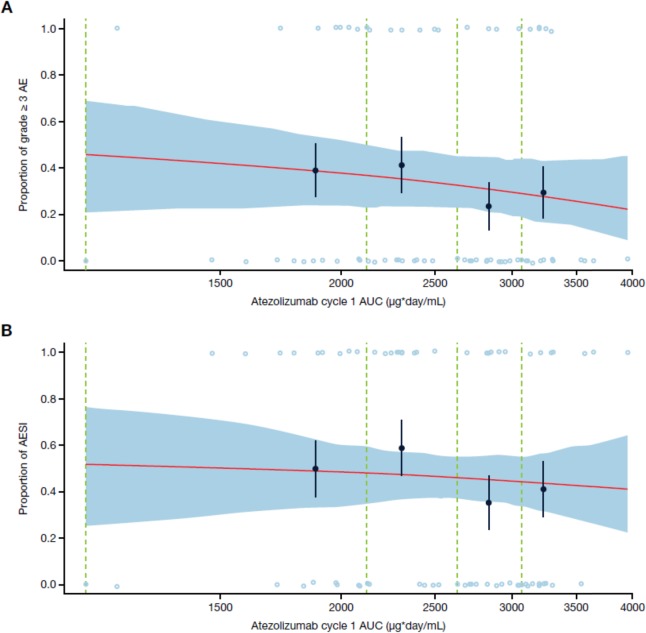
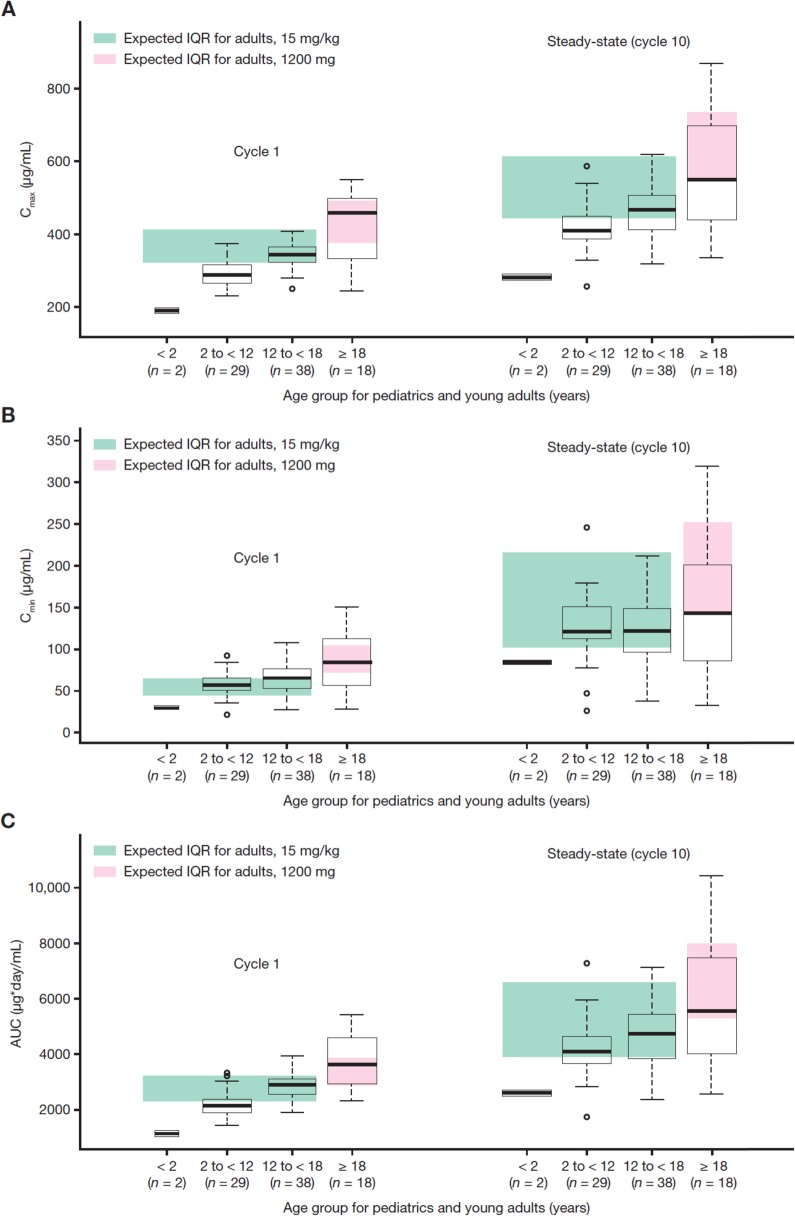
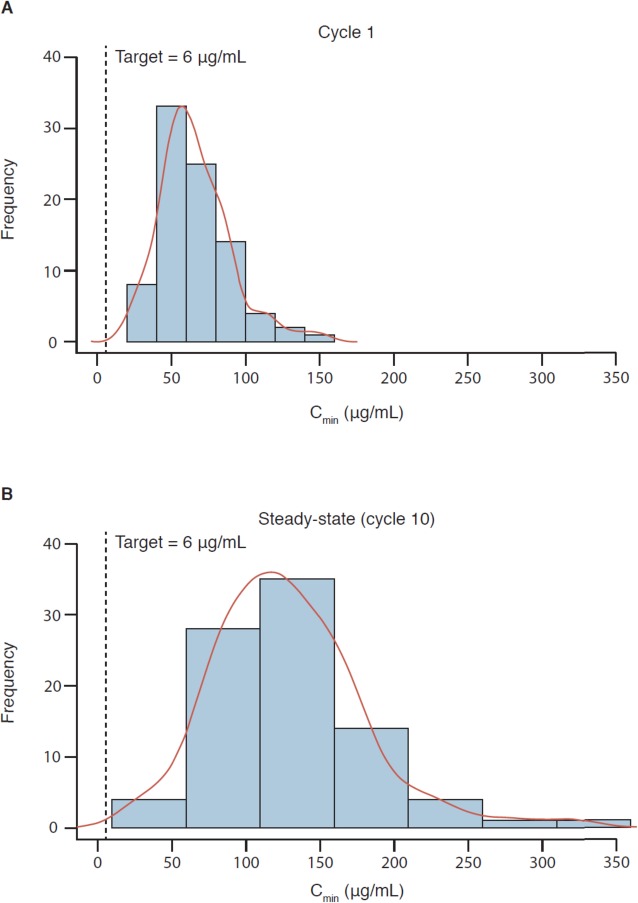
A total of 431 atezolizumab serum concentrations from 87 relapse-refractory pediatric and young adult patients enrolled in the iMATRIX-atezolizumab study were used for the popPK analysis. The dataset comprised predominantly patients aged < 18 years, including two infants aged < 2 years, with a wide body weight and age range. The clearance and volume of distribution estimates of atezolizumab were 0.217 L/day and 3.01 L, respectively. Atezolizumab geometric mean trough exposures were ~ 20% lower in pediatric patients versus young adults; this was not clinically meaningful as both groups achieved the target concentration (6 μg/mL). Safety was similar between pediatric and young adult patients with no exposure-safety relationship observed. Limited responses (4/87) precluded an exposure-response assessment on outcomes. A comparable rate (13% vs 11%) of atezolizumab anti-drug antibodies was seen in pediatric and young adult patients.
These findings demonstrate a similar exposure-safety profile of atezolizumab in pediatric and young adult patients, supportive of weight-based dosing in pediatric patients.
NCT02541604.
iMATRIX-atezolizumab 研究是一项 I/II 期、多中心、开放性研究,旨在评估 atezolizumab 在儿科和年轻成年转移性实体瘤或血液恶性肿瘤患者中的安全性和药代动力学。我们描述了在这项研究中入组的儿科和年轻成年转移性实体瘤或血液恶性肿瘤患者的 atezolizumab 药代动力学(PK)、暴露-安全性和免疫原性。
<18 岁的患者(n=69)接受体重调整剂量的 atezolizumab(15mg/kg,每 3 周 1 次[q3w];最大剂量 1200mg);≥18 岁的患者(n=18)接受固定剂量(1200mg,q3w)。先前建立的 atezolizumab 两室静脉输注成人群体药代动力学(popPK)模型被用作儿科数据建模的基础。
共纳入 87 例复发/难治性儿科和年轻成年患者,从 iMATRIX-atezolizumab 研究中获得了 431 个 atezolizumab 血清浓度,用于 popPK 分析。该数据集主要包括<18 岁的患者,包括 2 名<2 岁的婴儿,体重和年龄范围广泛。atezolizumab 的清除率和分布容积估计值分别为 0.217L/天和 3.01L。儿科患者的几何平均谷浓度暴露约比年轻成年人低 20%;这在临床上并不重要,因为两组均达到了目标浓度(6μg/mL)。儿科和年轻成年患者的安全性相似,未观察到暴露-安全性关系。由于对结果的评估受到有限的反应(4/87)的限制,因此无法进行暴露-反应评估。儿科和年轻成年患者的 atezolizumab 抗药物抗体发生率相似(13%vs11%)。
这些发现表明,在儿科和年轻成年患者中,atezolizumab 的暴露-安全性特征相似,支持对儿科患者进行基于体重的给药。
NCT02541604。