Department of Chemistry and Biochemistry, Boise State University, Boise, ID 83725, USA.
Biomolecular Sciences PhD Program, Boise State University, Boise, ID 83725, USA.
Toxins (Basel). 2019 Nov 20;11(12):682. doi: 10.3390/toxins11120682.
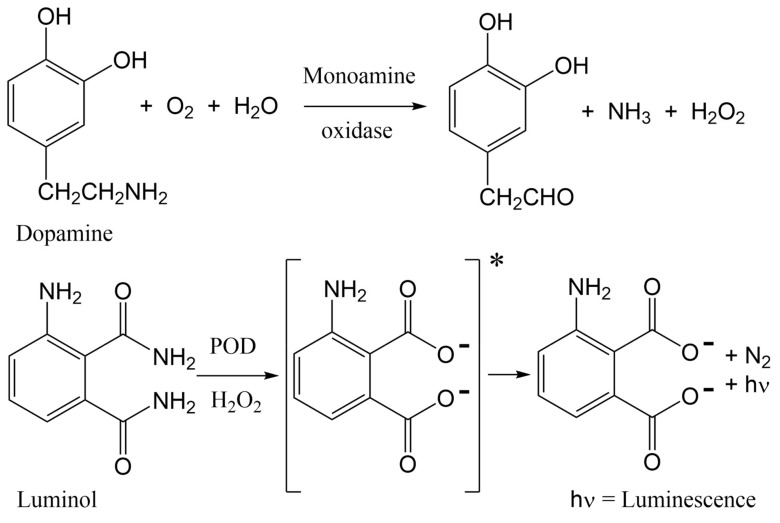
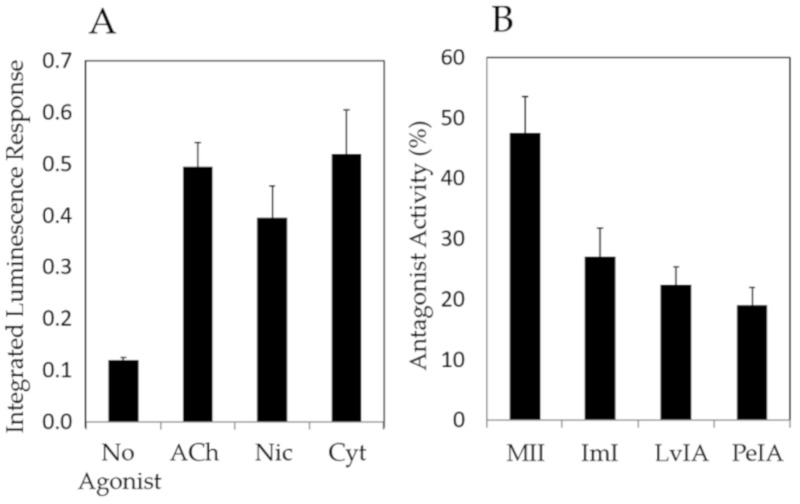
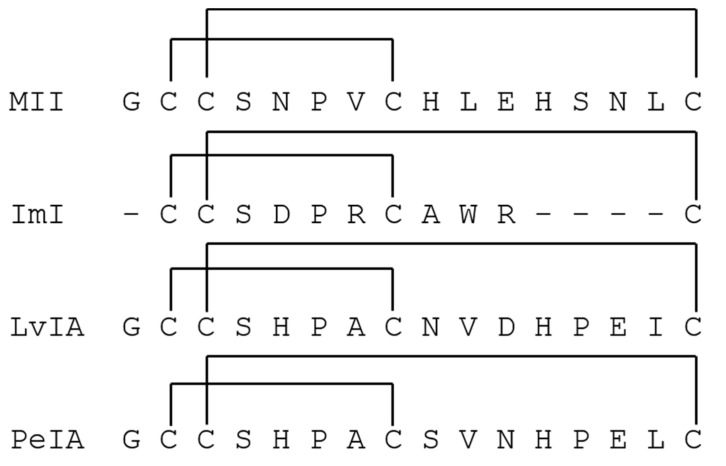
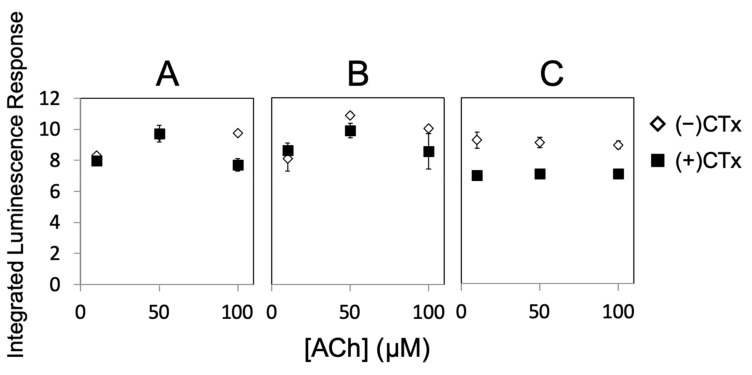
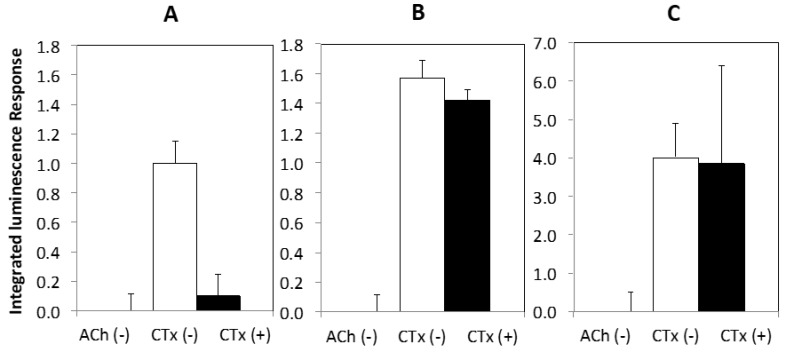
A pheochromocytoma of the rat adrenal medulla derived (a.k.a. PC12) cell-based assay for dopamine measurement by luminescence detection was customized for the qualitative evaluation of agonists and antagonists of nicotinic acetylcholine receptors (nAChRs). The assay mechanism begins with ligand binding to transmembrane nAChRs, altering ion flow into the cell and inducing dopamine release from the cell. Following release, dopamine is oxidized by monoamine oxidase generating hydrogen peroxide that catalyzes a chemiluminescence reaction involving luminol and horseradish peroxidase, thus producing a detectable response. Results are presented for the action of nAChR agonists (acetylcholine, nicotine, and cytisine), and antagonists (α-conotoxins (α-CTxs) MII, ImI, LvIA, and PeIA) that demonstrate a luminescence response correlating to the increase or decrease of dopamine release. A survey of cell growth and treatment conditions, including nerve growth factor, nicotine, ethanol, and temperature, led to optimal assay requirements to achieve maximal signal intensity and consistent response to ligand treatment. It was determined that PC12 cells treated with a combination of nerve growth factor and nicotine, and incubated at 37 °C, provided favorable results for a reduction in luminescence signal upon treatment of cells with α-CTxs. The PC12 assay is intended for use as a fast, efficient, and economic qualitative method to assess the bioactivity of molecules that act on nAChRs, in which testing of ligand-nAChR binding hypotheses and computational predictions can be validated. As a screening method for nAChR bioactivity, lead compounds can be assessed for their likelihood of exhibiting desired bioactivity prior to being subjected to more complex quantitative methods, such as electrophysiology or live animal studies.
一种基于大鼠肾上腺髓质嗜铬细胞瘤衍生(亦称 PC12)细胞的多巴胺测定发光检测法,专门用于定性评估烟碱型乙酰胆碱受体(nAChR)激动剂和拮抗剂。该测定法的机制始于配体与跨膜 nAChR 结合,改变离子流入细胞,并诱导多巴胺从细胞中释放。释放后,多巴胺被单胺氧化酶氧化生成过氧化氢,过氧化氢催化涉及鲁米诺和辣根过氧化物酶的化学发光反应,从而产生可检测的反应。结果显示了 nAChR 激动剂(乙酰胆碱、尼古丁和 cytisine)和拮抗剂(α-CTXs MII、ImI、LvIA 和 PeIA)的作用,这些激动剂和拮抗剂的作用表现为与多巴胺释放增加或减少相关的发光反应。对细胞生长和处理条件(包括神经生长因子、尼古丁、乙醇和温度)的调查导致了最佳测定要求,以实现最大信号强度和对配体处理的一致反应。结果表明,用神经生长因子和尼古丁联合处理的 PC12 细胞,并在 37°C 下孵育,可在细胞用 α-CTXs 处理时提供降低发光信号的有利结果。PC12 测定法旨在用作快速、高效和经济的定性方法,以评估作用于 nAChR 的分子的生物活性,其中可以验证配体-nAChR 结合假说和计算预测的测试。作为 nAChR 生物活性的筛选方法,可以在进行更复杂的定量方法(如电生理学或活体动物研究)之前,评估先导化合物显示所需生物活性的可能性。