
利用德国南部深大陆钻探地点KTB的接收函数探测地壳各向异性
Probing crustal anisotropy by receiver functions at the deep continental drilling site KTB in Southern Germany.
作者信息
Bianchi Irene, Bokelmann Götz
机构信息
Department of Meteorology and Geophysics University of Vienna Wien Austria.
Istituto Nazionale di Geofisica e Vulcanologia (INGV) Sezione Roma1 Rome Italy.
出版信息
Geophys Prospect. 2019 Nov;67(9):2450-2464. doi: 10.1111/1365-2478.12883. Epub 2019 Oct 14.
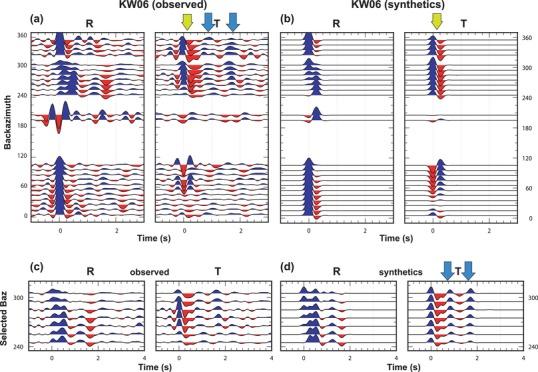
Seismic anisotropy is a unique observational tool for remotely studying deformation and stress within the Earth. Effects of anisotropy can be seen in seismic data; they are due to mineral alignment, fractures or layering. Seismic anisotropy is linked to local stress and strain, allowing modern geophysics to derive geomechanical properties from seismic data for supporting well planning and fracking. For unravelling anisotropic properties of the crust, the teleseismic receiver functions methodology has started to be widely applied recently due to its ability in retrieving the three-dimensional characteristics of the media sampled by the waves. The applicability of this technique is tested here by a field test carried out around the Kontinental Tiefbohrung site in southeastern Germany. We compare our results to previous investigations of the metamorphic rock pile of the Zone Erbendorf-Vohenstrauss, drilled down to 9 km depth, which sampled an alternating sequence of paragneiss and amphibolite, in which a strong foliation has been produced by ductile deformation. The application of the receiver functions reveals the presence of two distinct anisotropic layers within the metamorphic rock pile at 0-4 km and below 6 km depth, with up to 8% anisotropy; the depth of these two layers corresponds to the location of mica-rich paragneiss which show intense foliation, and finally proves the relation between the signal in the receiver functions, rock texture and presence of cracks. We have now the capability of providing insights from passive seismic data on geomechanical properties of the rocks, useful for geological exploration and engineering purposes, which will help influencing expensive drilling decisions thanks to future application of this seismic technique.
地震各向异性是一种用于远程研究地球内部变形和应力的独特观测工具。各向异性的影响可以在地震数据中看到;它们是由矿物排列、裂缝或分层引起的。地震各向异性与局部应力和应变相关联,使现代地球物理学能够从地震数据中推导地质力学性质,以支持钻井规划和水力压裂。为了揭示地壳的各向异性特性,远震接收函数方法由于能够获取波所采样介质的三维特征,近年来已开始被广泛应用。本文通过在德国东南部大陆深钻站点周围进行的现场测试,检验了该技术的适用性。我们将结果与之前对埃尔本多夫 - 沃亨施特劳斯带变质岩堆的研究进行了比较,该变质岩堆钻探深度达9公里,采样了副片麻岩和角闪岩的交替序列,其中韧性变形产生了强烈的叶理。接收函数的应用揭示了变质岩堆在0 - 4公里和6公里深度以下存在两个不同的各向异性层,各向异性高达8%;这两个层的深度对应于富含云母的副片麻岩的位置,这些副片麻岩显示出强烈的叶理,最终证明了接收函数中的信号、岩石纹理和裂缝存在之间的关系。我们现在有能力从被动地震数据中获取有关岩石地质力学性质的见解,这对地质勘探和工程目的很有用,由于这种地震技术的未来应用,将有助于影响昂贵的钻井决策。




 Zotero 插件