Xie Kaipeng, Xu Pengfei, Fu Ziyi, Gu Xiaohong, Li Hui, Cui Xianwei, You Lianghui, Zhu Lijun, Ji Chenbo, Guo Xirong
Women's Hospital of Nanjing Medical University The Affiliated Obstetrics and Gynecology Hospital of Nanjing Medical University Nanjing Maternity and Child Health Care Hospital Nanjing China.
Tongren Hospital Shanghai Jiao Tong University School of Medicine Shanghai China.
Food Sci Nutr. 2019 Oct 18;7(11):3759-3765. doi: 10.1002/fsn3.1235. eCollection 2019 Nov.
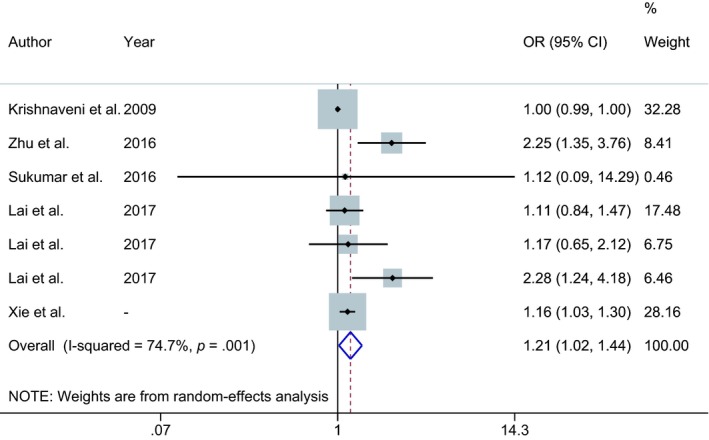
Interest in the high folate status of pregnant women has increased due to its role in the prevention of neural tube defects (NTDs). The effect of increased red blood cell (RBC) folate status during the second trimester of pregnancy on gestational diabetes mellitus (GDM) remains unclear. We measured RBC folate concentrations by competitive protein-binding assay and obtained clinical information from electronic medical records. Logistic regression analysis was used to explore the associations of RBC folate concentrations with risks of gestational diabetes mellitus (GDM). We further assessed the potential nonlinear relations between continuous log-transformed RBC folate concentrations and GDM risk by using the restricted cubic splines. We observed high RBC folate concentrations in GDM patients compared to control group [median (interquartile range, IQR), GDM vs. controls: 1,554.03 (1,240.54-1,949.99) vs. 1,478.83 (1,124.60-1,865.71) nmol/L, = .001]. Notably, high folate concentrations were significantly associated with an increased risk of GDM [RR per 1- increase: 1.16 (1.03, 1.30), = .012] after adjustment for maternal age, parity, and body mass index (BMI) at enrollment. In the restricted cubic spline model, a test of the null hypothesis of the linear relationship was rejected ( = .001). Our study firstly showed that maternal RBC folate concentrations during the second trimester of pregnancy increase the risk of GDM in a Chinese population. Further randomized clinical trials (RCTs) are warranted to confirm the adverse effect.
由于叶酸在预防神经管缺陷(NTDs)中的作用,对孕妇高叶酸状态的关注有所增加。妊娠中期红细胞(RBC)叶酸水平升高对妊娠期糖尿病(GDM)的影响尚不清楚。我们通过竞争性蛋白结合测定法测量了红细胞叶酸浓度,并从电子病历中获取了临床信息。采用逻辑回归分析探讨红细胞叶酸浓度与妊娠期糖尿病(GDM)风险之间的关联。我们进一步使用受限立方样条评估了连续对数转换后的红细胞叶酸浓度与GDM风险之间的潜在非线性关系。与对照组相比,我们观察到GDM患者的红细胞叶酸浓度较高[中位数(四分位间距,IQR),GDM组与对照组:1,554.03(1,240.54 - 1,949.99)对1,478.83(1,124.60 - 1,865.71)nmol/L,P = 0.001]。值得注意的是,在调整了母亲年龄、产次和入组时的体重指数(BMI)后,高叶酸浓度与GDM风险增加显著相关[每增加1 nmol/L的相对风险(RR):1.16(1.03,1.30),P = 0.012]。在受限立方样条模型中,线性关系零假设的检验被拒绝(P = 0.001)。我们的研究首次表明,中国人群中妊娠中期母亲的红细胞叶酸浓度会增加GDM的风险。有必要进行进一步的随机临床试验(RCT)来证实这种不良影响。