Xiang Hongzhong, Yang Jianfei, Feng Zixing, Hu Wanhe, Liang Fang, Ni Liangmeng, Gao Qi, Liu Zhijia
International Centre for Bamboo and Rattan, Beijing 100102, Beijing, China.
SFA/Beijing Key Lab of Bamboo and Rattan Science and Technology, Beijing 100102, Beijing, China.
ACS Omega. 2019 Nov 4;4(21):19246-19254. doi: 10.1021/acsomega.9b02593. eCollection 2019 Nov 19.
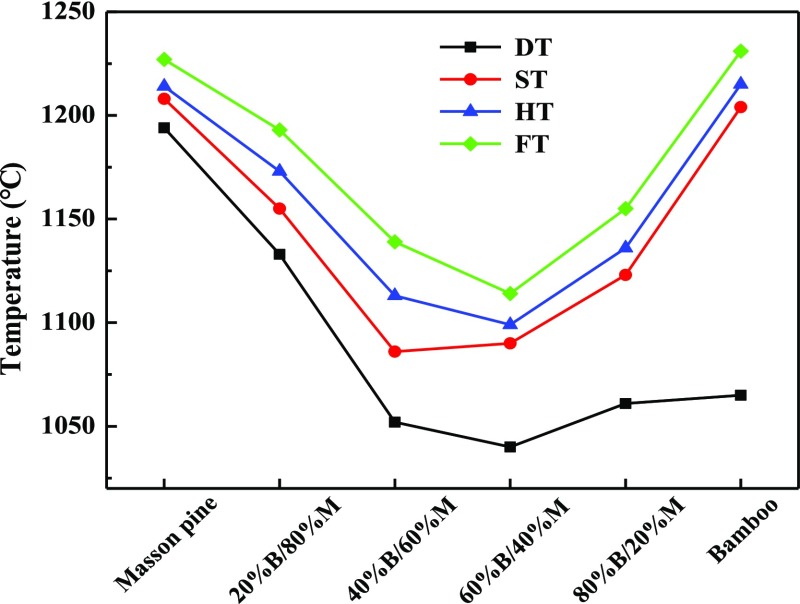
Cofiring characteristics of raw or torrefied bamboo and masson pine blends with different blend ratios were investigated by cone calorimetry, and its ash performance from cofiring was also determined by a YX-HRD testing instrument, X-ray fluorescence, scanning electron microscopy (SEM), and transmission electron microscopy (TEM). Results showed that bamboo and masson pine had the different physicochemical properties. Torrefaction improved fuel performances, resulting in a more stable cofiring process. It also decreased the heat release rate, total heat release, and total suspended particulates of fuels, especially CO and CO release. Masson pine ash mainly included CaO, SiO, FeO, KO, and AlO. Bamboo ash was mainly composed of KO, SiO, MgO, and SO. There were different melting temperatures and trends between different samples. The synergistic reaction of ash components was found during the cofiring process. The surface morphology of blend ash changed with the variation of bamboo or masson pine content.
采用锥形量热法研究了不同混合比例的生竹或烘焙竹与马尾松混合物的混烧特性,并通过YX-HRD测试仪、X射线荧光光谱仪、扫描电子显微镜(SEM)和透射电子显微镜(TEM)测定了混烧后的灰分性能。结果表明,竹子和马尾松具有不同的物理化学性质。烘焙改善了燃料性能,使混烧过程更加稳定。它还降低了燃料的热释放速率、总热释放量和总悬浮颗粒物,尤其是一氧化碳和一氧化碳的释放量。马尾松灰分主要包括氧化钙、二氧化硅、氧化铁、氧化钾和氧化铝。竹灰主要由氧化钾、二氧化硅、氧化镁和二氧化硫组成。不同样品之间存在不同的熔化温度和趋势。在混烧过程中发现了灰分成分的协同反应。混合灰的表面形态随着竹子或马尾松含量的变化而改变。