
与孤立性19号染色体三体及肿瘤性肥大细胞噬血细胞作用相关的高度侵袭性CD4阳性肥大细胞白血病(白血病变异型):1例伴有挑战性经历的病例报告及文献复习
Highly Aggressive CD4-Positive Mast Cell Leukaemia (Leukaemic Variant) Associated with Isolated Trisomy 19 and Hemophagocytosis by Neoplastic Mast Cells: A Case Report with Challenging Experience and Review.
作者信息
Soliman Dina Sameh, Al-Sabbagh Ahmad, Ibrahim Feryal, Gameil Amna, Yassin Mohamed, El-Omri Halima
机构信息
Department of Laboratory Medicine and Pathology, National Center for Cancer Care and Research, Hamad Medical Corporation, Doha, Qatar.
Clinical Pathology Department, National Cancer Institute, Cairo University, Cairo, Egypt.
出版信息
Case Rep Hematol. 2019 Oct 27;2019:1805270. doi: 10.1155/2019/1805270. eCollection 2019.
BACKGROUND
Mast cell leukaemia is a unique disease among hematopoietic neoplasms, being one of the rarest leukaemia subtypes. In addition, its prompt diagnosis is usually challenging. This is due to its heterogeneity in clinical presentations and cytomorphological and immunophenotypical features together with potential associations with other hematologic neoplasms which can complicate the condition and delay accurate diagnosis. To the best of our knowledge, this is the first case report of CD4-positive mast cell leukaemia.
CASE PRESENTATION
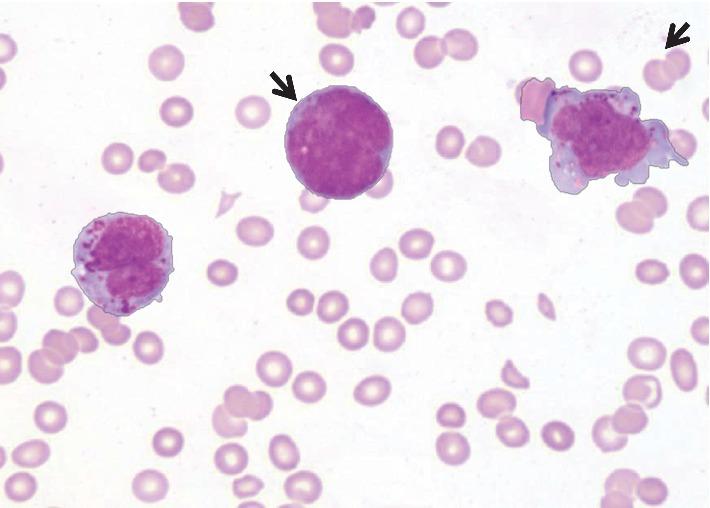
A 39-year-old male presented with acute onset of fever, abdominal pain, and generalized body aches of two-week duration. Peripheral blood smear showed circulating blasts (13%) with coarsely basophilic granulation. Bone marrow (BM) aspirate showed extensive infiltration with immature mast cells of blast-like morphology with trilineage dysplasia and evident hemophagocytic activity exhibited by histiocytes and neoplastic mast cells. BM biopsy was diffusely infiltrated with many atypical mast cells positive for CD45, CD117, mast cell tryptase, CD25, and CD4 with partial positivity for CD7 and CD30. Cytogenetics showed an abnormal karyotype: 47, XY, +1947, XY, +19[13]/46, XY[9]. Molecular analysis revealed a D816V mutation consistent with a diagnosis of systemic mastocytosis, mast cell leukaemia.
CONCLUSION
The expression of T-cell associated markers by abnormal mast cells is well documented; however, CD4 and CD7 expression have not previously been described in association with mast cell leukaemia. Coexpression of CD2, CD4, CD7, and CD30 by the mast cells particularly in skin lesions may provoke misinterpretation as a cutaneous T-cell neoplasm. To the best of our knowledge, this is the first report of CD4-positive mast cell leukaemia. Moreover, hemophagocytic mast cell leukaemia is a very rare morphologic variant, and possible correlation between this finding and expression of CD4 by neoplastic mast cells is a topic for further investigation.
背景
肥大细胞白血病是造血系统肿瘤中一种独特的疾病,是最罕见的白血病亚型之一。此外,其快速诊断通常具有挑战性。这是由于其临床表现、细胞形态学和免疫表型特征的异质性,以及与其他血液系统肿瘤的潜在关联,这些可能会使病情复杂化并延迟准确诊断。据我们所知,这是首例CD4阳性肥大细胞白血病的病例报告。
病例介绍
一名39岁男性,急性起病,发热、腹痛及全身疼痛两周。外周血涂片显示循环原始细胞(13%),有粗大嗜碱性颗粒。骨髓穿刺显示大量未成熟肥大细胞浸润,呈原始样形态,伴有三系发育异常,组织细胞和肿瘤性肥大细胞表现出明显的噬血细胞活性。骨髓活检显示弥漫性浸润,许多非典型肥大细胞CD45、CD117、肥大细胞胰蛋白酶、CD25和CD4阳性,CD7和CD30部分阳性。细胞遗传学显示核型异常:47, XY, +19[13]/46, XY[9]。分子分析显示D816V突变,符合系统性肥大细胞增多症、肥大细胞白血病的诊断。
结论
异常肥大细胞表达T细胞相关标志物已有充分文献记载;然而,CD4和CD7表达此前尚未与肥大细胞白血病相关联进行描述。肥大细胞共表达CD2、CD4、CD7和CD30,尤其是在皮肤病变中,可能会被误诊为皮肤T细胞肿瘤。据我们所知,这是首例CD4阳性肥大细胞白血病的报告。此外,噬血细胞性肥大细胞白血病是一种非常罕见的形态学变异,这一发现与肿瘤性肥大细胞CD4表达之间的可能相关性是一个有待进一步研究的课题。



 Zotero 插件