Pathology and Cytology Department, Centre Hospitalo-Universitaire de Toulouse,Institut Universitaire du Cancer de Toulouse-Oncopole, Toulouse, France.
Centre de Recherche en Cancerologie de Toulouse, INSERM, UMR1037 laboratoire d'excellence Toulouse Cancer (Labex TOUCAN), Paul Sabatier University Toulouse III, Toulouse, France.
Blood. 2020 Jan 30;135(5):360-370. doi: 10.1182/blood.2019001904.
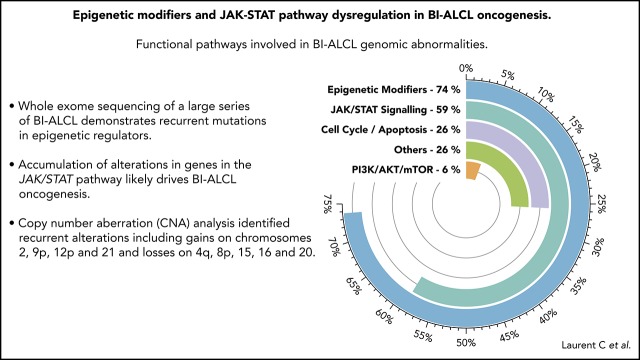
The oncogenic events involved in breast implant-associated anaplastic large cell lymphoma (BI-ALCL) remain elusive. To clarify this point, we have characterized the genomic landscape of 34 BI-ALCLs (15 tumor and 19 in situ subtypes) collected from 54 BI-ALCL patients diagnosed through the French Lymphopath network. Whole-exome sequencing (n = 22, with paired tumor/germline DNA) and/or targeted deep sequencing (n = 24) showed recurrent mutations of epigenetic modifiers in 74% of cases, involving notably KMT2C (26%), KMT2D (9%), CHD2 (15%), and CREBBP (15%). KMT2D and KMT2C mutations correlated with a loss of H3K4 mono- and trimethylation by immunohistochemistry. Twenty cases (59%) showed mutations in ≥1 member of the JAK/STAT pathway, including STAT3 (38%), JAK1 (18%), and STAT5B (3%), and in negative regulators, including SOCS3 (6%), SOCS1 (3%), and PTPN1 (3%). These mutations were more frequent in tumor-type samples than in situ samples (P = .038). All BI-ALCLs expressed pSTAT3, regardless of the mutational status of genes in the JAK/STAT pathway. Mutations in the EOMES gene (12%) involved in lymphocyte development, PI3K-AKT/mTOR (6%), and loss-of-function mutations in TP53 (12%) were also identified. Copy-number aberration (CNA) analysis identified recurrent alterations, including gains on chromosomes 2, 9p, 12p, and 21 and losses on 4q, 8p, 15, 16, and 20. Regions of CNA encompassed genes involved in the JAK/STAT pathway and epigenetic regulators. Our results show that the BI-ALCL genomic landscape is characterized by not only JAK/STAT activating mutations but also loss-of-function alterations of epigenetic modifiers.
涉及乳房植入物相关间变性大细胞淋巴瘤(BI-ALCL)的致癌事件仍不明确。为了阐明这一点,我们对通过法国淋巴病理学网络诊断的 54 名 BI-ALCL 患者的 34 例 BI-ALCL(15 例肿瘤和 19 例原位亚型)进行了基因组特征分析。全外显子组测序(n = 22,具有配对的肿瘤/种系 DNA)和/或靶向深度测序(n = 24)显示,74%的病例中存在表观遗传修饰物的反复突变,特别是 KMT2C(26%)、KMT2D(9%)、CHD2(15%)和 CREBBP(15%)。KMT2D 和 KMT2C 突变与免疫组化中 H3K4 单甲基化和三甲基化的丢失相关。20 例(59%)显示 JAK/STAT 通路中≥1 个成员的突变,包括 STAT3(38%)、JAK1(18%)和 STAT5B(3%),以及负调节因子,包括 SOCS3(6%)、SOCS1(3%)和 PTPN1(3%)。这些突变在肿瘤型样本中比原位样本更常见(P =.038)。所有 BI-ALCL 均表达 pSTAT3,无论 JAK/STAT 通路中基因的突变状态如何。在淋巴细胞发育中涉及的 EOMES 基因(12%)、PI3K-AKT/mTOR(6%)和 TP53(12%)的功能丧失突变也被鉴定出来。拷贝数改变(CNA)分析确定了反复出现的改变,包括 2 号染色体、9p、12p 和 21 号染色体的增益,以及 4q、8p、15、16 和 20 号染色体的缺失。CNA 区域包含涉及 JAK/STAT 通路和表观遗传调节因子的基因。我们的结果表明,BI-ALCL 的基因组特征不仅表现为 JAK/STAT 激活突变,还表现为表观遗传修饰物的功能丧失改变。