Biben Johannes Albert, Atmodiwirjo Parintosa
Division of Plastic Reconstructive and Aesthetic Surgery, Department of Surgery, Dr. Cipto Mangunkusumo National Referral Hospital, Faculty of Medicine Universitas Indonesia, Jakarta, Indonesia.
Arch Plast Surg. 2019 Nov;46(6):572-579. doi: 10.5999/aps.2019.00738. Epub 2019 Nov 15.
Even with satisfactory anastomosis technique and adequate experience of the surgeon, flap loss due to thrombosis can still occur due to the patient's underlying condition. Patients with hypercoagulability due to etiologies such as malignancy, hereditary conditions, and acquired thrombophilia are among those who could benefit from free flap procedures. This review aimed to evaluate the risk of free flap thrombosis in patients with hypercoagulability and to identify the most effective thromboprophylaxis regimen.
This review was conducted in accordance with the Preferred Reporting Items for Systematic Reviews and Meta-Analyses guideline. The PubMed, Embase, and Cochrane Library databases were explored. Types of free flaps, types of hypercoagulable states, thrombosis prevention protocols, thrombosis complication rates, and flap vitality outcomes were reviewed. Samples from the included studies were pooled to calculate the relative risk of free flap thrombosis complications in patients with hypercoagulability compared to those without hypercoagulability.
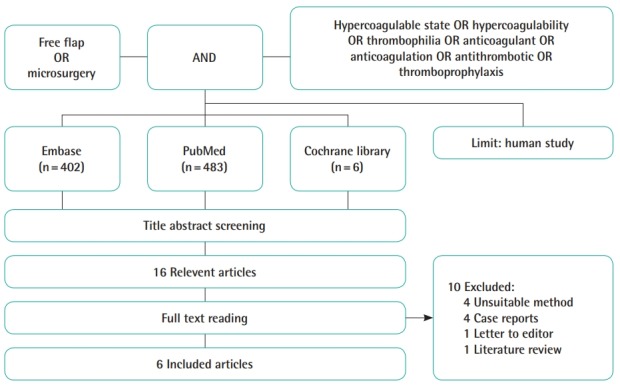
In total, 885 articles underwent title, abstract, and full-text screening. Six articles met the inclusion criteria. The etiologies of hypercoagulability varied. The overall incidence of thrombosis and flap loss in hypercoagulable patients was 13% and 10.3%, respectively. The thrombosis risk was two times higher in hypercoagulable patients (P=0.074) than in controls. Thromboprophylaxis regimens were variable. Heparin was the most commonly used regimen.
Hypercoagulability did not significantly increase the risk of free flap thrombosis. The most effective thromboprophylaxis regimen could not be determined due to variation in the regimens. Further well-designed studies should be conducted to confirm this finding.
即使吻合技术令人满意且外科医生经验丰富,但由于患者的基础疾病,仍可能因血栓形成导致皮瓣丢失。患有因恶性肿瘤、遗传性疾病和获得性血栓形成倾向等病因引起的高凝状态的患者,是那些可能从游离皮瓣手术中受益的人群。本综述旨在评估高凝状态患者游离皮瓣血栓形成的风险,并确定最有效的血栓预防方案。
本综述按照系统评价和Meta分析的首选报告项目指南进行。检索了PubMed、Embase和Cochrane图书馆数据库。对游离皮瓣类型、高凝状态类型、血栓预防方案、血栓并发症发生率和皮瓣活力结果进行了综述。汇总纳入研究的样本,以计算高凝状态患者与非高凝状态患者相比游离皮瓣血栓形成并发症的相对风险。
总共对885篇文章进行了标题、摘要和全文筛选。6篇文章符合纳入标准。高凝状态的病因各不相同。高凝患者血栓形成和皮瓣丢失的总体发生率分别为13%和10.3%。高凝患者的血栓形成风险比对照组高两倍(P=0.074)。血栓预防方案各不相同。肝素是最常用的方案。
高凝状态并未显著增加游离皮瓣血栓形成的风险。由于方案的差异,无法确定最有效的血栓预防方案。应进行进一步设计良好的研究以证实这一发现。