Kishore Shweta, Jatwani Shraddha, Malhotra Bharat, Lirette Seth T, Mittal Varun, Majithia Vikas
University of Mississippi Medical Center Jackson.
St. Vincent Evansville Evansville.
ACR Open Rheumatol. 2019 May 13;1(3):194-200. doi: 10.1002/acr2.1030. eCollection 2019 May.
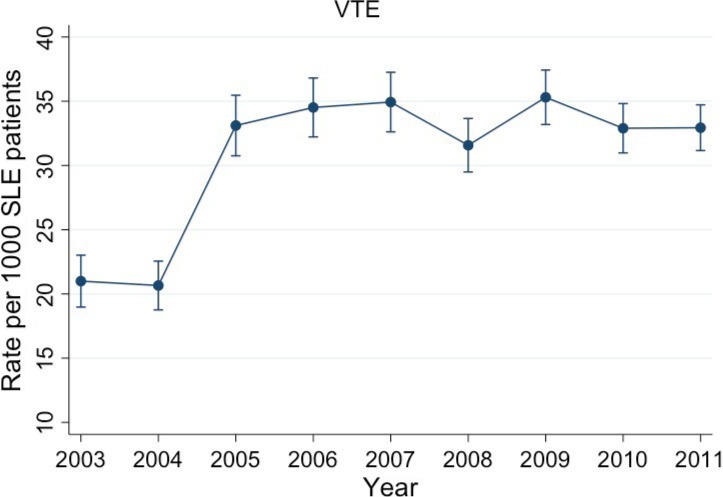
Venous thromboembolism (VTE) is a major cause of mortality and morbidity in hospitalized patients, particularly those with autoimmune disorders. The Nationwide Inpatient Sample (NIS) database was analyzed to determine trends in the rate of hospitalization, mortality from VTE, epidemiology, and outcomes in hospitalized patients with systemic lupus erythematosus (SLE) to assess its impact.
The 2003-2011 NIS database of the Healthcare Cost and Utilization Project was queried to identify all adults (age 18 years and older) hospitalized with SLE and VTE. Demographic characteristics and in-hospital outcomes of this population were compared with those of patients with SLE without a VTE diagnosis. A multivariate logistic regression analysis was used to obtain the adjusted odds ratio (OR).
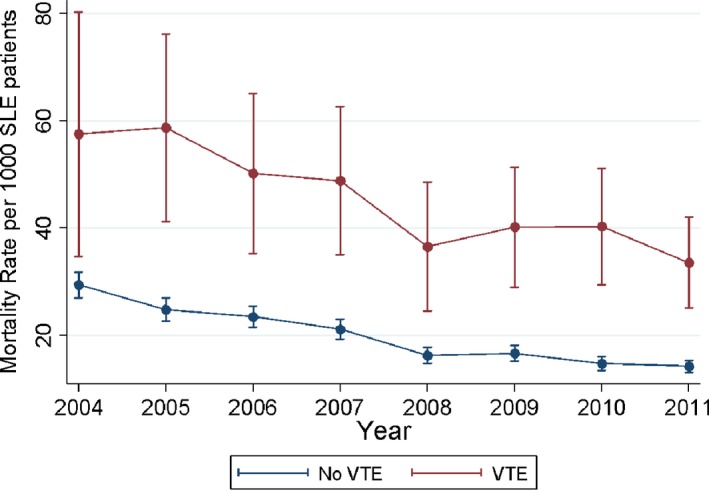
The total number of hospitalized patients with SLE was 299 595, of whom 9175 (3.06%) had VTE. After adjusting for potential confounders, compared with those without VTE, patients with SLE and VTE had significantly higher inpatient mortality (5% vs. 2.0%; OR 2.35 [95% confidence interval (CI) 2.10-2.62]; < 0.001), greater disability at discharge (34% vs. 26%; OR 1.53 [95% CI 1.46-1.62]; < 0.001), a longer length of stay (LOS) by 3.57 days, and higher cost of hospitalization by $25 400. In this database, patients with SLE and VTE were younger and of male sex. Also, African American race and a higher number of comorbidities were associated with an increased risk of VTE in patients with SLE.
VTE in hospitalized patients with SLE is associated with significantly higher inpatient mortality, greater disability at discharge, an increased LOS, and higher cost of hospitalization. This cross-sectional study helps with quantifying the risk of VTE in hospitalized patients with SLE and provides information on the immense human and material cost this complication leads to. These data can be very useful in the development and implementation of appropriate prophylactic strategies in the high-risk population with SLE.
静脉血栓栓塞症(VTE)是住院患者,尤其是自身免疫性疾病患者发病和死亡的主要原因。分析全国住院患者样本(NIS)数据库,以确定系统性红斑狼疮(SLE)住院患者的住院率、VTE死亡率、流行病学及转归趋势,从而评估其影响。
查询2003 - 2011年医疗成本与利用项目的NIS数据库,以确定所有因SLE和VTE住院的成年人(年龄18岁及以上)。将该人群的人口统计学特征和住院转归与未诊断为VTE的SLE患者进行比较。采用多因素逻辑回归分析以获得校正比值比(OR)。
SLE住院患者总数为299595例,其中9175例(3.06%)发生VTE。在对潜在混杂因素进行校正后,与未发生VTE的患者相比,SLE合并VTE的患者住院死亡率显著更高(5%对2.0%;OR 2.35[95%置信区间(CI)2.10 - 2.62];P < 0.001),出院时残疾程度更高(34%对26%;OR 1.53[95% CI 1.46 - 1.62];P < 0.001),住院时间(LOS)延长3.57天,住院费用增加25400美元。在该数据库中,SLE合并VTE的患者更年轻且为男性。此外,非裔美国人种族和更多的合并症与SLE患者发生VTE的风险增加相关。
SLE住院患者发生VTE与显著更高的住院死亡率、出院时更大的残疾程度、住院时间延长及住院费用增加相关。这项横断面研究有助于量化SLE住院患者发生VTE的风险,并提供有关该并发症导致的巨大人力和物力成本的信息。这些数据对于在SLE高危人群中制定和实施适当的预防策略可能非常有用。