Meir Drexler Shira, Merz Christian J, Lissek Silke, Tegenthoff Martin, Wolf Oliver T
Department of Cognitive Psychology, Institute of Cognitive Neuroscience, Ruhr University Bochum, Bochum, Germany.
Department of Neurology, BG University Hospital Bergmannsheil, Ruhr University Bochum, Bochum, Germany.
Front Behav Neurosci. 2019 Nov 12;13:254. doi: 10.3389/fnbeh.2019.00254. eCollection 2019.
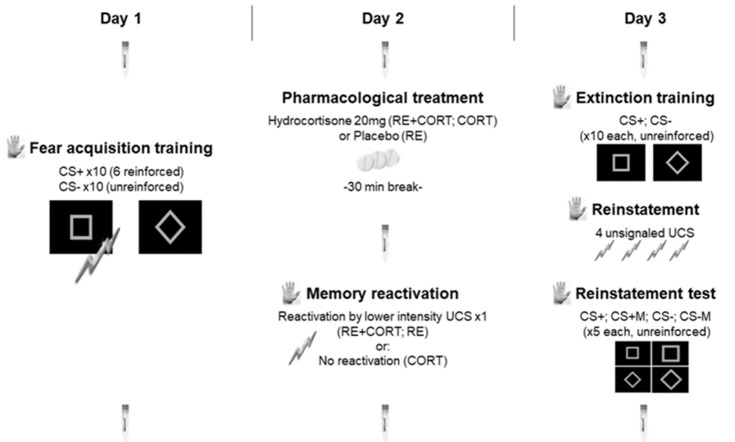
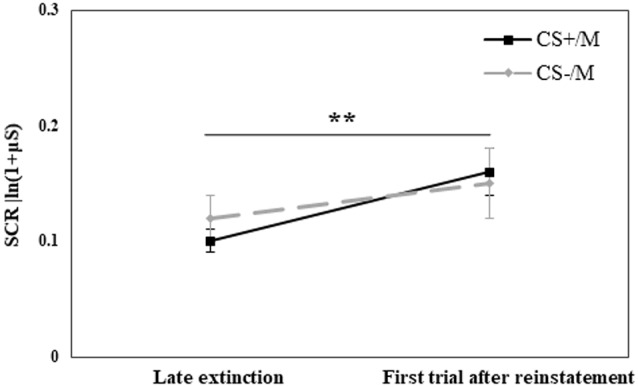
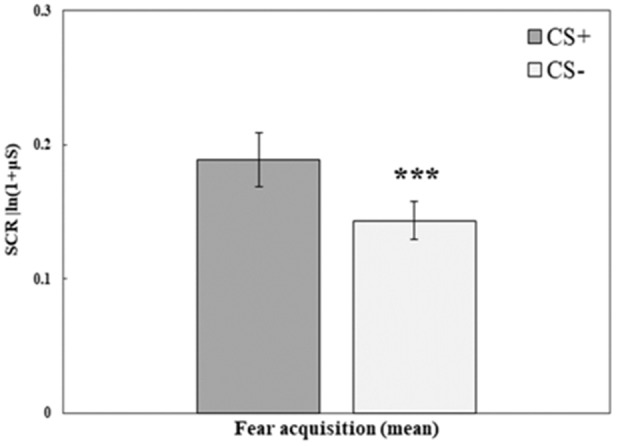
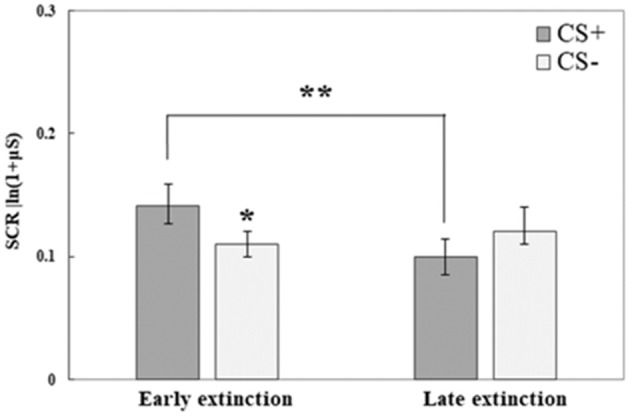
Reconsolidation is the post-retrieval stabilization of memories, a time-limited process during which reactivated (i.e., retrieved) memories can be updated with new information, become stronger or weaker, depending on the specific treatment. We have previously shown that the stress hormone cortisol has an enhancing effect on the reconsolidation of fear memories in men. This effect was specific, i.e., limited to the conditioned stimulus (CS) that was reactivated, and did not generalize to other previously reinforced, but not reactivated CS. Based on these results, we suggested that cortisol plays a critical role in the continuous strengthening of reactivated emotional memories, contributing to their persistence and robustness. In the current study, we aimed to achieve a more generalized reconsolidation enhancement using an alternative reactivation method, i.e., by a low-intensity unconditioned stimulus (UCS) presentation instead of the more common unreinforced CS presentation. In previous studies, UCS reactivation was shown to lead to a more generalized reconsolidation effect. Therefore, we hypothesized that the combination of cortisol treatment and UCS reactivation would lead to an enhanced fear memory reconsolidation, which would generalize from previously reinforced CS to stimuli that resemble it. We tested 75 men in a 3-day fear conditioning paradigm: fear acquisition training on day 1; UCS reactivation/no reactivation and pharmacological treatment (20 mg hydrocortisone/placebo) on day 2; extinction training, reinstatement and test (of original and modified stimuli) on day 3. In contrast to our hypothesis, UCS reactivation prevented the return of fear [observed in skin conductance responses (SCR)] regardless of the pharmacological manipulation: while reinstatement to the original CS was found in the no-reactivation group, both reactivation groups (cortisol and placebo) showed no reinstatement. As the only methodological difference between our previous study and the current one was the reactivation method, we focus on UCS reactivation as the main explanation for these unexpected findings. We suggest that the robust prediction error generated by the UCS reactivation method (as opposed to CS reactivation), combined with the lower UCS intensity, has by itself weakened the emotional value of the UCS, thus preventing the return of fear to the CS that was associated with it. We call for future research to support these findings and to examine the potential of this reactivation method, or variations thereof, as a tool for therapeutic use.
重新巩固是记忆检索后的稳定过程,这是一个有时间限制的过程,在此期间,重新激活(即检索)的记忆可以用新信息进行更新,根据具体治疗情况变得更强或更弱。我们之前已经表明,应激激素皮质醇对男性恐惧记忆的重新巩固有增强作用。这种作用是特异性的,即仅限于重新激活的条件刺激(CS),不会推广到其他先前强化但未重新激活的CS。基于这些结果,我们认为皮质醇在重新激活的情绪记忆的持续强化中起关键作用,有助于它们的持续性和稳固性。在当前的研究中,我们旨在使用另一种重新激活方法实现更广泛的重新巩固增强,即通过呈现低强度非条件刺激(UCS)而不是更常见的未强化CS呈现。在先前的研究中,UCS重新激活被证明会导致更广泛的重新巩固效应。因此,我们假设皮质醇治疗和UCS重新激活的组合将导致恐惧记忆重新巩固增强,这将从先前强化的CS推广到与其相似的刺激。我们在一个为期3天的恐惧条件范式中测试了75名男性:第1天进行恐惧习得训练;第2天进行UCS重新激活/不重新激活以及药物治疗(20毫克氢化可的松/安慰剂);第3天进行消退训练、恢复以及对原始和修改刺激的测试。与我们的假设相反,无论药物处理如何,UCS重新激活都阻止了恐惧的恢复[在皮肤电反应(SCR)中观察到]:虽然在未重新激活组中发现了对原始CS的恢复,但两个重新激活组(皮质醇和安慰剂)均未显示恢复。由于我们先前的研究与当前研究之间唯一的方法学差异是重新激活方法,我们将UCS重新激活作为这些意外发现的主要解释。我们认为,UCS重新激活方法(与CS重新激活相反)产生的强烈预测误差,加上较低的UCS强度,本身削弱了UCS的情感价值,从而阻止了与它相关的CS的恐惧恢复。我们呼吁未来的研究支持这些发现,并研究这种重新激活方法或其变体作为治疗工具的潜力。