Godoy Pamela Andrea, Ramírez-Molina Oscar, Fuentealba Jorge
Neuroactive Compounds Screening Laboratory,Departamento de Fisiología, Facultad de Cs. Biológicas, Universidad de Concepción, Concepción, Chile.
Front Pharmacol. 2019 Nov 7;10:1330. doi: 10.3389/fphar.2019.01330. eCollection 2019.
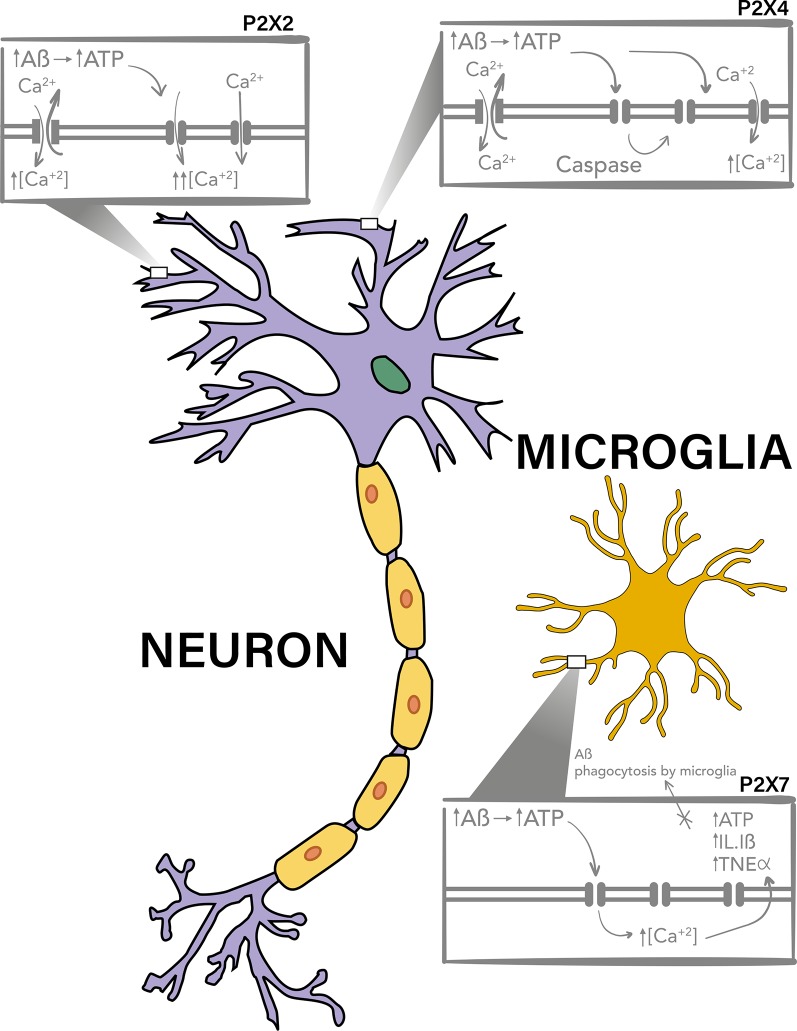
Several studies have pointed to soluble oligomers of beta amyloid peptide (SOAβ) as the principal neurotoxic agents responsible for the generation of synaptotoxic events that can explain the main symptoms of Alzheimer's disease (AD). Among the toxic features associated with SOAβ, one of the most notorious is the formation of a non-selective pore-like structure in the plasma membrane, which may partly explain the overload of intracellular Ca. There is evidence that the pore causes leakage of key intracellular compounds, such as adenosine triphosphate (ATP), to the extracellular milieu. Extracellular ATP activates P2X receptors (P2XR), which are ligand-gated ion channels (LGICs) widely expressed in both neuron and glial cells and act as neuromodulators of synaptic activity by promoting Ca entry and facilitating neurotransmitter release. There is abundant evidence correlating the overexpression of these receptors to neurodegenerative diseases, including AD, thus opening the possibility that P2XR could potentiate the toxic mechanisms induced by SOAβ and contribute to intracellular Ca overload in neurons and other mechanisms related to glial activation and inflammation. In this review, we correlate scientific evidence related to the main toxic effects induced by SOAβ and those that are mediated by purinergic P2XR. The data suggest that these purinergic receptors participate in the deleterious cellular and molecular effects of SOAβ that lead to the pathogenesis of AD. This information sheds light on the participation of new components in SOAβ toxicity that could be interesting as pharmacological targets for the development of molecular or chemical compounds able to modulate them.
多项研究指出,β淀粉样肽可溶性寡聚体(SOAβ)是导致突触毒性事件产生的主要神经毒性因子,这些事件可解释阿尔茨海默病(AD)的主要症状。在与SOAβ相关的毒性特征中,最显著的特征之一是在质膜中形成非选择性的孔状结构,这可能部分解释了细胞内钙超载的原因。有证据表明,该孔会导致关键细胞内化合物(如三磷酸腺苷(ATP))泄漏到细胞外环境中。细胞外ATP激活P2X受体(P2XR),P2X受体是配体门控离子通道(LGICs),在神经元和神经胶质细胞中广泛表达,并通过促进钙离子内流和促进神经递质释放,作为突触活动的神经调节剂。有大量证据表明这些受体的过表达与包括AD在内的神经退行性疾病相关,因此P2XR有可能增强SOAβ诱导的毒性机制,并导致神经元内钙超载以及与神经胶质细胞激活和炎症相关的其他机制。在本综述中,我们将与SOAβ诱导的主要毒性作用以及由嘌呤能P2XR介导的毒性作用相关的科学证据联系起来。数据表明,这些嘌呤能受体参与了导致AD发病机制的SOAβ的有害细胞和分子效应。这些信息揭示了新成分在SOAβ毒性中的作用,这对于开发能够调节它们的分子或化合物的药理学靶点可能是有意义的。