Ke Xixian, Chen Cheng, Song Yongxiang, Cai Qingyong, Li Jian, Tang Yang, Han Xu, Qu Wendong, Chen Anping, Wang Hui, Xu Gang, Liu Daxing
Department of Cardiothoracic Surgery, Affiliated Hospital of Zunyi Medical University, Zunyi, Guizhou 563000, P.R. China.
Oncol Lett. 2019 Dec;18(6):5871-5878. doi: 10.3892/ol.2019.10956. Epub 2019 Oct 3.
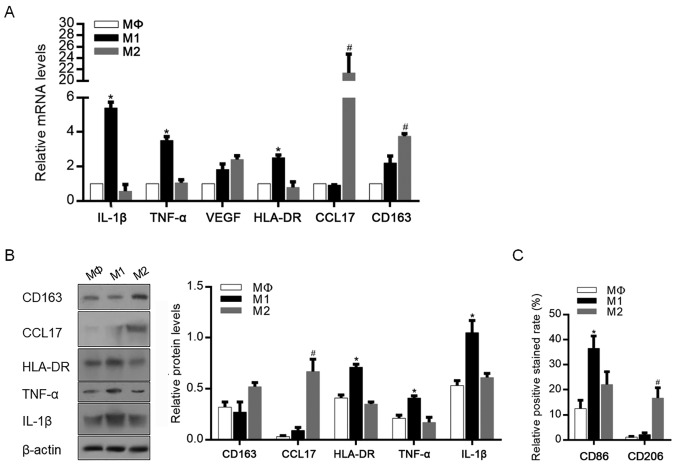
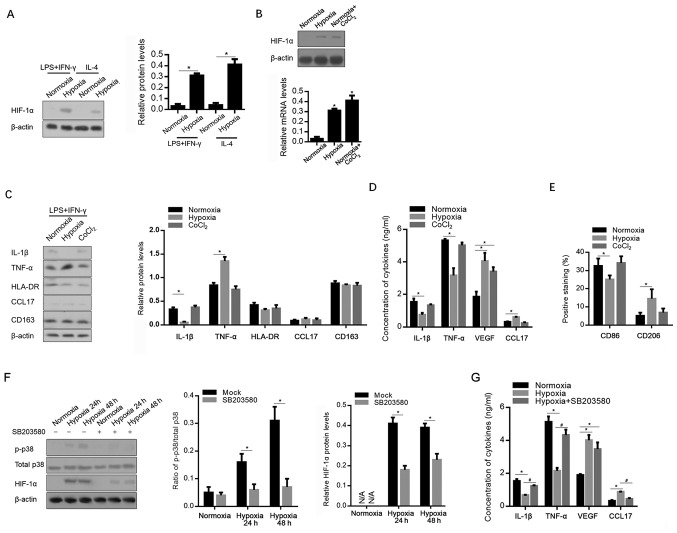
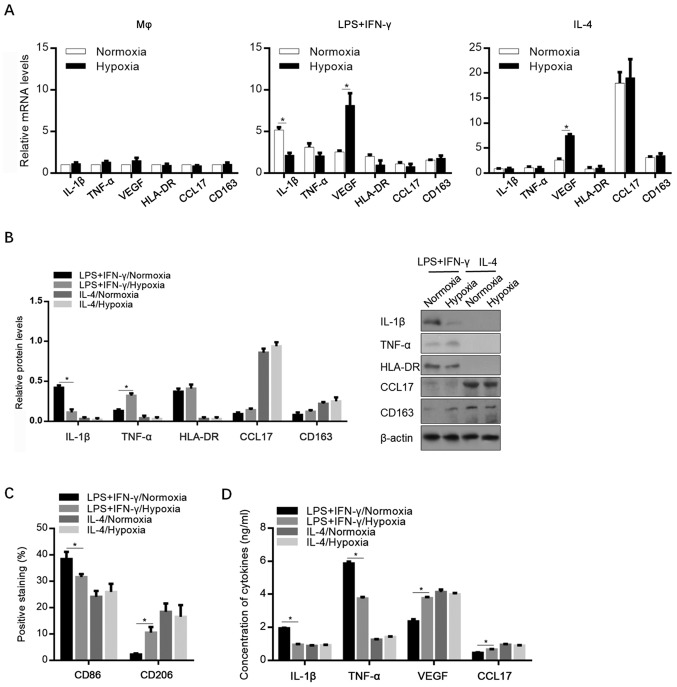
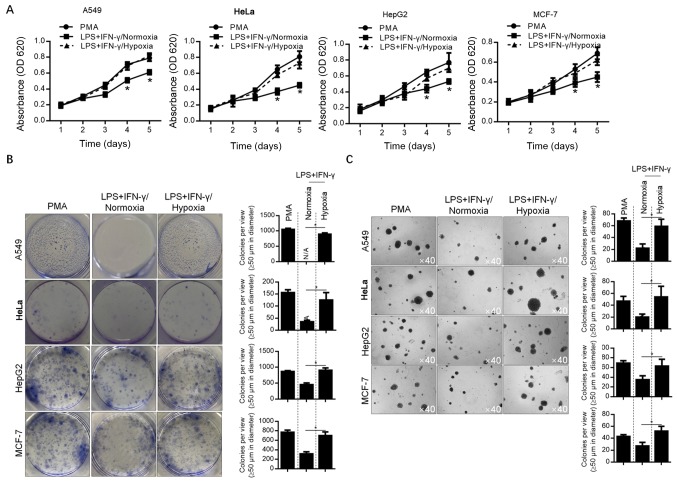
Macrophages are a heterogeneous group of phagocytes that play critical roles in inflammation, infection and tumor growth. Macrophages respond to different environmental factors and are thereby polarized into specialized functional subsets. Although hypoxia is an important environmental factor, its impact on human macrophage polarization and subsequent modification of the inflammatory microenvironment have not been fully established. The present study aimed to elucidate the effect of hypoxia exposure on the ability of human macrophages to polarize into the classically activated (pro-inflammatory) M1, and the alternatively activated (anti-inflammatory) M2 phenotypes. The effect on the inflammatory microenvironment and the subsequent modification of A549 lung carcinoma cells was also investigated. The presented data show that hypoxia promoted macrophage polarization towards the M2 phenotype, and modified the inflammatory microenvironment by decreasing the release of proinflammatory cytokines. Modification of the microenvironment by proinflammatory M1 macrophages under hypoxia reversed the inhibition of malignant behaviors within the proinflammatory microenvironment. Furthermore, it was identified p38 signaling (a major contributor to the response to reactive oxygen species generated by hypoxic stress), but not hypoxia-induced factor, as a key regulator of macrophages under hypoxia. Taken together, the data suggest that hypoxia affects the inflammatory microenvironment by modifying the polarization of macrophages, and thus, reversing the inhibitory effects of a proinflammatory microenvironment on the malignant behaviors of several types of cancer cell.
巨噬细胞是一类异质性吞噬细胞,在炎症、感染和肿瘤生长中发挥关键作用。巨噬细胞对不同的环境因素做出反应,从而极化为特定的功能亚群。尽管缺氧是一种重要的环境因素,但其对人类巨噬细胞极化以及随后对炎症微环境的影响尚未完全明确。本研究旨在阐明缺氧暴露对人类巨噬细胞极化为经典激活(促炎)的M1型和交替激活(抗炎)的M2型表型能力的影响。还研究了其对炎症微环境以及随后对A549肺癌细胞的影响。所呈现的数据表明,缺氧促进巨噬细胞向M2表型极化,并通过减少促炎细胞因子的释放来改变炎症微环境。缺氧条件下促炎M1巨噬细胞对微环境的改变逆转了促炎微环境中对恶性行为的抑制作用。此外,已确定p38信号通路(对缺氧应激产生的活性氧反应的主要贡献者)而非缺氧诱导因子是缺氧条件下巨噬细胞的关键调节因子。综上所述,数据表明缺氧通过改变巨噬细胞极化来影响炎症微环境,从而逆转促炎微环境对几种癌细胞恶性行为的抑制作用。