Physical Chemistry, University of Potsdam, Karl-Liebknecht-Str. 24-25, 14476 Potsdam, Germany.
Leibniz Institute for Agricultural Engineering and Bioeconomy (ATB), Max-Eyth-Allee 100, 14469 Potsdam, Germany.
Sensors (Basel). 2019 Nov 28;19(23):5244. doi: 10.3390/s19235244.
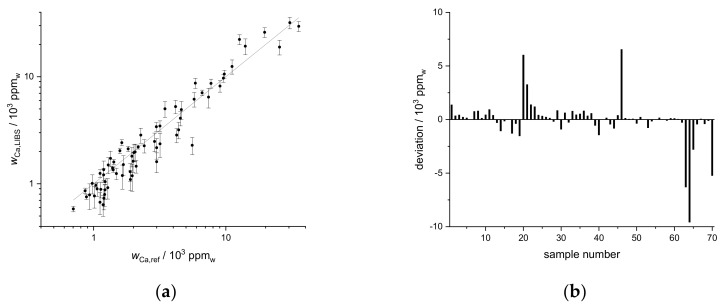
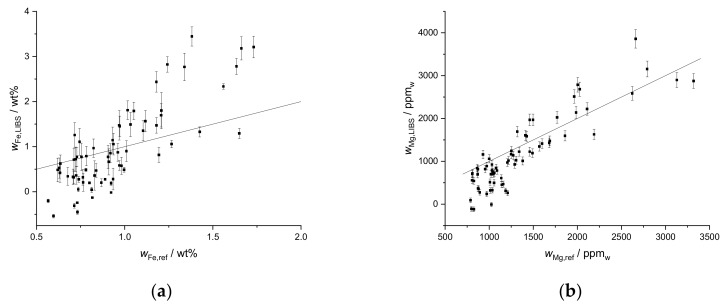
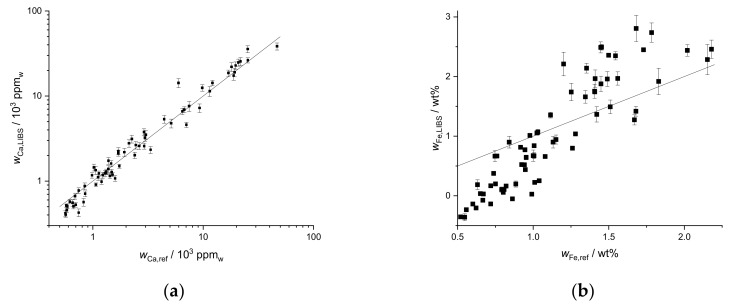
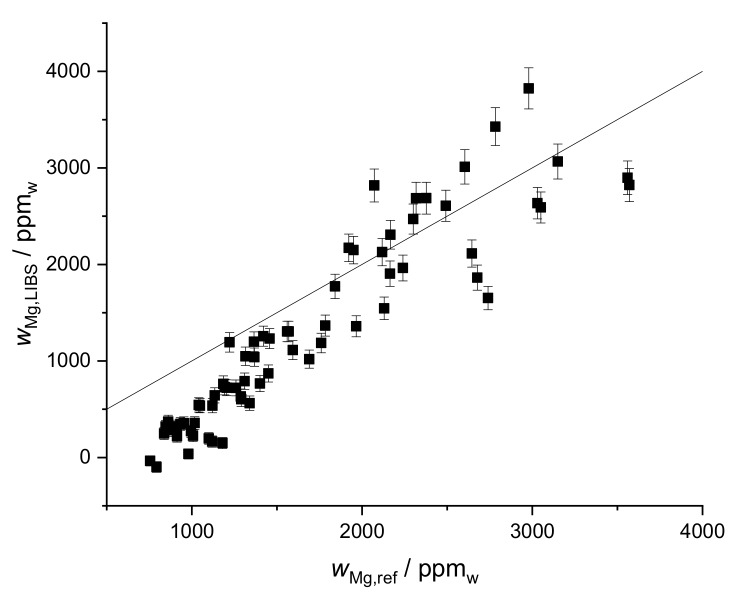
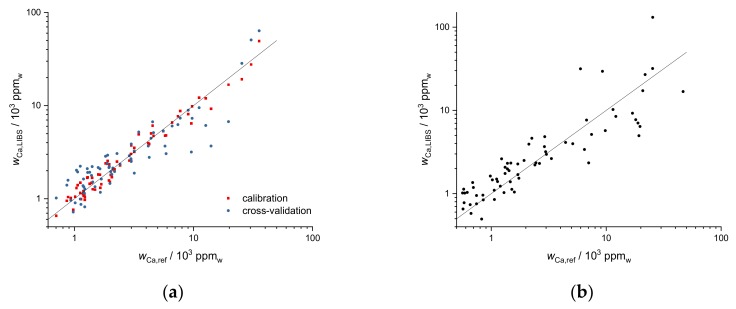
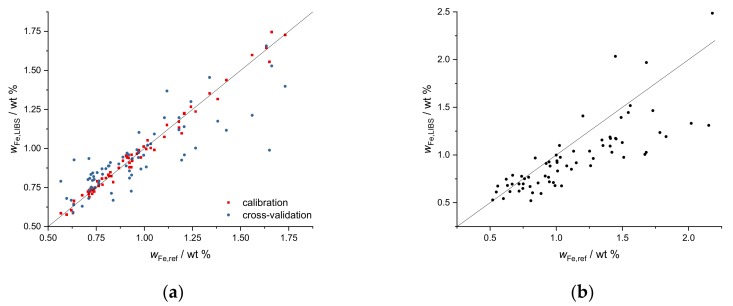
The lack of soil data, which are relevant, reliable, affordable, immediately available, and sufficiently detailed, is still a significant challenge in precision agriculture. A promising technology for the spatial assessment of the distribution of chemical elements within fields, without sample preparation is laser-induced breakdown spectroscopy (LIBS). Its advantages are contrasted by a strong matrix dependence of the LIBS signal which necessitates careful data evaluation. In this work, different calibration approaches for soil LIBS data are presented. The data were obtained from 139 soil samples collected on two neighboring agricultural fields in a quaternary landscape of northeast Germany with very variable soils. Reference analysis was carried out by inductively coupled plasma optical emission spectroscopy after wet digestion. The major nutrients Ca and Mg and the minor nutrient Fe were investigated. Three calibration strategies were compared. The first method was based on univariate calibration by standard addition using just one soil sample and applying the derived calibration model to the LIBS data of both fields. The second univariate model derived the calibration from the reference analytics of all samples from one field. The prediction is validated by LIBS data of the second field. The third method is a multivariate calibration approach based on partial least squares regression (PLSR). The LIBS spectra of the first field are used for training. Validation was carried out by 20-fold cross-validation using the LIBS data of the first field and independently on the second field data. The second univariate method yielded better calibration and prediction results compared to the first method, since matrix effects were better accounted for. PLSR did not strongly improve the prediction in comparison to the second univariate method.
土壤数据的缺乏仍然是精准农业的一个重大挑战,这些数据需要具有相关性、可靠性、可负担性、即时可用性和足够详细等特点。一种有前途的用于评估田间化学元素分布的空间技术是无需样品制备的激光诱导击穿光谱(LIBS)。LIBS 信号强烈依赖于基质,这需要仔细的数据评估,因此其优势受到了限制。在这项工作中,提出了几种用于土壤 LIBS 数据的校准方法。这些数据是从德国东北部第四纪景观中的两个相邻农田中采集的 139 个土壤样本中获得的,这些土壤的变化非常大。参考分析是通过电感耦合等离子体发射光谱法在湿消解后进行的。研究了主要养分 Ca 和 Mg 以及微量元素 Fe。比较了三种校准策略。第一种方法是基于单变量校准,通过仅使用一个土壤样本进行标准添加,并将推导的校准模型应用于两个农田的 LIBS 数据。第二种单变量模型从一个农田的所有样本的参考分析中得出校准模型。预测结果通过第二个农田的 LIBS 数据进行验证。第三种方法是基于偏最小二乘回归(PLSR)的多变量校准方法。第一个农田的 LIBS 光谱用于训练。验证是通过使用第一个农田的 LIBS 数据进行 20 倍交叉验证,并独立于第二个农田的数据进行验证。与第一种方法相比,第二种单变量方法的校准和预测结果更好,因为更好地考虑了基质效应。与第二种单变量方法相比,PLSR 并没有显著提高预测效果。