BioMed X Innovation Center, Im Neuenheimer Feld 515, 69120, Heidelberg, Germany.
B CUBE - Center for Molecular Bioengineering, Technische Universitaet Dresden, 01307, Dresden, Germany.
Acta Neuropathol Commun. 2019 Dec 3;7(1):192. doi: 10.1186/s40478-019-0823-2.
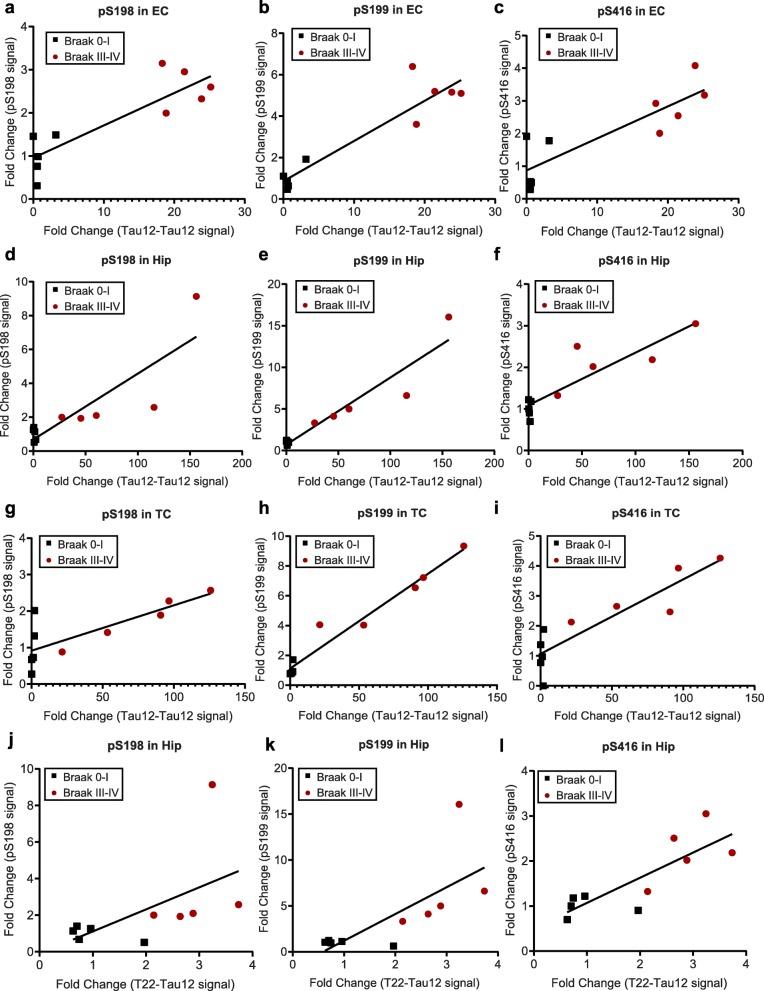
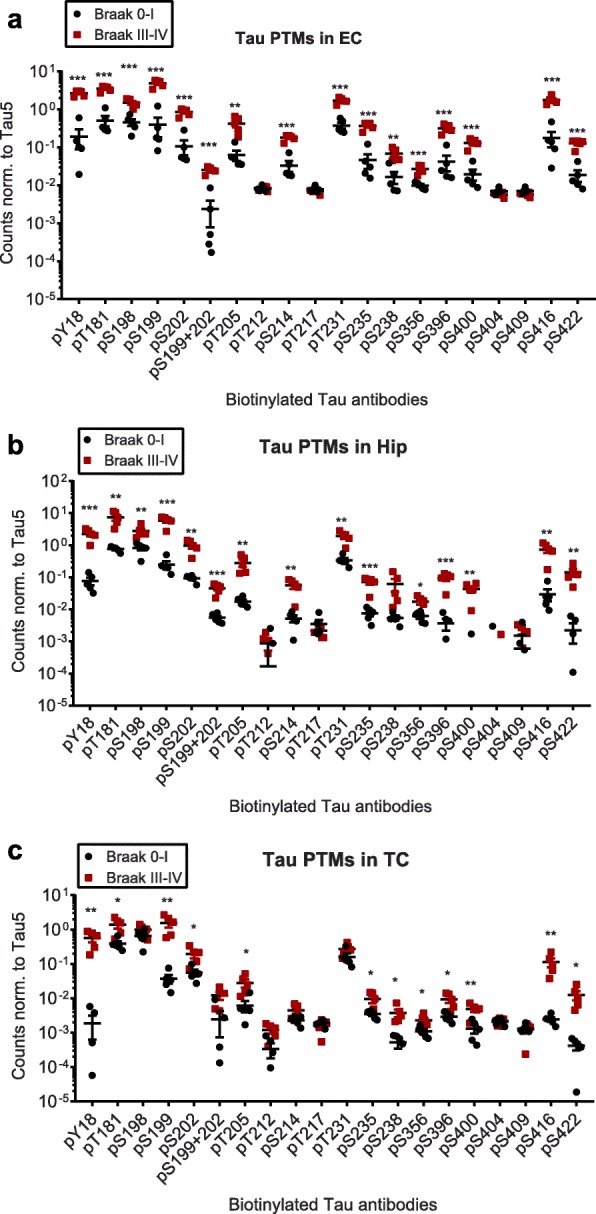
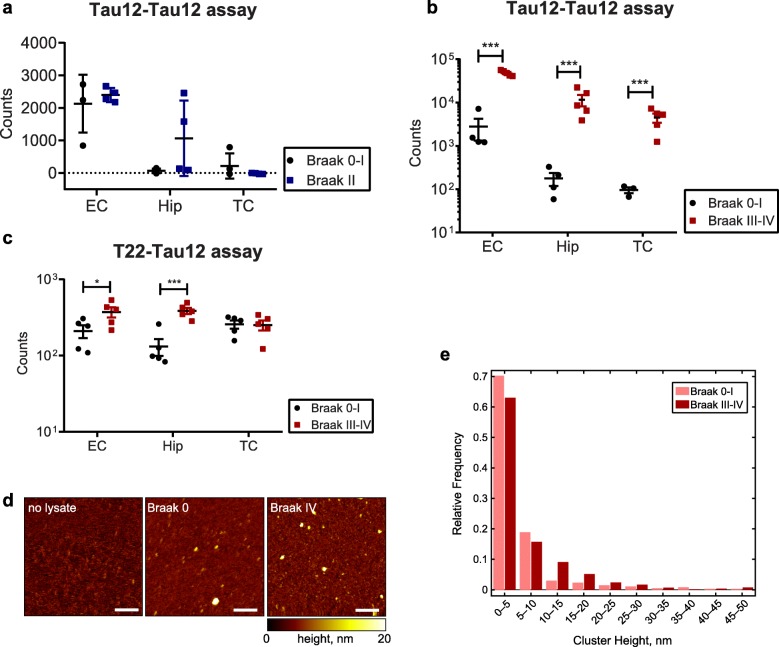
Tau is a microtubule-binding protein that can receive various post-translational modifications (PTMs) including phosphorylation, methylation, acetylation, glycosylation, nitration, sumoylation and truncation. Hyperphosphorylation of tau is linked to its aggregation and the formation of neurofibrillary tangles (NFTs), which are a hallmark of Alzheimer's disease (AD). While more than 70 phosphorylation sites have been detected previously on NFT tau, studies of oligomeric and detergent-soluble tau in human brains during the early stages of AD are lacking. Here we apply a comprehensive electrochemiluminescence ELISA assay to analyze twenty-five different PTM sites as well as tau oligomerization in control and sporadic AD brain. The samples were classified as Braak stages 0-I, II or III-IV, corresponding to the progression of microscopically detectable tau pathology throughout different brain regions. We found that soluble tau multimers are strongly increased at Braak stages III-IV in all brain regions under investigation, including the temporal cortex, which does not contain NFTs or misfolded oligomers at this stage of pathology. We additionally identified five phosphorylation sites that are specifically and consistently increased across the entorhinal cortex, hippocampus and temporal cortex in the same donors. Three of these sites correlate with tau multimerization in all three brain regions, but do not overlap with the epitopes of phospho-sensitive antibodies commonly used for the immunohistochemical detection of NFTs. Our results thus suggest that soluble multimers are characterized by a small set of specific phosphorylation events that differ from those dominating in mature NFTs. These findings shed light on early PTM changes of tau during AD pathogenesis in human brains.
tau 是一种微管结合蛋白,可以接受各种翻译后修饰(PTMs),包括磷酸化、甲基化、乙酰化、糖基化、硝化、SUMO 化和截断。tau 的过度磷酸化与其聚集和神经原纤维缠结(NFTs)的形成有关,NFTs 是阿尔茨海默病(AD)的标志。虽然以前已经在 NFT tau 上检测到了 70 多个磷酸化位点,但在 AD 的早期阶段,对人类大脑中寡聚体和去污剂可溶性 tau 的研究还很缺乏。在这里,我们应用一种全面的电化学发光 ELISA 测定法来分析 25 个不同的 PTM 位点以及控制和散发性 AD 大脑中的 tau 寡聚化。这些样本被分类为 Braak 阶段 0-I、II 或 III-IV,对应于不同大脑区域中显微镜下可检测 tau 病理学的进展。我们发现,可溶性 tau 多聚体在所有研究的大脑区域中,在 Braak 阶段 III-IV 时强烈增加,包括颞叶皮质,在该病理阶段,颞叶皮质不含有 NFT 或错误折叠的寡聚物。我们还发现了五个磷酸化位点,在相同供体的内嗅皮质、海马体和颞叶皮质中特异性且一致地增加。这三个位点与所有三个大脑区域中的 tau 多聚化相关,但与常用于 NFT 免疫组织化学检测的磷酸化敏感抗体的表位不重叠。因此,我们的结果表明,可溶性多聚体的特征是一组特定的磷酸化事件,与成熟 NFT 中主导的事件不同。这些发现为人类大脑 AD 发病机制中 tau 的早期 PTM 变化提供了线索。