Bera Kallol, Kamajaya Aron, Shivange Amol V, Muthusamy Anand K, Nichols Aaron L, Borden Philip M, Grant Stephen, Jeon Janice, Lin Elaine, Bishara Ishak, Chin Theodore M, Cohen Bruce N, Kim Charlene H, Unger Elizabeth K, Tian Lin, Marvin Jonathan S, Looger Loren L, Lester Henry A
Division of Biology and Biological Engineering, California Institute of Technology, Pasadena, CA, United States.
Division of Chemistry and Chemical Engineering, California Institute of Technology, Pasadena, CA, United States.
Front Cell Neurosci. 2019 Nov 12;13:499. doi: 10.3389/fncel.2019.00499. eCollection 2019.
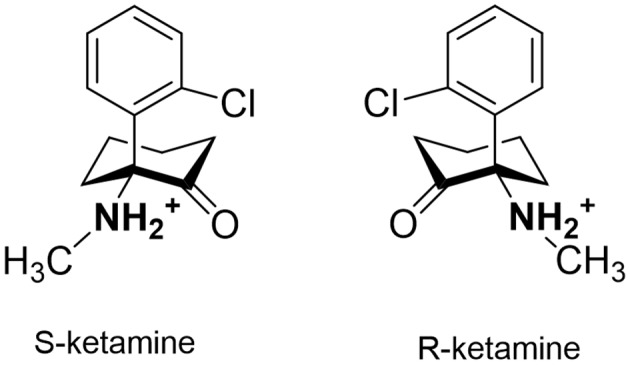
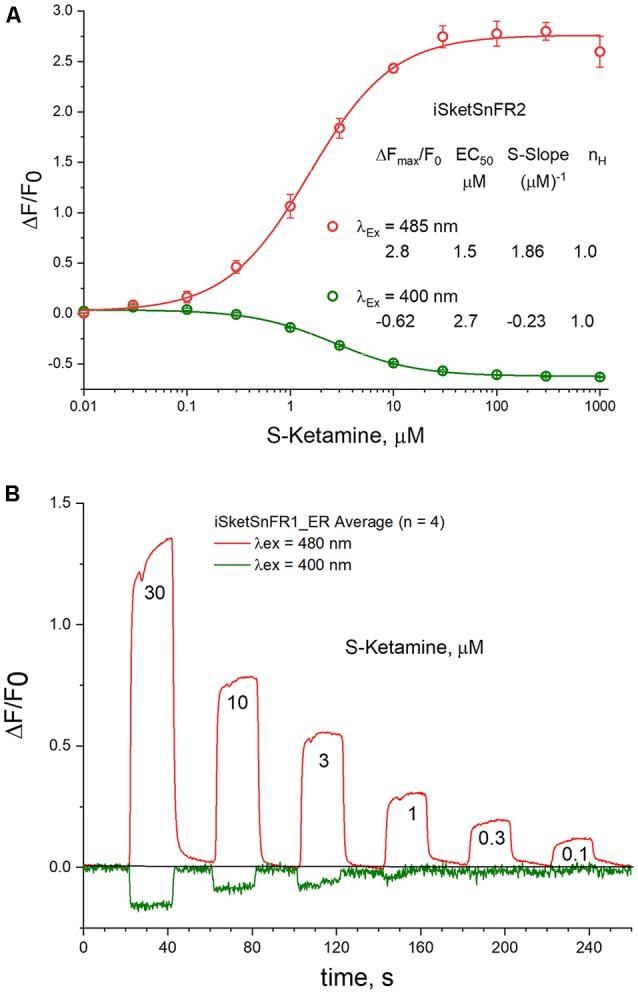
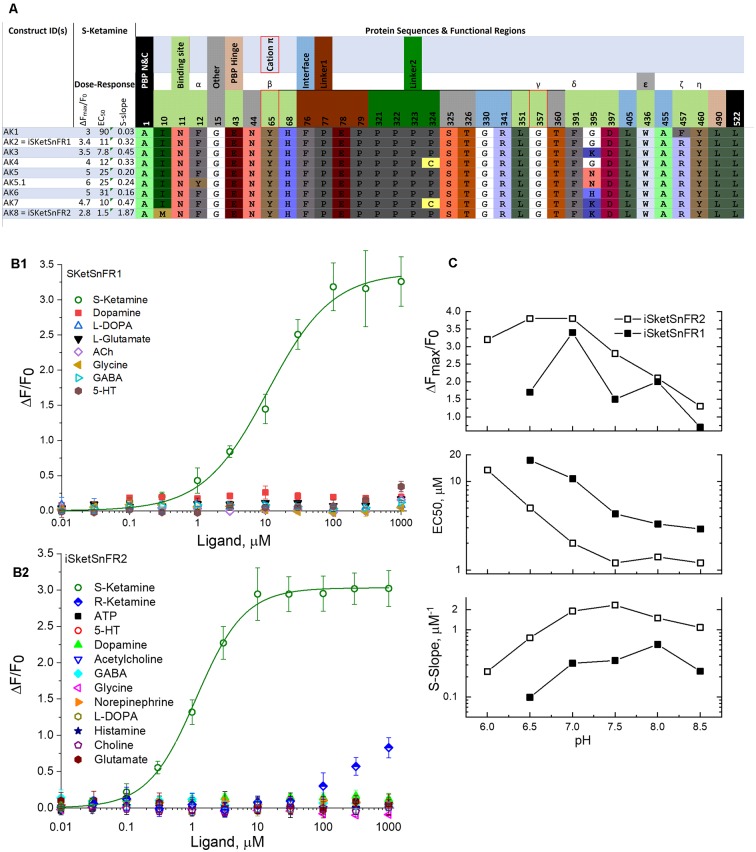
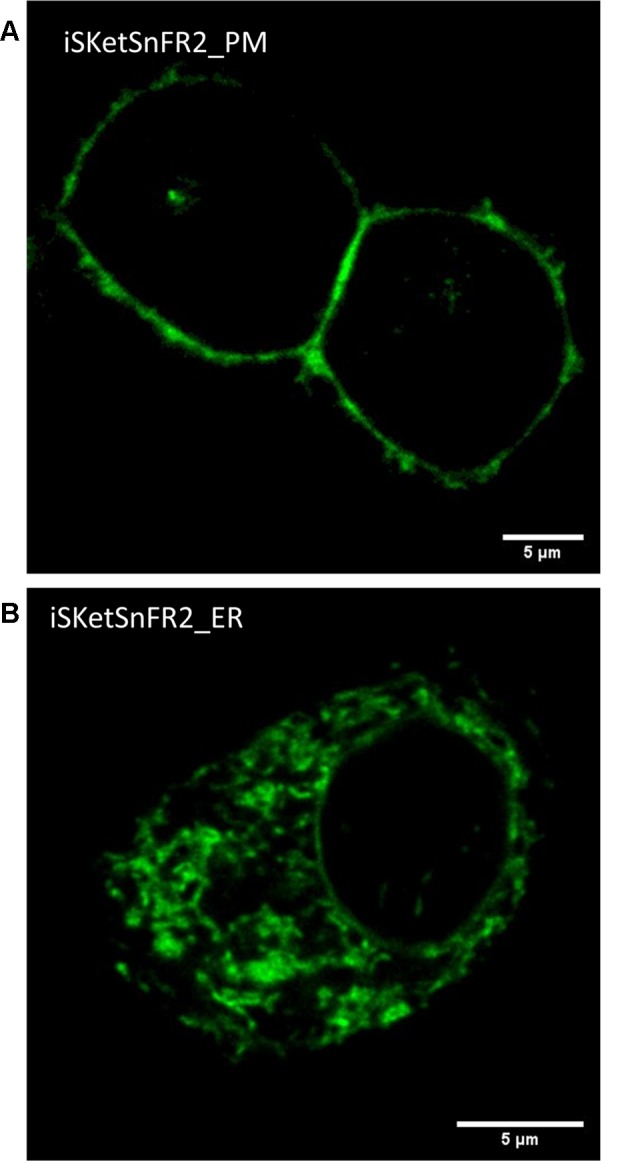
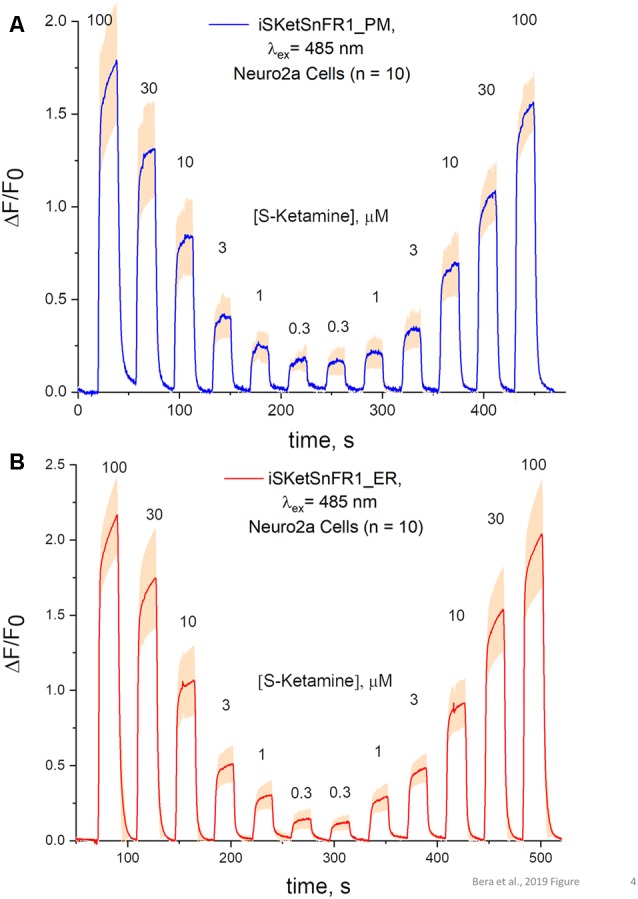
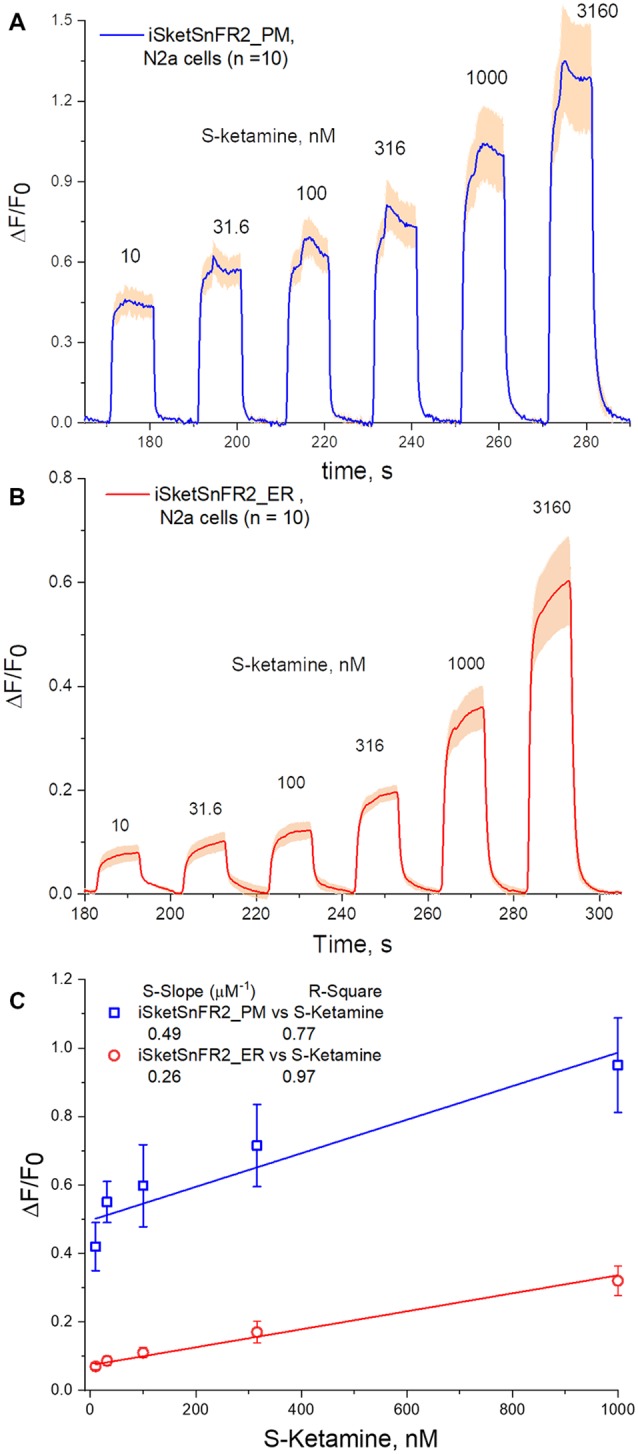
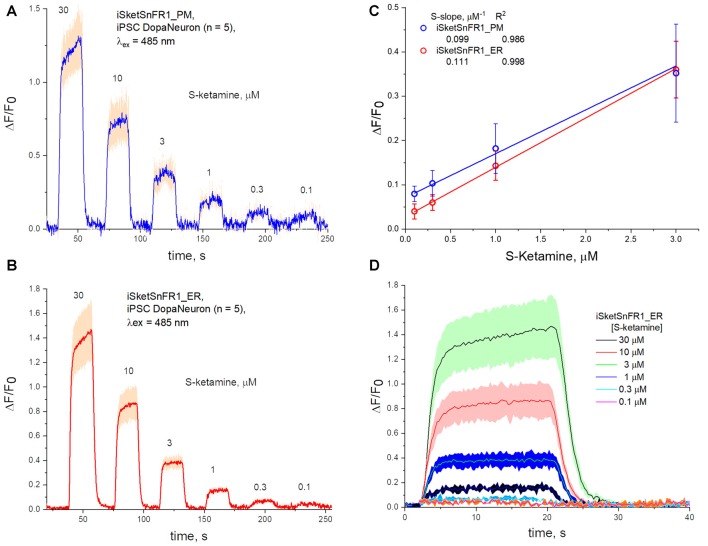
The target for the "rapid" (<24 h) antidepressant effects of S-ketamine is unknown, vitiating programs to rationally develop more effective rapid antidepressants. To describe a drug's target, one must first understand the compartments entered by the drug, at all levels-the organ, the cell, and the organelle. We have, therefore, developed molecular tools to measure the subcellular, organellar pharmacokinetics of S-ketamine. The tools are genetically encoded intensity-based S-ketamine-sensing fluorescent reporters, iSKetSnFR1 and iSKetSnFR2. In solution, these biosensors respond to S-ketamine with a sensitivity, S-slope = delta(F/F)/(delta[S-ketamine]) of 0.23 and 1.9/μM, respectively. The iSKetSnFR2 construct allows measurements at <0.3 μM S-ketamine. The iSKetSnFR1 and iSKetSnFR2 biosensors display >100-fold selectivity over other ligands tested, including R-ketamine. We targeted each of the sensors to either the plasma membrane (PM) or the endoplasmic reticulum (ER). Measurements on these biosensors expressed in Neuro2a cells and in human dopaminergic neurons differentiated from induced pluripotent stem cells (iPSCs) show that S-ketamine enters the ER within a few seconds after appearing in the external solution near the PM, then leaves as rapidly after S-ketamine is removed from the extracellular solution. In cells, S-slopes for the ER and PM-targeted sensors differ by <2-fold, indicating that the ER [S-ketamine] is less than 2-fold different from the extracellular [S-ketamine]. Organelles represent potential compartments for the engagement of S-ketamine with its antidepressant target, and potential S-ketamine targets include organellar ion channels, receptors, and transporters.
S-氯胺酮“快速”(<24小时)抗抑郁作用的靶点尚不清楚,这使得合理开发更有效的快速抗抑郁药物的计划受到影响。要描述一种药物的靶点,首先必须了解药物进入的各个层次的区室——器官、细胞和细胞器。因此,我们开发了分子工具来测量S-氯胺酮的亚细胞、细胞器药代动力学。这些工具是基于强度的基因编码S-氯胺酮传感荧光报告基因,iSKetSnFR1和iSKetSnFR2。在溶液中,这些生物传感器对S-氯胺酮的响应灵敏度分别为S斜率=δ(F/F)/δ[S-氯胺酮]=0.23和1.9/μM。iSKetSnFR2构建体允许在<0.3μM S-氯胺酮浓度下进行测量。iSKetSnFR1和iSKetSnFR2生物传感器对包括R-氯胺酮在内的其他测试配体具有超过100倍的选择性。我们将每个传感器靶向质膜(PM)或内质网(ER)。对在Neuro2a细胞和从诱导多能干细胞(iPSC)分化而来的人多巴胺能神经元中表达的这些生物传感器的测量表明,S-氯胺酮在出现在质膜附近的外部溶液中几秒钟内就进入内质网,然后在从细胞外溶液中去除S-氯胺酮后同样迅速离开。在细胞中,内质网和质膜靶向传感器的S斜率差异小于2倍,表明内质网中的[S-氯胺酮]与细胞外[S-氯胺酮]的差异小于2倍。细胞器是S-氯胺酮与其抗抑郁靶点结合的潜在区室,潜在的S-氯胺酮靶点包括细胞器离子通道、受体和转运体。