Mughini-Gras Lapo, Kooh Pauline, Fravalo Philippe, Augustin Jean-Christophe, Guillier Laurent, David Julie, Thébault Anne, Carlin Frederic, Leclercq Alexandre, Jourdan-Da-Silva Nathalie, Pavio Nicole, Villena Isabelle, Sanaa Moez, Watier Laurence
Centre for Infectious Disease Control, National Institute for Public Health and the Environment, Bilthoven, Netherlands.
Faculty of Veterinary Medicine, Institute for Risk Assessment Sciences, Utrecht University, Utrecht, Netherlands.
Front Microbiol. 2019 Nov 12;10:2578. doi: 10.3389/fmicb.2019.02578. eCollection 2019.
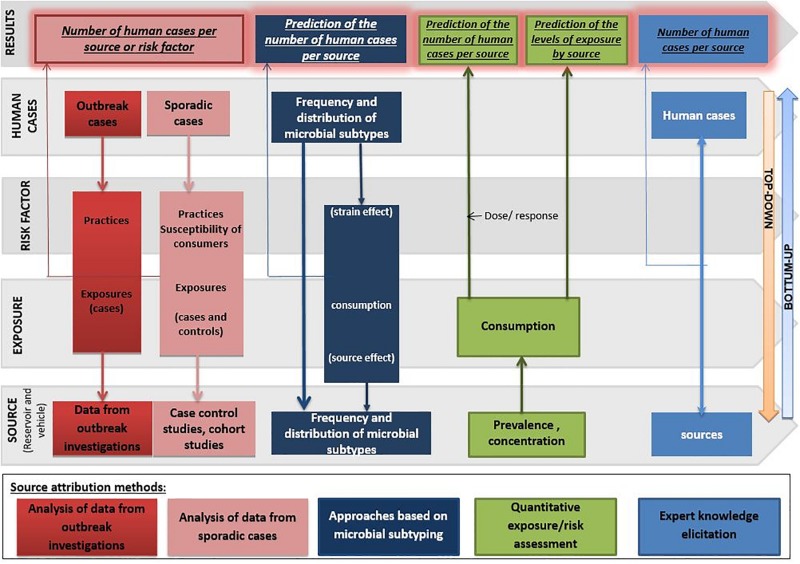
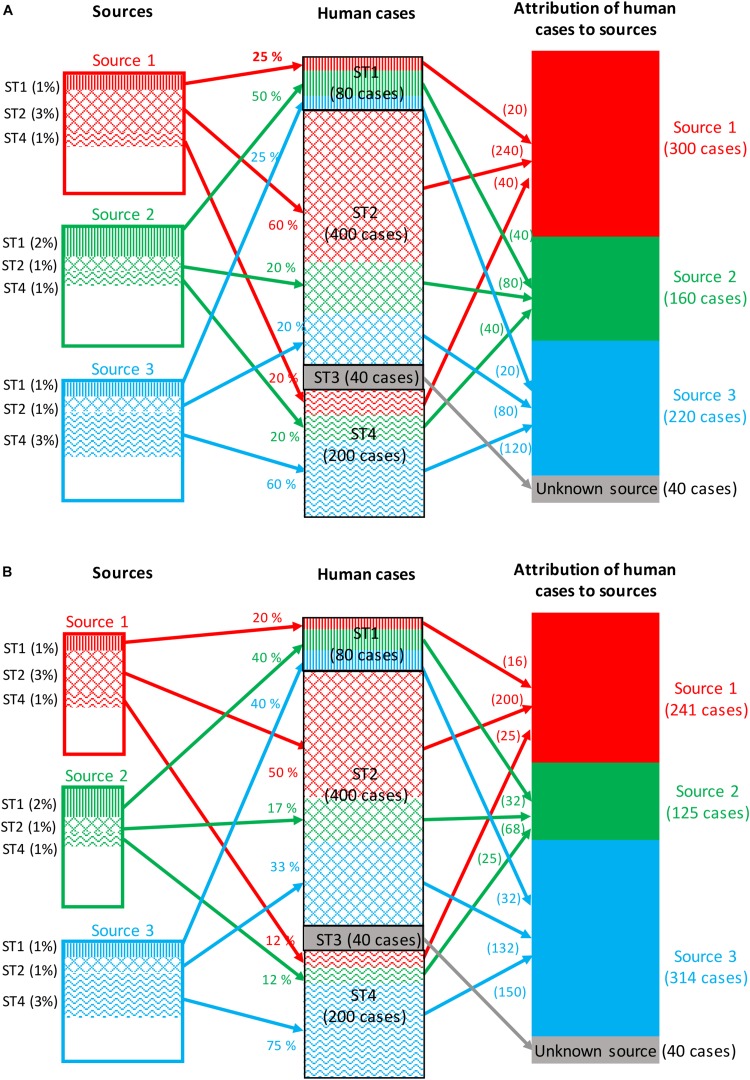
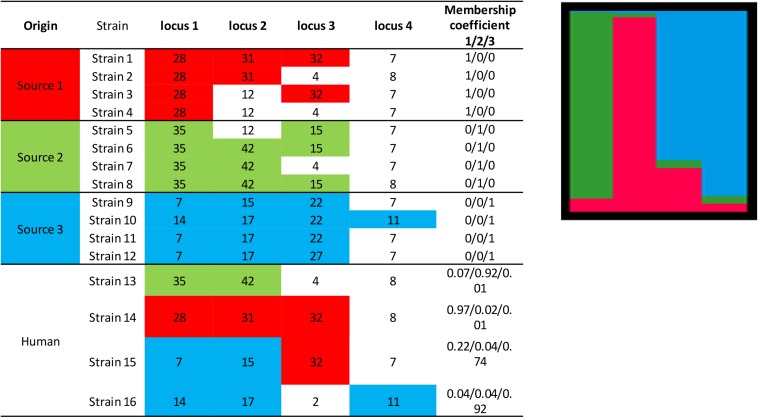
With increased interest in source attribution of foodborne pathogens, there is a need to sort and assess the applicability of currently available methods. Herewith we reviewed the most frequently applied methods for source attribution of foodborne diseases, discussing their main strengths and weaknesses to be considered when choosing the most appropriate methods based on the type, quality, and quantity of data available, the research questions to be addressed, and the (epidemiological and microbiological) characteristics of the pathogens in question. A variety of source attribution approaches have been applied in recent years. These methods can be defined as top-down, bottom-up, or combined. Top-down approaches assign the human cases back to their sources of infection based on epidemiological (e.g., outbreak data analysis, case-control/cohort studies, etc.), microbiological (i.e., microbial subtyping), or combined (e.g., the so-called 'source-assigned case-control study' design) methods. Methods based on microbial subtyping are further differentiable according to the modeling framework adopted as frequency-matching (e.g., the Dutch and Danish models) or population genetics (e.g., Asymmetric Island Models and STRUCTURE) models, relying on the modeling of either phenotyping or genotyping data of pathogen strains from human cases and putative sources. Conversely, bottom-up approaches like comparative exposure assessment start from the level of contamination (prevalence and concentration) of a given pathogen in each source, and then go upwards in the transmission chain incorporating factors related to human exposure to these sources and dose-response relationships. Other approaches are intervention studies, including 'natural experiments,' and expert elicitations. A number of methodological challenges concerning all these approaches are discussed. In absence of an universally agreed upon 'gold' standard, i.e., a single method that satisfies all situations and needs for all pathogens, combining different approaches or applying them in a comparative fashion seems to be a promising way forward.
随着对食源性病原体来源归因的关注度不断提高,有必要对当前可用方法的适用性进行分类和评估。在此,我们回顾了食源性疾病来源归因最常用的方法,讨论了在根据现有数据的类型、质量和数量、要解决的研究问题以及相关病原体的(流行病学和微生物学)特征选择最合适的方法时应考虑的主要优点和缺点。近年来应用了多种来源归因方法。这些方法可分为自上而下、自下而上或综合方法。自上而下的方法基于流行病学(如疫情数据分析、病例对照/队列研究等)、微生物学(即微生物分型)或综合(如所谓的“来源指定病例对照研究”设计)方法,将人类病例追溯到其感染源。基于微生物分型的方法根据所采用的建模框架进一步区分,如频率匹配(如荷兰和丹麦模型)或群体遗传学(如非对称岛屿模型和STRUCTURE)模型,这些模型依赖于对人类病例和假定来源的病原体菌株的表型或基因分型数据进行建模。相反,自下而上的方法如比较暴露评估从每种来源中给定病原体的污染水平(流行率和浓度)开始,然后在传播链中向上追溯,纳入与人类接触这些来源相关的因素和剂量反应关系。其他方法包括干预研究,包括“自然实验”和专家意见征集。讨论了与所有这些方法相关的一些方法学挑战。由于缺乏普遍认可的“金标准”,即一种能满足所有病原体所有情况和需求的单一方法,结合不同方法或以比较方式应用它们似乎是一条有前途的前进道路。