Department of Surgery, Keio University School of Medicine, Tokyo, Japan.
Endowed Research Chair in Molecular Targeted Therapy of Gastrointestinal Cancer, Keio University School of Medicine, Tokyo, Japan.
Cancer Sci. 2020 Feb;111(2):739-748. doi: 10.1111/cas.14268. Epub 2020 Jan 15.
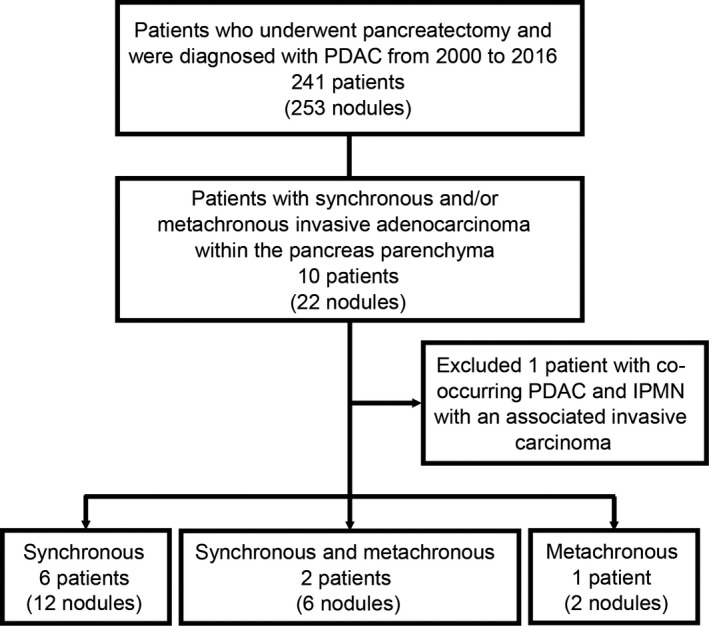
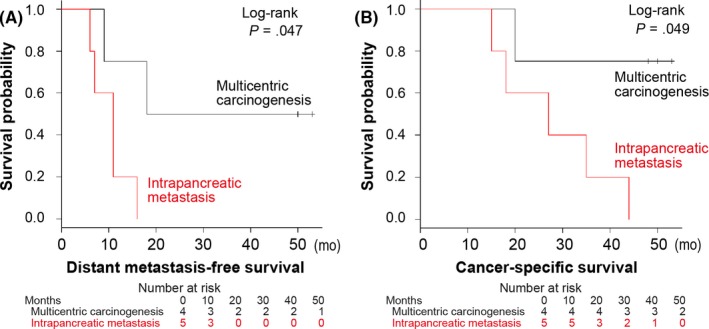
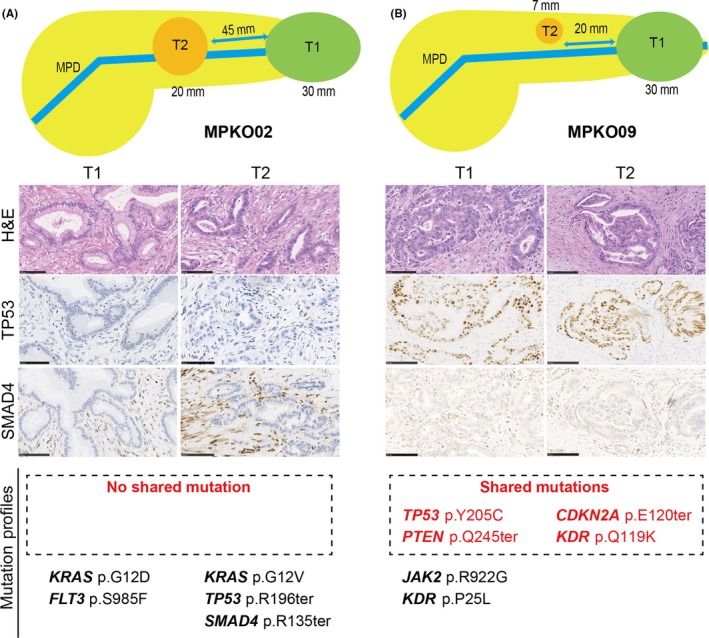
There are increased opportunities in oncology clinics to identify multiple pancreatic ductal adenocarcinomas (PDAC) that co-occur simultaneously or arise metachronously in the pancreatic parenchyma, yet their pathogenesis remains elusive. We hypothesized that two potential pathways, multicentric carcinogenesis and intrapancreatic metastasis, might contribute to forming multiple PDAC. Among 241 resected cases, we identified 20 cancer nodules from nine patients with multiple PDAC (six with synchronous PDAC, one with metachronous PDAC, and two with both synchronous and metachronous PDAC). Integrated clinical, pathological, and mutational analyses, using TP53 and SMAD4 immunostaining and targeted next-generation sequencing of 50 cancer-related genes, were conducted to examine the intertumor relationships. Four of the nine patients were assessed as having undergone multicentric carcinogenesis because of heterogeneity of immunohistochemical and/or mutation characteristics. In contrast, tumors in the other five patients showed intertumor molecular relatedness. Two of these five patients, available for matched sequencing data, showed two or more shared mutations. Moreover, all the smaller nodules in these five patients showed identical TP53 and SMAD4 expression patterns to the corresponding main tumors. Consequently, these five patients were considered to have undergone intrapancreatic metastasis. None of the five smaller nodules arising from intrapancreatic metastasis was accompanied by pancreatic intraepithelial neoplasia, and three of them were tiny (≤1mm). Patients whose tumors resulted from intrapancreatic metastasis appeared to have higher disease stages and worse outcome than those with tumors from multicentric carcinogenesis. Our results provide insight into pancreatic carcinogenesis, showing that the development of multiple PDAC involves distinct evolutionary paths that potentially affect patient prognosis.
在肿瘤学临床中,有越来越多的机会识别同时或相继出现在胰腺实质中的多个胰腺导管腺癌(PDAC),但其发病机制仍难以捉摸。我们假设两种潜在的途径,多中心发生和胰腺内转移,可能有助于形成多个 PDAC。在 241 例切除病例中,我们从 9 例多发性 PDAC 患者中鉴定出 20 个癌结节(6 例同时性 PDAC,1 例异时性 PDAC,2 例同时性和异时性 PDAC)。对这些肿瘤进行了综合的临床、病理和突变分析,包括 TP53 和 SMAD4 免疫组化染色以及对 50 个与癌症相关的基因进行靶向下一代测序,以检查肿瘤间的关系。由于免疫组化和/或突变特征的异质性,9 例患者中的 4 例被评估为多中心发生。相比之下,其他 5 例患者的肿瘤显示出肿瘤间分子相关性。这 5 例患者中有 2 例可进行匹配测序数据,显示有两个或更多共享突变。此外,这 5 例患者中的所有较小结节均与相应的主肿瘤具有相同的 TP53 和 SMAD4 表达模式。因此,这 5 例患者被认为发生了胰腺内转移。这些患者中没有一个较小的结节是由胰腺上皮内瘤变引起的,其中 3 个结节非常小(≤1mm)。发生胰腺内转移的患者的疾病分期似乎比多中心发生的患者更高,预后也更差。我们的结果提供了对胰腺发生的深入了解,表明多个 PDAC 的发展涉及不同的进化途径,这可能影响患者的预后。