Xie Jingjing, Li Bo, Yao Bing, Zhang Pingchao, Wang Lixin, Lu Hua, Song Xuan
Department of Orthopedic Surgery, Xinhua Hospital Affiliated to Shanghai Jiao Tong University School of Medicine, Chongming Branch, Shanghai 202150, China.
Biosci Rep. 2020 Feb 28;40(2). doi: 10.1042/BSR20191726.
During disc degeneration, inflammatory cytokine tumor necrosis factor (TNF)-α is correlated with nucleus pulposus (NP) cell apoptosis. Transforming growth factor (TGF)-β1 has the potential to regenerate degenerative disc.
To investigate the protective role of TGF-β1 against TNF-α-mediated NP cell apoptosis and the underlying mechanism.
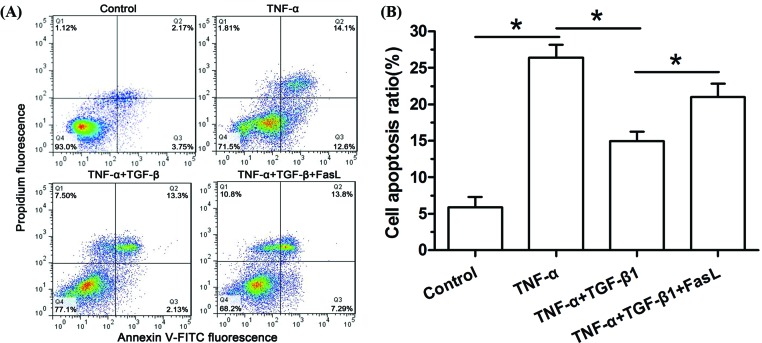
Rat NP cells were treated with TNF-α (100 ng/ml) for 48 h. TGF-β1 was added into the culture medium to investigate its protective effects against TNF-α-induced NP cell apoptosis. Exogenous FasL was used to investigate the potential role of the Fas/FasL pathway in this process. Flow cytometry assay was used to analyze NP cell apoptosis. Real-time PCR and Western blotting were used to analyze gene and protein expression of apoptosis-related molecules.
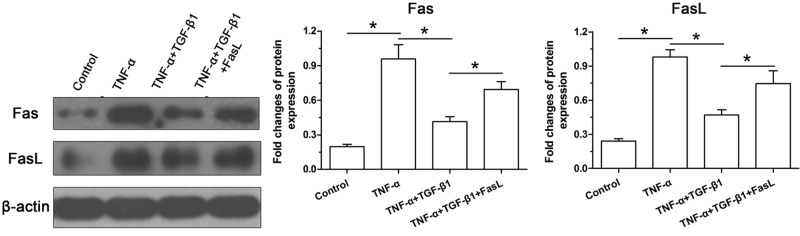
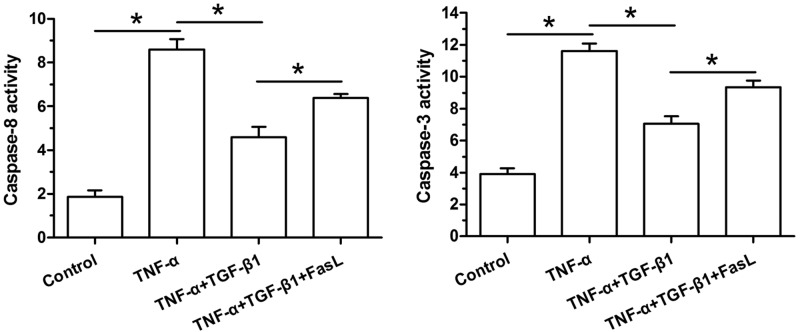
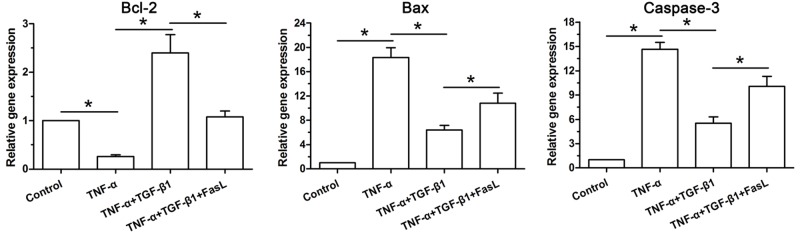
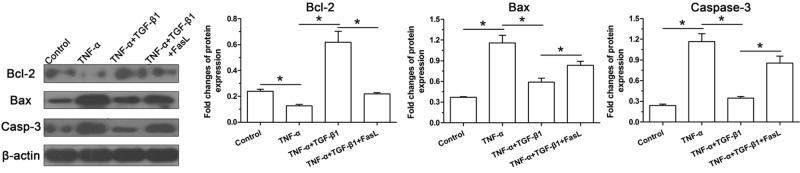
In TNF-α-treated NP cells, TGF-β1 significantly decreased NP cell apoptosis, declined caspase-3 and -8 activity, and decreased expression of Bax and caspase-3 (cleaved-caspase-3) but increased expression of Bcl-2. However, exogenous FasL partly reversed these effects of TGF-β1 in NP cells treated with TNF-α. Additionally, expression of Fas and FasL in TNF-α-treated NP cells partly decreased by TGF-β1, whereas exogenous FasL increased expression of Fas and FasL in NP cells treated with TGF-β1 and TNF-α.
TGF-β1 helps to inhibit TNF-α-induced NP cell apoptosis and the Fas/FasL pathway may be involved in this process. The present study suggests that TGF-β1 may be effective to retard inflammation-mediated disc degeneration.
在椎间盘退变过程中,炎性细胞因子肿瘤坏死因子(TNF)-α与髓核(NP)细胞凋亡相关。转化生长因子(TGF)-β1具有使退变椎间盘再生的潜力。
探讨TGF-β1对TNF-α介导的NP细胞凋亡的保护作用及其潜在机制。
将大鼠NP细胞用TNF-α(100 ng/ml)处理48小时。在培养基中加入TGF-β1以研究其对TNF-α诱导的NP细胞凋亡的保护作用。使用外源性FasL研究Fas/FasL途径在此过程中的潜在作用。采用流式细胞术分析NP细胞凋亡。采用实时PCR和蛋白质印迹法分析凋亡相关分子的基因和蛋白表达。
在TNF-α处理的NP细胞中,TGF-β1显著降低NP细胞凋亡,降低半胱天冬酶-3和-8活性,降低Bax和半胱天冬酶-3(裂解的半胱天冬酶-3)的表达,但增加Bcl-2的表达。然而,外源性FasL部分逆转了TGF-β1在TNF-α处理的NP细胞中的这些作用。此外,TGF-β1部分降低了TNF-α处理的NP细胞中Fas和FasL的表达,而外源性FasL增加了TGF-β1和TNF-α处理的NP细胞中Fas和FasL的表达。
TGF-β1有助于抑制TNF-α诱导的NP细胞凋亡,Fas/FasL途径可能参与此过程。本研究表明,TGF-β1可能有效延缓炎症介导的椎间盘退变。