
B19V 在甲状腺疾病患者中的存在。
Presence of B19V in Patients with Thyroid Gland Disorders.
机构信息
Institute of Microbiology and Virology, Rīga Stradiņš University, 5 Ratsupites St., LV-1067 Riga, Latvia.
Department of Surgery, Riga East Clinical University Hospital "Gailezers", 2 Hipokrata St., LV-1039 Riga, Latvia.
出版信息
Medicina (Kaunas). 2019 Dec 4;55(12):774. doi: 10.3390/medicina55120774.
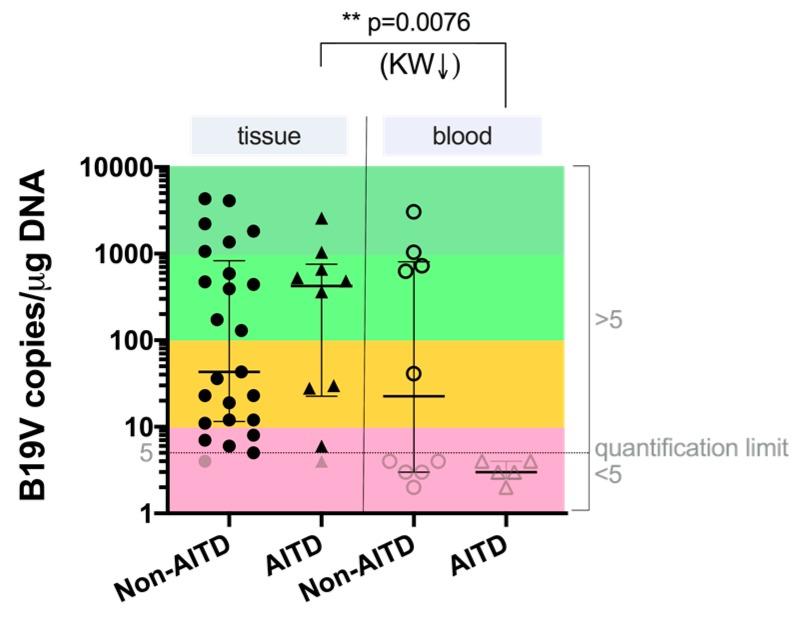
Viral infections are frequently cited as a major environmental factor implicated in thyroid gland diseases. This work aimed to estimate the presence of B19V infection in patients with thyroid gland disorders. Thyroid gland tissue and blood samples of 50 patients with autoimmune thyroid gland diseases (AITDs), 76 patients with non-autoimmune thyroid gland diseases (non-AITDs), and 35 deceased subjects whose histories did not show any autoimmune or thyroid diseases (control group) were enrolled in the study. Virus-specific IgM and IgG were detected using ELISA, and the presence and viral load of B19V in the tissue and blood were detected using PCRs. B19V IgG antibodies were detected in 35/50 AITDs patients and in 51/76 non-AITDs patients, and B19V IgM antibodies were detected in 1/50 patients with AITDs and in none of the 76 patients with non-AITDs. The B19V NS sequence was found in the tissue DNA of 10/50 patients with AITDs, in 30/76 with non-AITDs, and in 1/35 control group individuals. The median B19V load in the tissue of patients with AITDs and non-AITDs was 423.00 copies/µg DNA (IQR: 22.50-756.8) and 43.00 copies/µg DNA (IQR: 11.50-826.5), respectively. The viral load in one of the 35 nPCR B19V-positive thyroid tissue samples from the deceased subjects was 13.82 copies/µg DNA. The viral load in the tissue of patients with AITDs was higher than in whole blood, which possibly indicates B19V persistency in thyrocytes ( = 0.0076). The fact that the genoprevalence of B19V NS was significantly higher in patients with non-AITDs compared to the control group and in the thyroid gland tissue of patients with AITDs, and that the non-AITDs viral load was higher than in tissue derived from the control group individuals, suggest the possibility that B19V infection could be involved in the development of thyroid gland diseases.
病毒感染常被认为是甲状腺疾病的一个主要环境因素。本研究旨在评估 B19V 感染在甲状腺疾病患者中的存在情况。研究纳入了 50 例自身免疫性甲状腺疾病(AITD)患者、76 例非自身免疫性甲状腺疾病(非 AITD)患者和 35 例无自身免疫或甲状腺疾病病史的已故患者的甲状腺组织和血液样本。采用 ELISA 检测病毒特异性 IgM 和 IgG,采用 PCR 检测组织和血液中 B19V 的存在和病毒载量。在 35/50 例 AITD 患者和 51/76 例非 AITD 患者中检测到 B19V IgG 抗体,在 1/50 例 AITD 患者和 76 例非 AITD 患者中均未检测到 B19V IgM 抗体。在 10/50 例 AITD 患者、30/76 例非 AITD 患者和 1/35 例对照组个体的组织 DNA 中发现了 B19V NS 序列。AITD 和非 AITD 患者组织中 B19V 的中位病毒载量分别为 423.00 拷贝/μg DNA(IQR:22.50-756.8)和 43.00 拷贝/μg DNA(IQR:11.50-826.5)。35 例已故患者的 nPCR B19V 阳性甲状腺组织样本中,有 1 例病毒载量为 13.82 拷贝/μg DNA。AITD 患者组织中的病毒载量高于全血,这可能表明 B19V 在甲状腺细胞中持续存在( = 0.0076)。与对照组相比,非 AITD 患者的 B19V NS 基因阳性率显著更高,且 AITD 患者的甲状腺组织中也存在更高的 B19V 病毒载量,而非 AITD 患者的病毒载量高于对照组个体的组织,这表明 B19V 感染可能与甲状腺疾病的发生有关。

 Zotero 插件