Department of Radiation Oncology, The First Affiliated Hospital of Xi'an Jiao Tong University, 277# West Yanta Road, Xi'an, Shaanxi, China.
Department of Radiation Oncology, Peking Union Medical College Hospital, Chinese Academy of Medical Sciences and Peking Union Medical College, Beijing, 100032, China.
BMC Cancer. 2019 Dec 16;19(1):1219. doi: 10.1186/s12885-019-6423-5.
The posterior-inferior border of symphysis (PIBS) point system is a novel vaginal dose-reporting method and is a simple and reliable method proposed by the Medical University of Vienna proposed for both external-beam radiotherapy (EBRT) and brachytherapy (BT). In this multicenter study, we sought to first evaluate the vaginal radiation dose in Chinese cervical cancer patients according to the PIBS point system and then to analyze the factors influencing the dose distribution.
We collected data from the medical records of 936 cervical cancer patients who underwent concurrent radiochemotherapy at 13 different institutions in China. Radiation doses at points A, PIBS+ 2 cm, PIBS and PIBS-2 cm, International Commission on Radiation Units (ICRU)-R and ICRU-B were measured.
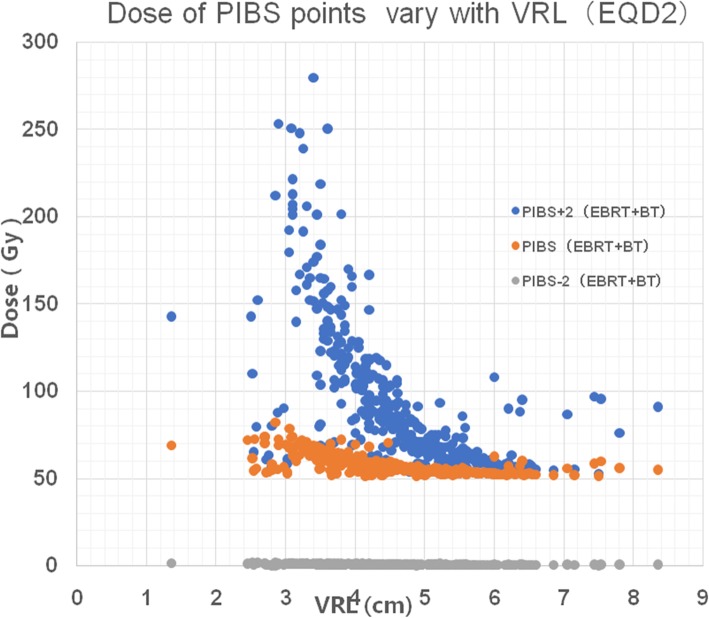
The median total doses in EQD2 at points PIBS+ 2 cm, PIBS and PIBS-2 cm were 82.5 (52.7-392.1) Gy, 56.2 (51.4-82.1) Gy and 2.6 (0.9-7.4) Gy, respectively. The median total doses in EQD2 at ICRU-R and ICRU-B were 77.5 (54.8-132.4) Gy and 79.9 (60.7-133.7) Gy, respectively. The mean vaginal reference length (VRL) was 4.6 ± 1.0 cm (median, 4.5 cm). In patients with VRL ≤4.5 cm, the mean total doses in EQD2 at points PIBS+ 2 cm, PIBS and PIBS-2 cm were 128.5, 60.7 and 0.8 Gy, respectively. In patients with VRL > 4.5 cm, the mean total doses at these three points were 68.9, 0.5 and 54.5 Gy, respectively. Classification of patients revealed significant differences (P < 0.05) between these two groups.
With the PIBS point system, Chinese patients with a shorter VRL of < 4.5 cm received higher radiation doses at the PIBS+ 2 cm, PIBS and PIBS-2 cm points than European and American patients. Further studies are required to establish the dose-effect relationships with these points as references. The study was registered as a clinical trial (NCT03257475) on August 22, 2017.
耻骨联合后下边界(PIBS)点系统是一种新的阴道剂量报告方法,是维也纳医科大学提出的一种简单可靠的方法,适用于外照射放疗(EBRT)和近距离放疗(BT)。在这项多中心研究中,我们首先根据 PIBS 点系统评估中国宫颈癌患者的阴道辐射剂量,然后分析影响剂量分布的因素。
我们收集了 936 名在中国 13 家不同机构接受同期放化疗的宫颈癌患者的病历数据。测量了点 A、PIBS+2cm、PIBS 和 PIBS-2cm、国际辐射单位委员会(ICRU)-R 和 ICRU-B 处的辐射剂量。
PIBS+2cm、PIBS 和 PIBS-2cm 处的中位总剂量(EQD2)分别为 82.5(52.7-392.1)Gy、56.2(51.4-82.1)Gy 和 2.6(0.9-7.4)Gy。ICRU-R 和 ICRU-B 处的中位总剂量(EQD2)分别为 77.5(54.8-132.4)Gy 和 79.9(60.7-133.7)Gy。阴道参考长度(VRL)的平均值为 4.6±1.0cm(中位数,4.5cm)。在 VRL≤4.5cm 的患者中,PIBS+2cm、PIBS 和 PIBS-2cm 处的平均总剂量(EQD2)分别为 128.5、60.7 和 0.8Gy。在 VRL>4.5cm 的患者中,这三点的平均总剂量分别为 68.9、0.5 和 54.5Gy。患者分类显示两组之间存在显著差异(P<0.05)。
使用 PIBS 点系统,VRL<4.5cm 的中国患者在 PIBS+2cm、PIBS 和 PIBS-2cm 点处接受的辐射剂量高于欧美患者。需要进一步研究以建立这些点与剂量-效应关系。该研究于 2017 年 8 月 22 日作为临床试验(NCT03257475)注册。