Delaney Emily K, Hoekstra Hopi E
Department of Organismic & Evolutionary Biology Department of Molecular & Cellular Biology Museum of Comparative Zoology Howard Hughes Medical Institute Cambridge MA USA.
Present address: Department of Evolution and Ecology University of California-Davis Davis CA USA.
Ecol Evol. 2019 Sep 30;9(21):12045-12050. doi: 10.1002/ece3.5630. eCollection 2019 Nov.
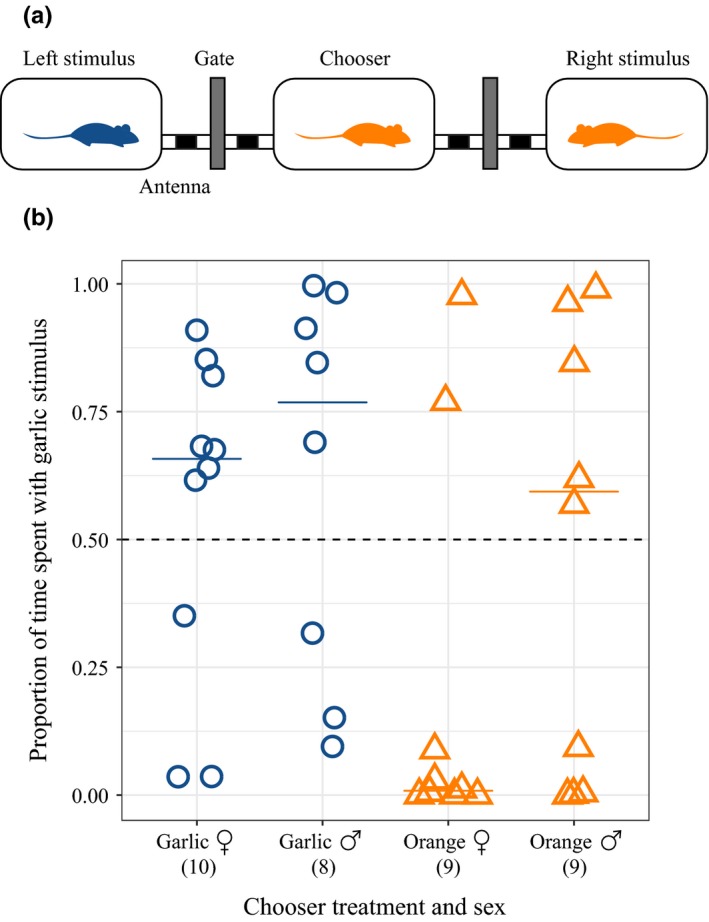
Speciation is facilitated by "magic traits," where divergent natural selection on such traits also results in assortative mating. In animal populations, diet has the potential to act as a magic trait if populations diverge in consumed food that incidentally affects mating and therefore sexual isolation. While diet-based assortative mating has been observed in the laboratory and in natural populations, the mechanisms causing positive diet-based assortment remain largely unknown. Here, we experimentally created divergent diets in a sexually imprinting species of mouse, (the cotton mouse), to test the hypothesis that sexual imprinting on diet could be a mechanism that generates rapid and significant sexual isolation. We provided breeding pairs with novel garlic- or orange-flavored water and assessed whether their offspring, exposed to these flavors in utero and in the nest before weaning, later preferred mates that consumed the same flavored water as their parents. While males showed no preference, females preferred males of their parental diet, which is predicted to yield moderate sexual isolation. Thus, our experiment demonstrates the potential for sexual imprinting on dietary cues learned in utero and/or postnatally to facilitate reproductive isolation and potentially speciation.
This article has earned an Open Data Badge for making publicly available the digitally-shareable data necessary to reproduce the reported results. The data is available at https://doi.org/10.5061/dryad.n1qq6v3.
物种形成由“神奇性状”推动,对这些性状的趋异自然选择也会导致选型交配。在动物种群中,如果种群在消耗的食物上存在差异,而这些差异会偶然影响交配从而导致性隔离,那么饮食就有可能成为一种神奇性状。虽然基于饮食的选型交配在实验室和自然种群中都已被观察到,但导致正向饮食选型的机制在很大程度上仍不为人所知。在这里,我们通过实验在一种具有性印记的小鼠物种(棉鼠)中创造了不同的饮食,以检验以下假设:对饮食的性印记可能是一种产生快速且显著性隔离的机制。我们为繁殖对提供了新奇的大蒜味或橙子味水,并评估它们的后代,即在子宫内和断奶前在巢穴中接触过这些味道的后代,之后是否更倾向于选择饮用与父母相同味道水的配偶。虽然雄性没有表现出偏好,但雌性更倾向于选择与父母饮食相同的雄性,预计这会产生适度的性隔离。因此,我们的实验证明了在子宫内和/或出生后学到的饮食线索上进行性印记,有促进生殖隔离并可能导致物种形成的潜力。
本文因公开提供了重现报告结果所需的可数字共享数据而获得开放数据徽章。数据可在https://doi.org/10.5061/dryad.n1qq6v3获取。