Amavizca-Nazar Alejandra, Montalvo-Corral Maricela, González-Rios Humberto, Pinelli-Saavedra Araceli
Department of Nutrition and Metabolism, Centro de Investigación en Alimentación y Desarrollo, A.C. (CIAD), Sonora 83304, México.
Department of Science of Animal Technology, Centro de Investigación en Alimentación y Desarrollo, A.C. (CIAD), Sonora 83304, México.
J Anim Sci Technol. 2019 Nov;61(6):340-351. doi: 10.5187/jast.2019.61.6.340. Epub 2019 Nov 30.
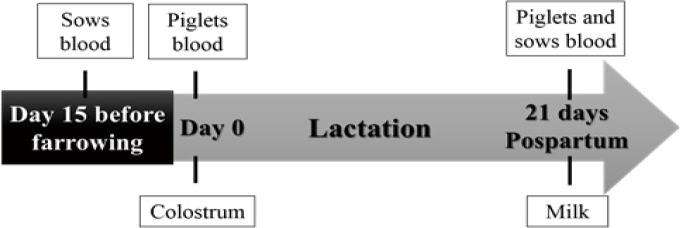
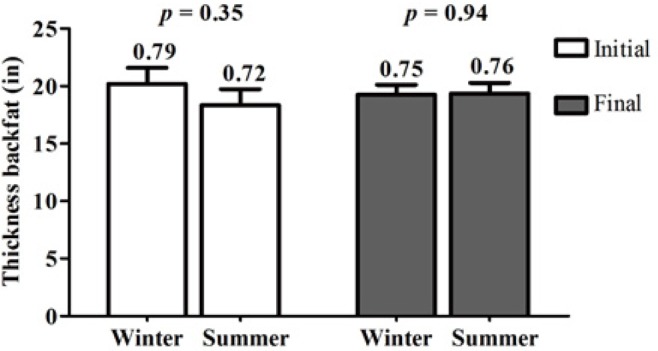
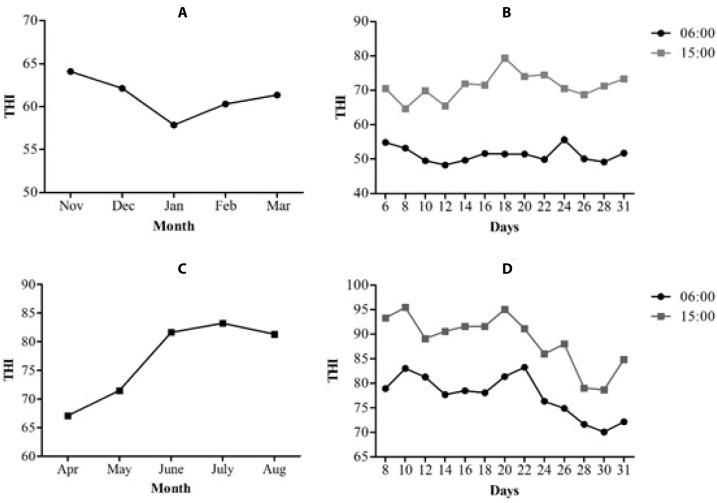
Hot environments can affect feed intake and lactation, and the subsequent unavailability of important micronutrients to the newborn piglet can impair piglet growth, reduce the viability of newborn piglets and limit their subsequent performance. This work addresses the effects of hot environments (summer season) upon the reproductive performance of sows during gestation and lactation as well as on the serum levels of vitamins and the concentration of immunoglobulins in their litters in comparison with the winter season. Fourteen sows were evaluated over 100 ± 2 days of gestation in each season. The temperature and humidity index (THI) was used as an indirect measure of heat stress during gestation. The reproductive performance, milk yield, and body condition of the sows were recorded. The concentrations of vitamin E and vitamin A in piglets and in sow serum, colostrum, milk and feed were determined by HPLC; immunoglobulins were assessed by an ELISA. The THI index indicated that animals were subject to heat stress only in during the summer. Although the effect was not significant, there were a lower number of piglets at birth and at weaning and the milk yield in summer compared with winter. There was no difference ( > 0.05) in the body condition of sows between seasons. Season had an effect ( < 0.05) on the vitamin A concentration of postpartum sow serum (0.29 μg/mL in winter vs 0.21 μg/mL in summer) and on the vitamin E concentration before birth (2.00 μg/mL in winter vs 0.90 μg/mL in summer). Vitamin E in milk was higher ( < 0.05) in winter than in summer (2.23 vs 1.81 μg/mL). Serum levels of vitamins A and E in piglets at birth were lower ( < 0.05) in winter than in summer. The concentrations of immunoglobulins (IgG and IgA) in colostrum and milk were similar between seasons ( > 0.05), but the IgA in piglet serum was higher in winter than in summer ( < 0.05). High temperatures produced heat stress in sows, which affected certain aspects of production that can be translated into economic losses for this sector.
炎热环境会影响采食量和泌乳,随后新生仔猪无法获得重要的微量营养素会损害仔猪生长,降低新生仔猪的存活率并限制其后续性能。本研究探讨炎热环境(夏季)对母猪妊娠和泌乳期间繁殖性能的影响,以及与冬季相比,对母猪血清维生素水平及其仔猪窝中免疫球蛋白浓度的影响。在每个季节对14头母猪进行为期100±2天的妊娠评估。温度湿度指数(THI)用作妊娠期间热应激的间接指标。记录母猪的繁殖性能、产奶量和体况。通过高效液相色谱法测定仔猪和母猪血清、初乳、乳汁和饲料中维生素E和维生素A的浓度;通过酶联免疫吸附测定法评估免疫球蛋白。THI指数表明动物仅在夏季受到热应激。尽管影响不显著,但与冬季相比,夏季出生和断奶时的仔猪数量较少,产奶量也较低。不同季节母猪的体况没有差异(>0.05)。季节对产后母猪血清维生素A浓度(冬季为0.29μg/mL,夏季为0.21μg/mL)和产前维生素E浓度(冬季为2.00μg/mL,夏季为0.90μg/mL)有影响(<0.05)。冬季乳汁中的维生素E含量高于夏季(<0.05)(2.23对1.81μg/mL)。冬季出生仔猪血清中维生素A和E的水平低于夏季(<0.05)。初乳和乳汁中免疫球蛋白(IgG和IgA)的浓度在不同季节相似(>0.05),但冬季仔猪血清中的IgA高于夏季(<0.05)。高温会使母猪产生热应激,影响生产的某些方面,这可能会给该行业带来经济损失。