Sendanayake Sukhi V, Thambiratnam David P, Perera Nimal, Chan Tommy, Aghdamy Sanam
School of Civil Engineering & Built Environment, Science and Engineering Faculty, Queensland University of Technology, Brisbane, Australia.
Heliyon. 2019 Nov 14;5(11):e02751. doi: 10.1016/j.heliyon.2019.e02751. eCollection 2019 Nov.
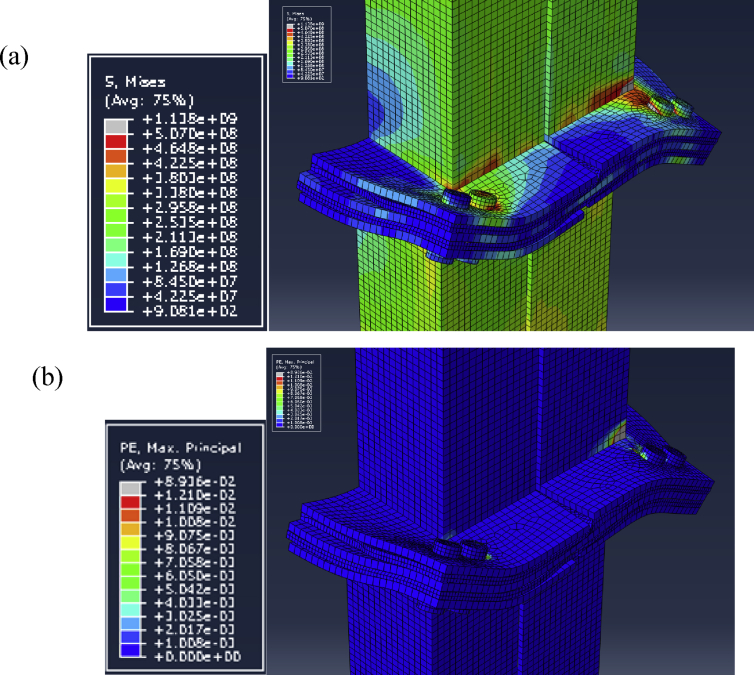
Steel modular building structures are being increasingly adopted for a variety of building applications since their method of construction, despite being relatively new, offers many benefits over conventional constructional methods. Even though their behaviour under gravity (dead and live) loads is generally well understood, their response to lateral dynamic loads such as seismic and wind loads, is relatively less known. Due to their unique structural detailing, their structural response and failure patterns under lateral dynamic loading can vary considerably from that exhibited by conventional structures. Limited research has shown that under lateral loadings, modular structures tend to fail at the columns which are critical members whose failure can lead to partial or total collapse of the structure. This paper aims to mitigate this by shifting the failure away from the columns to inter-modular connections which can be allowed to deform in a ductile manner. Towards this end, this paper proposes two innovative inter-modular connections and investigates their performance under monotonic and cyclic lateral loading using comprehensive validated numerical techniques. The proposed connections have an additional steel plate and resilient layers to provide increased ductility and dissipation of seismic energy with desired ductile failure mechanisms. Three-dimensional numerical models of the proposed connections are developed in ABAQUS software considering geometric and material nonlinearities, as well as contact formulations to accurately capture their response to the lateral loads and failure propagations. The numerical model is verified based on experimental results in the literature and used for extensive parametric studies. Seismic reliance of the proposed connections in terms of ductility, failure patterns, and energy absorption are compared with those of a standard inter-modular connection currently used in modular buildings. The outcome of this study demonstrates that the proposed connections have superior dynamic performances compared to the standard inter-modular connections in use today. New information generated through this study will enable to improve life safety and dynamic performance of modular building structures under typical gravity loads as well as under seismic loading.
钢模块化建筑结构因其施工方法尽管相对较新,但与传统施工方法相比具有许多优势,正越来越多地被应用于各种建筑领域。尽管它们在重力(恒载和活载)作用下的性能通常已被充分了解,但它们对横向动态荷载(如地震和风荷载)的响应相对较少为人所知。由于其独特的结构细节,它们在横向动态荷载作用下的结构响应和破坏模式可能与传统结构有很大不同。有限的研究表明,在横向荷载作用下,模块化结构往往在柱中失效,而柱是关键构件,其失效可能导致结构部分或全部倒塌。本文旨在通过将破坏从柱转移到模块化连接来减轻这种情况,模块化连接可以以延性方式变形。为此,本文提出了两种创新的模块化连接,并使用经过全面验证的数值技术研究它们在单调和循环横向荷载作用下的性能。所提出的连接有一个额外的钢板和弹性层,以提供更高的延性和地震能量耗散,并具有所需的延性破坏机制。考虑几何和材料非线性以及接触公式,在ABAQUS软件中开发了所提出连接的三维数值模型,以准确捕捉它们对横向荷载的响应和破坏传播。基于文献中的实验结果对数值模型进行了验证,并用于广泛地参数研究。将所提出连接在延性、破坏模式和能量吸收方面的抗震性能与目前模块化建筑中使用的标准模块化连接进行了比较。这项研究的结果表明,与目前使用的标准模块化连接相比,所提出的连接具有优越的动态性能。通过这项研究产生的新信息将有助于提高模块化建筑结构在典型重力荷载以及地震荷载作用下的生命安全和动态性能。