Department of Gastrointestinal Surgery, the Fourth Affiliated Hospital of China Medical University, Shenyang 110032, Liaoning Province, China.
World J Gastroenterol. 2019 Dec 14;25(46):6713-6727. doi: 10.3748/wjg.v25.i46.6713.
Aberrant methylation in DNA regulatory regions could downregulate tumor suppressor genes without changing the sequences. However, our knowledge of secreted protein acidic and rich in cysteine (SPARC) and its aberrant methylation in gastric cancer (GC) is still inadequate. In the present research, we performed fundamental research to clarify the precise function of methylation on SPARC and its significance in GC.
To investigate promoter methylation and the effects of the gene in GC cells and tissues and to evaluate its clinical significance.
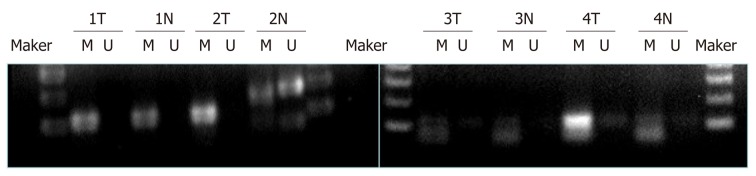
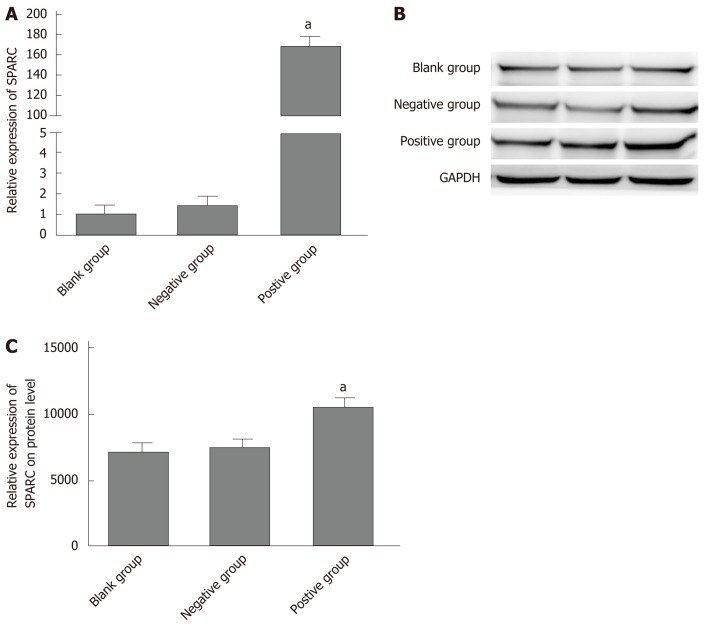
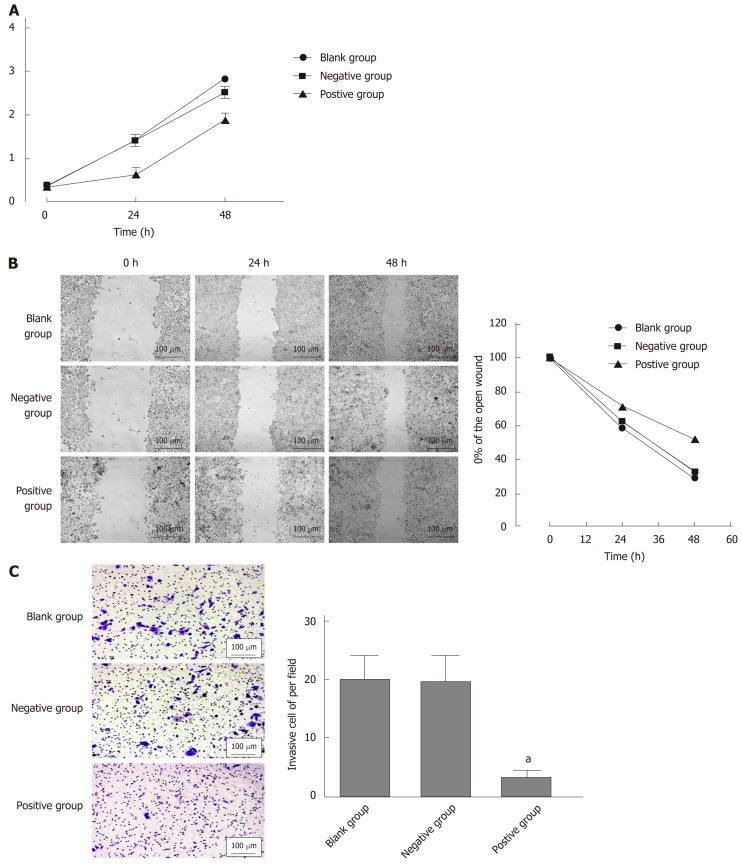
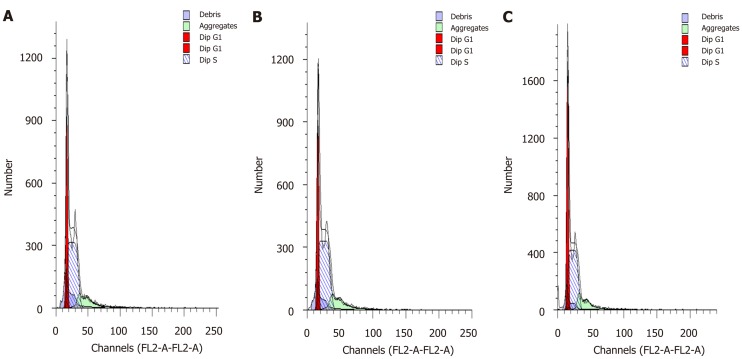
Plasmids that overexpressed the gene were transfected into human GC BGC-823 cells; non-transfected cells were used as a control group (NC group). Quantitative real-time polymerase chain reaction and western blotting (WB) were then used to detect the expression of SPARC. Methylation-specific polymerase chain reaction was executed to analyze the gene promoter methylation status. Cell viability was measured by the cell counting kit-8 assay. The migration and invasion ability of cells were detected by scratch assays and transwell chamber assays, respectively. Cell cycle events and apoptosis were observed with a flow cytometer.
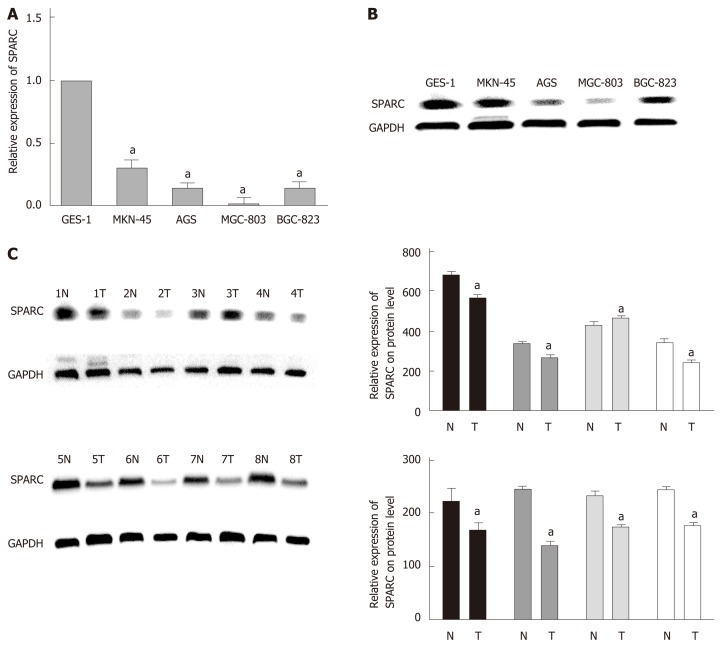
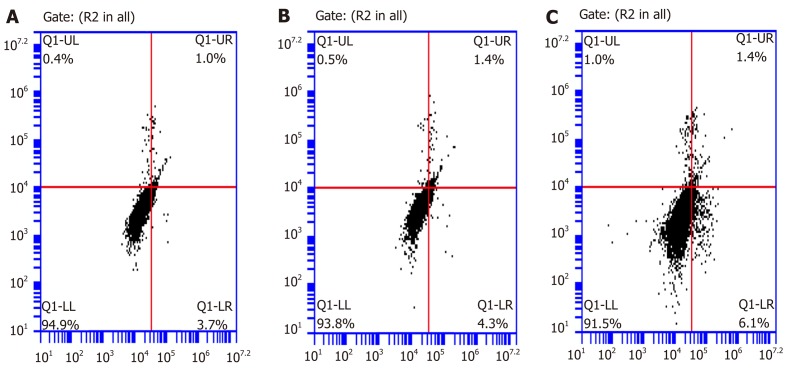
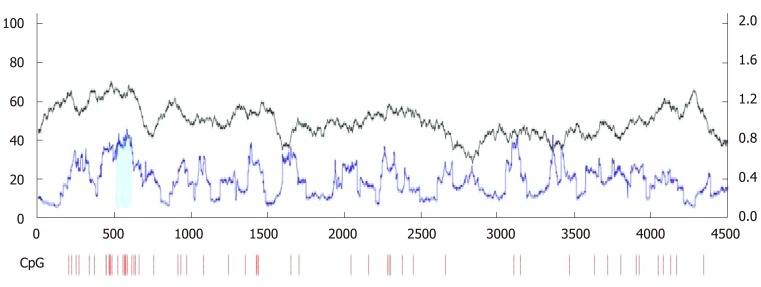
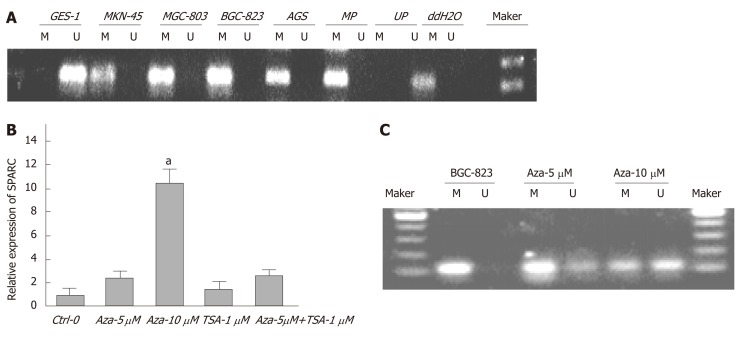
The expression of SPARC mRNA in GC tissues and cells was significantly lower and showed differing degrees of hypermethylation, respectively, than that in normal adjacent tissues and control cells. Treatment with 5-Aza-2'-deoxycytidine (5-Aza-Cdr) was able to restore the expression of SPARC and reverse promoter hypermethylation. Overexpression of the gene significantly inhibited proliferation, migration, and invasion of GC cells, while also causing cell cycle arrest and apoptosis; the NC group exhibited the opposite effects.
This study demonstrated that SPARC could function as a tumor suppressor and might be silenced by promoter hypermethylation. Furthermore, in GC cells, SPARC inhibited migration, invasion, and proliferation, caused cell cycle arrest at the G/G phase, and promoted apoptosis.
DNA 调控区域的异常甲基化可能会下调肿瘤抑制基因,而不会改变其序列。然而,我们对分泌型酸性富含半胱氨酸蛋白(SPARC)及其在胃癌(GC)中的异常甲基化的了解仍然不足。在本研究中,我们进行了基础研究,以阐明甲基化对 SPARC 的精确作用及其在 GC 中的意义。
研究 GC 细胞和组织中 SPARC 启动子甲基化及其对基因表达的影响,并评估其临床意义。
将过表达基因的质粒转染入人 GC BGC-823 细胞;未转染的细胞作为对照组(NC 组)。然后使用定量实时聚合酶链反应(qRT-PCR)和蛋白质印迹法(WB)检测 SPARC 的表达。采用甲基化特异性聚合酶链反应(MSP)分析基因启动子甲基化状态。通过细胞计数试剂盒-8(CCK-8)测定细胞活力。通过划痕试验和 Transwell 小室试验分别检测细胞迁移和侵袭能力。通过流式细胞仪观察细胞周期事件和细胞凋亡。
GC 组织和细胞中 SPARC mRNA 的表达明显低于正常相邻组织和对照细胞,且存在不同程度的过度甲基化。用 5-氮杂-2'-脱氧胞苷(5-Aza-Cdr)处理可以恢复 SPARC 的表达并逆转启动子过度甲基化。过表达基因显著抑制 GC 细胞的增殖、迁移和侵袭,同时引起细胞周期阻滞和凋亡;而 NC 组则表现出相反的效果。
本研究表明 SPARC 可作为肿瘤抑制基因,其表达可能受到启动子过度甲基化的抑制。此外,在 GC 细胞中,SPARC 抑制迁移、侵袭和增殖,导致 G1/G0 期细胞周期阻滞,并促进细胞凋亡。