Department of Family Medicine, Kaohsiung Medical University Hospital, Kaohsiung, Taiwan.
Graduate Institute of Clinical Medicine, College of Medicine, Kaohsiung Medical University, Kaohsiung, Taiwan.
Arthritis Res Ther. 2019 Dec 26;21(1):301. doi: 10.1186/s13075-019-2078-5.
Systemic sclerosis (SSc), a life-threatening autoimmune disease characterized by vasculopathy. Numerous SSc patients demonstrate gastrointestinal (GI) involvement but the delicate GI bleeding risk remains sparse. We aimed to explore the role of SSc in determining the long-term risk of GI bleeding, including bleedings of upper (peptic and non-peptic ulcers) and lower GI tracts.
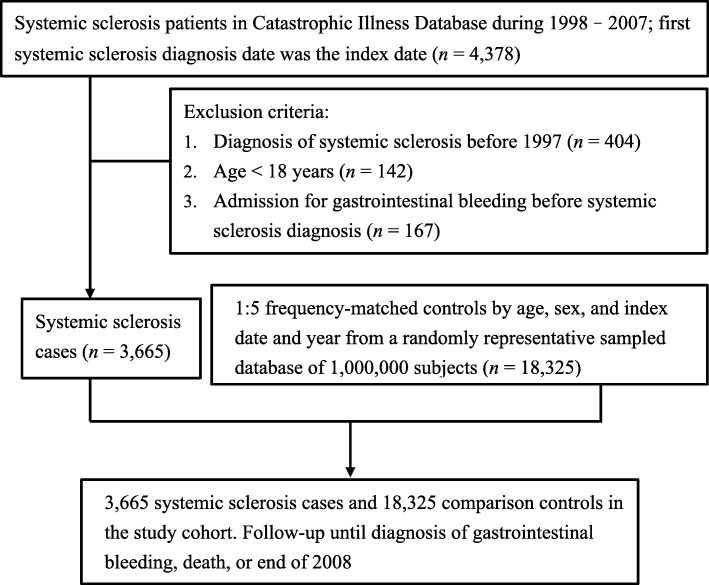
Patients with SSc diagnosis were identified from the Catastrophic Illness Patient Database and the National Health Insurance Research Database from 1998 to 2007. Each SSc patient was matched with five SSc-free individuals by age, sex, and index date. All individuals (case = 3665, control = 18,325) were followed until the appearance of a GI bleeding event, death, or end of 2008. A subdistribution hazards model was assessed to evaluate the GI bleeding risk with adjustments for age, sex, and time-dependent covariates, comorbidity, and medications.
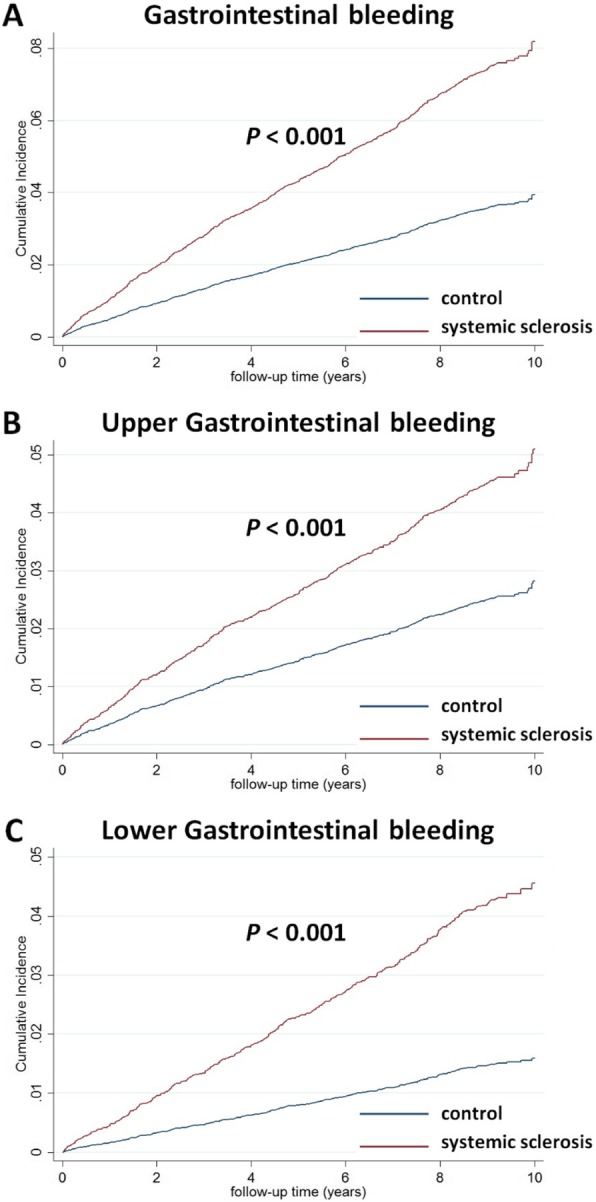
The incidence rate ratios of GI bleeding were 2.38 (95% confidence interval [CI], 2.02-2.79), 2.06 (95% CI, 1.68-2.53), and 3.16 (95% CI, 2.53-3.96) for over-all, upper, and lower GI bleeding events in SSc patients. In the competing death risk in the subdistribution hazards model with time-covariate adjustment, SSc was an independent risk factor for over-all GI bleeding events (subdistribution hazard ratio [sHR] 2.98, 95% CI, 2.21-4.02), upper GI bleeding events (sHR 2.80, 95% CI, 1.92-4.08), and lower GI bleeding events (sHR 3.93, 95% CI, 2.52-6.13).
SSc patients exhibited a significantly higher risk of over-all and different subtype GI bleeding events compared with the SSc-free population. The prevention strategy is needed for these high GI bleeding risk groups.
系统性硬化症(SSc)是一种危及生命的自身免疫性疾病,其特征为血管病变。许多 SSc 患者表现出胃肠道(GI)受累,但精细的 GI 出血风险仍然很少。我们旨在探讨 SSc 在确定 GI 出血长期风险中的作用,包括上(消化性和非消化性溃疡)和下 GI 出血。
从 1998 年至 2007 年,从灾难性疾病患者数据库和国家健康保险研究数据库中确定了 SSc 诊断患者。每个 SSc 患者通过年龄、性别和索引日期与 5 名无 SSc 个体匹配。所有个体(病例=3665,对照=18325)随访至出现 GI 出血事件、死亡或 2008 年底。采用亚分布风险模型评估 GI 出血风险,并对年龄、性别和随时间变化的协变量、合并症和药物进行调整。
SSc 患者的 GI 出血发生率分别为 2.38(95%置信区间[CI],2.02-2.79)、2.06(95% CI,1.68-2.53)和 3.16(95% CI,2.53-3.96),用于所有、上和下 GI 出血事件。在随时间变化的协变量调整的亚分布风险模型中,与竞争死亡风险相比,SSc 是所有 GI 出血事件(亚分布风险比[sHR]2.98,95% CI,2.21-4.02)、上 GI 出血事件(sHR 2.80,95% CI,1.92-4.08)和下 GI 出血事件(sHR 3.93,95% CI,2.52-6.13)的独立危险因素。
与无 SSc 人群相比,SSc 患者表现出更高的全胃肠道和不同亚型 GI 出血事件风险。需要针对这些高 GI 出血风险人群制定预防策略。