Division of Endocrinology and Metabolism, Department of Internal Medicine, Korea University College of Medicine, Seoul, Korea.
Department of Biostatistics, College of Medicine, The Catholic University of Korea, Seoul, Korea.
Endocrinol Metab (Seoul). 2019 Dec;34(4):406-414. doi: 10.3803/EnM.2019.34.4.406.
Metabolically healthy obese (MHO) is regarded as a transient concept. We examined the effect of the dynamic change of metabolic health status on the incidence of type 2 diabetes mellitus (T2DM) both in obese and normal weight individuals.
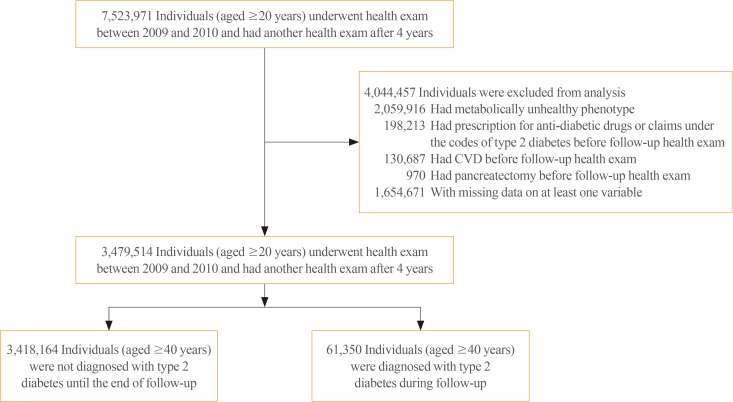
We analyzed 3,479,514 metabolically healthy subjects aged over 20 years from the Korean National Health Screening Program, who underwent health examination between 2009 and 2010, with a follow-up after 4 years. The relative risk for T2DM incidence until the December 2017 was compared among the four groups: stable metabolically healthy normal weight (MHNW), unstable MHNW, stable MHO, and unstable MHO.
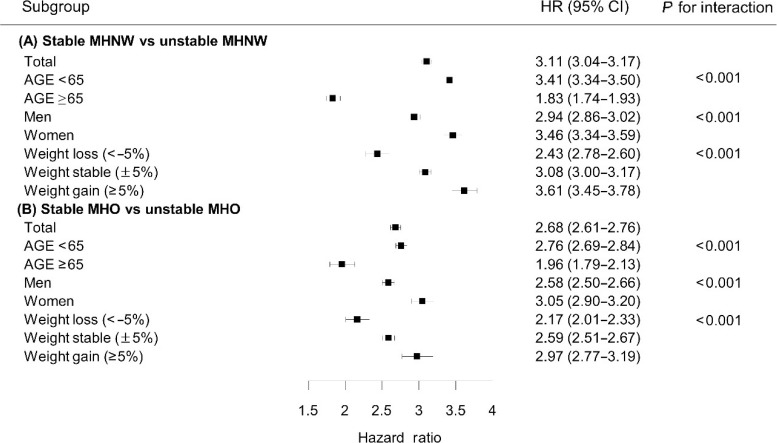
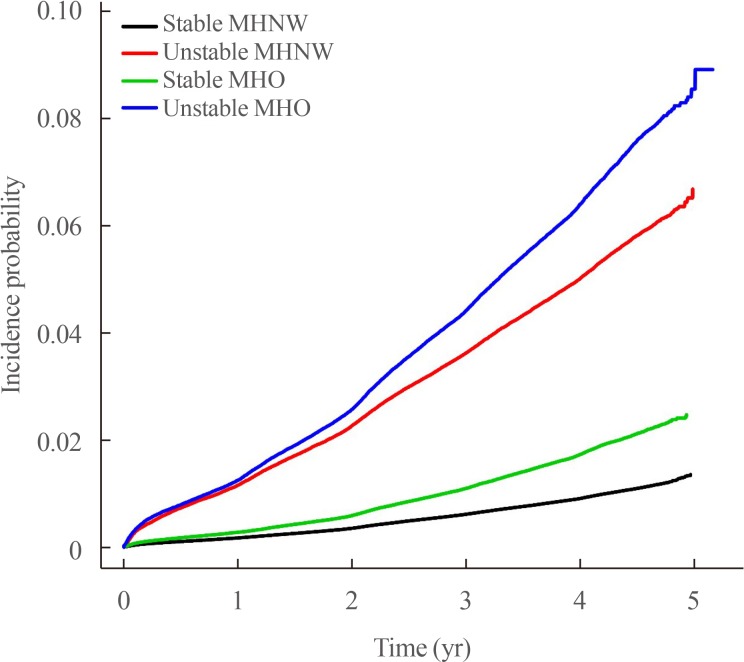
During the 4 years, 11.1% of subjects in the MHNW group, and 31.5% in the MHO group converted to a metabolically unhealthy phenotype. In the multivariate adjusted model, the unstable MHO group showed the highest risk of T2DM (hazard ratio [HR], 4.67; 95% confidence interval [CI], 4.58 to 4.77). The unstable MHNW group had a higher risk of T2DM than stable MHO group ([HR, 3.23; 95% CI, 3.16 to 3.30] vs. [HR, 1.81; 95% CI, 1.76 to 1.85]). The stable MHO group showed a higher risk of T2DM than the stable MHNW group. The influence of the transition into a metabolically unhealthy phenotype on T2DM incidence was greater in subjects with aged <65 years, women, and those with weight gain.
Metabolically healthy phenotype was transient both in normal weight and obese individuals. Maintaining metabolic health was critical for the prevention of T2DM, irrespective of their baseline body mass index.
代谢健康型肥胖(MHO)被认为是一种短暂的概念。我们研究了代谢健康状况的动态变化对肥胖和正常体重个体 2 型糖尿病(T2DM)发病的影响。
我们分析了 2009 年至 2010 年期间参加韩国国家健康筛查计划、年龄在 20 岁以上且接受健康检查的 3479514 名代谢健康受试者,随访时间为 4 年。比较了 4 年后 T2DM 发病率的相对风险,四组分别为:稳定代谢健康正常体重(MHNW)、不稳定 MHNW、稳定 MHO 和不稳定 MHO。
在 4 年期间,MHNW 组中有 11.1%和 MHO 组中有 31.5%的受试者转变为代谢不健康表型。在多变量调整模型中,不稳定 MHO 组的 T2DM 发病风险最高(风险比[HR],4.67;95%置信区间[CI],4.58 至 4.77)。不稳定 MHNW 组的 T2DM 发病风险高于稳定 MHO 组([HR,3.23;95%CI,3.16 至 3.30]比[HR,1.81;95%CI,1.76 至 1.85])。稳定 MHO 组的 T2DM 发病风险高于稳定 MHNW 组。在年龄<65 岁、女性和体重增加的受试者中,向代谢不健康表型的转变对 T2DM 发病率的影响更大。
代谢健康表型在正常体重和肥胖个体中都是短暂的。维持代谢健康对预防 T2DM 至关重要,与他们的基线体重指数无关。