Department of Health Economics and Health Management, School of Public Health, Bielefeld University, Bielefeld, Germany.
PLoS One. 2019 Dec 30;14(12):e0226496. doi: 10.1371/journal.pone.0226496. eCollection 2019.
Human milk-based fortifiers have shown a protective effect on major complications for very low birth weight newborns. The current study aimed to estimate the cost-effectiveness of an exclusive human milk diet (EHMD) compared to the current approach using cow's milk-based fortifiers in very low birth weight newborns.
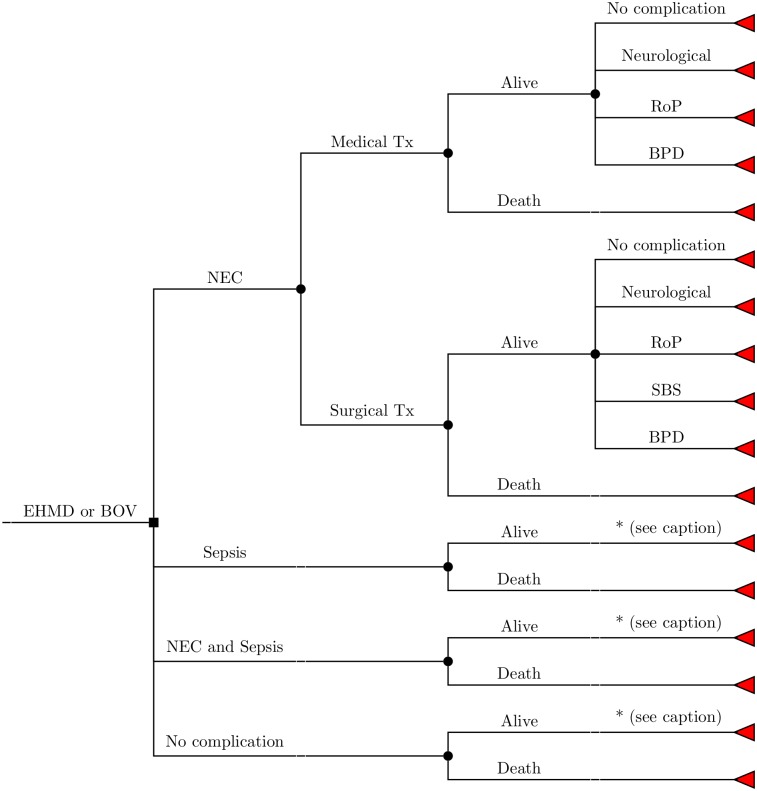
A decision tree model using the health states of necrotising enterocolitis (NEC), sepsis, NEC + sepsis and no complication was used to calculate the cost-effectiveness of an EHMD. For each health state, bronchopulmonary dysplasia (BPD), retinopathy of prematurity (RoP) and neurodevelopmental problems were included as possible complications; additionally, short-bowel syndrome (SBS) was included as a complication for surgical treatment of NEC. The model was stratified into birth weight categories. Costs for inpatient treatment and long-term consequences were considered from a third party payer perspective for the reference year 2017. Deterministic and probabilistic sensitivity analyses were performed, including a societal perspective, discounting rate and all input parameter-values.
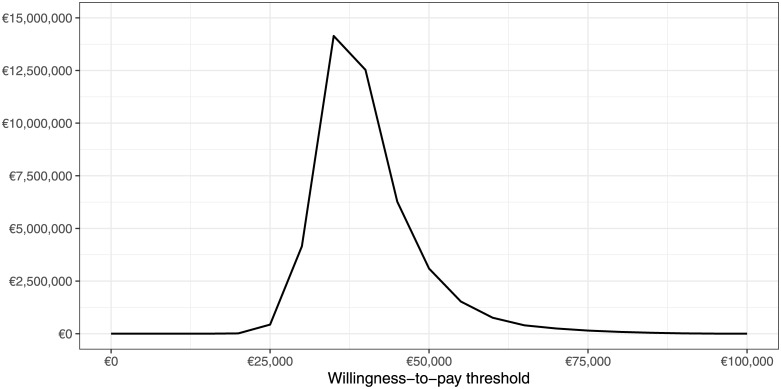
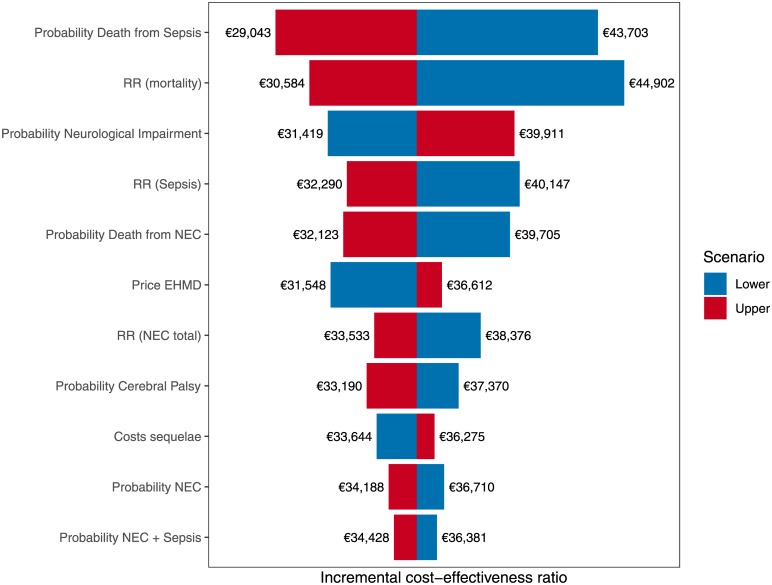
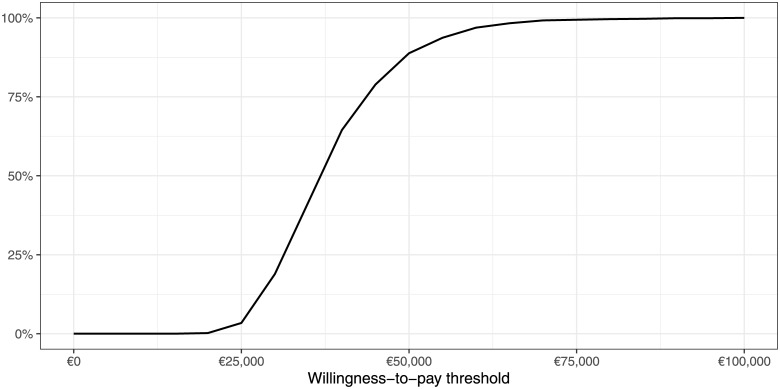
In the base case, the EHMD was estimated to be cost-effective compared to the current nutrition for very low birth weight newborns with an incremental cost-effectiveness ratio (ICER) of €28,325 per Life-Year-Gained (LYG). From a societal perspective, the ICER is €27,494/LYG using a friction cost approach and €16,112/LYG using a human capital approach. Deterministic sensitivity analyses demonstrated that the estimate was robust against changes in the input parameters and probabilistic sensitivity analysis suggested that the probability EHMD was cost-effective at a threshold of €45,790/LYG was 94.8 percent.
Adopting EHMD as the standard approach to nutrition is a cost-effective intervention for very low birth weight newborns in Germany.
人乳强化剂已显示出对极低出生体重儿主要并发症的保护作用。本研究旨在评估与目前使用牛乳强化剂的方法相比,极低出生体重儿采用纯人乳喂养(EHMD)的成本效益。
使用决策树模型,根据坏死性小肠结肠炎(NEC)、败血症、NEC+败血症和无并发症的健康状态,计算 EHMD 的成本效益。对于每种健康状态,均将支气管肺发育不良(BPD)、早产儿视网膜病变(ROP)和神经发育问题纳入可能的并发症;此外,还将短肠综合征(SBS)纳入 NEC 手术治疗的并发症。该模型分为出生体重类别。参考 2017 年,从第三方支付者的角度考虑住院治疗费用和长期后果。进行了确定性和概率敏感性分析,包括社会视角、贴现率和所有输入参数值。
在基础情况下,EHMD 被估计为比目前的极低出生体重儿营养更具成本效益,增量成本效益比(ICER)为每获得 1 个生命年(LYG)增加 28325 欧元。从社会角度来看,采用摩擦成本法时的 ICER 为 27494 欧元/LYG,采用人力资本法时为 16112 欧元/LYG。确定性敏感性分析表明,该估计值对输入参数的变化具有稳健性,概率敏感性分析表明,EHMD 在成本效益阈值为 45790 欧元/LYG 时,其具有 94.8%的概率是成本有效的。
在德国,将 EHMD 作为营养的标准方法是一种对极低出生体重儿具有成本效益的干预措施。