Department of Ecology, Swedish University of Agricultural Sciences (SLU), Box 7044, 75007, Uppsala, Sweden.
Laboratoire de Geólogie de l'ENS, PSL Research University - CNRS UMR8538, 75005, Paris, France.
Sci Rep. 2019 Dec 30;9(1):20319. doi: 10.1038/s41598-019-55058-1.
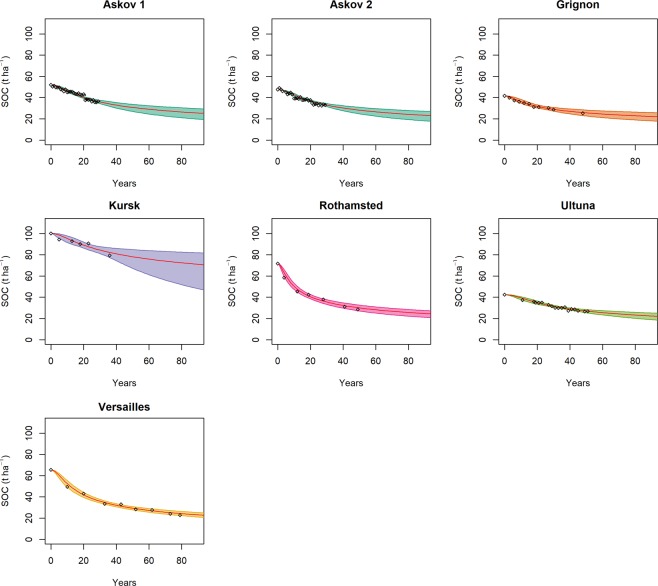
The conventional soil organic matter (SOM) decay paradigm considers the intrinsic quality of SOM as the dominant decay limitation with the result that it is modelled using simple first-order decay kinetics. This view and modelling approach is often criticized for being too simplistic and unreliable for predictive purposes. It is still under debate if first-order models can correctly capture the variability in temporal SOM decay observed between different agroecosystems and climates. To address this question, we calibrated a first-order model (Q) on six long-term bare fallow field experiments across Europe. Following conventional SOM decay theory, we assumed that parameters directly describing SOC decay (rate of SOM quality change and decomposer metabolism) are thermodynamically constrained and therefore valid for all sites. Initial litter input quality and edaphic interactions (both local by definition) and microbial efficiency (possibly affected by nutrient stoichiometry) were instead considered site-specific. Initial litter input quality explained most observed kinetics variability, and the model predicted a convergence toward a common kinetics over time. Site-specific variables played no detectable role. The decay of decades-old SOM seemed mostly influenced by OM chemistry and was well described by first order kinetics and a single set of general kinetics parameters.
传统的土壤有机质(SOM)衰减范式认为,SOM 的固有质量是主要的衰减限制因素,因此使用简单的一级衰减动力学对其进行建模。这种观点和建模方法经常因其过于简单和不可靠而受到批评,无法用于预测目的。对于一阶模型是否能够正确捕捉不同农业生态系统和气候条件下观察到的 SOM 衰减的时间变化的可变性,仍存在争议。为了解决这个问题,我们在欧洲的六个长期休耕农田实验上对一阶模型(Q)进行了校准。按照传统的 SOM 衰减理论,我们假设直接描述 SOC 衰减(SOM 质量变化和分解者代谢的速率)的参数在热力学上受到限制,因此对所有地点都有效。初始凋落物输入质量和土壤相互作用(从定义上讲都是局部的)以及微生物效率(可能受养分化学计量的影响)被认为是特定于地点的。初始凋落物输入质量解释了大部分观察到的动力学变化,并且该模型预测随着时间的推移会朝着共同的动力学收敛。特定于地点的变量没有发挥可检测到的作用。数十年的 SOM 衰减似乎主要受 OM 化学的影响,并且可以很好地用一阶动力学和一组通用动力学参数来描述。