De Santis A, Marchetti D, Pavón-Carrasco F J, Cianchini G, Perrone L, Abbattista C, Alfonsi L, Amoruso L, Campuzano S A, Carbone M, Cesaroni C, De Franceschi G, De Santis Anna, Di Giovambattista R, Ippolito A, Piscini A, Sabbagh D, Soldani M, Santoro F, Spogli L, Haagmans R
Istituto Nazionale di Geofisica e Vulcanologia, Via di Vigna Murata 605, Roma, 00143, Italy.
Now at School of Remote Sensing and Geomatics Engineering NUIST, Nanjing University of Information Science and Technology, Nanjing, China.
Sci Rep. 2019 Dec 30;9(1):20287. doi: 10.1038/s41598-019-56599-1.
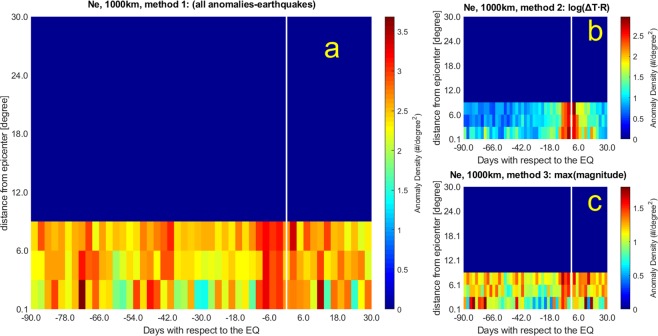
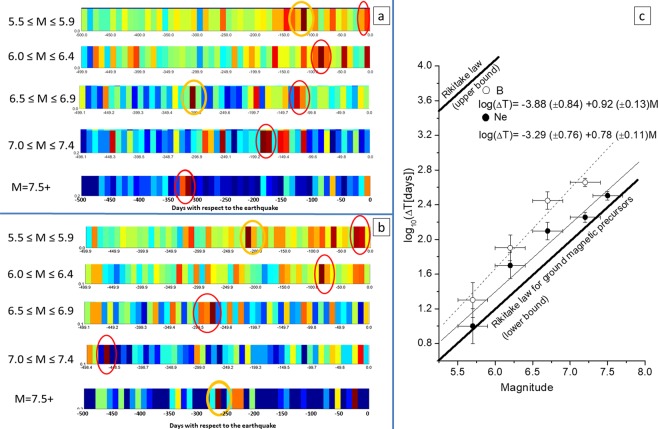
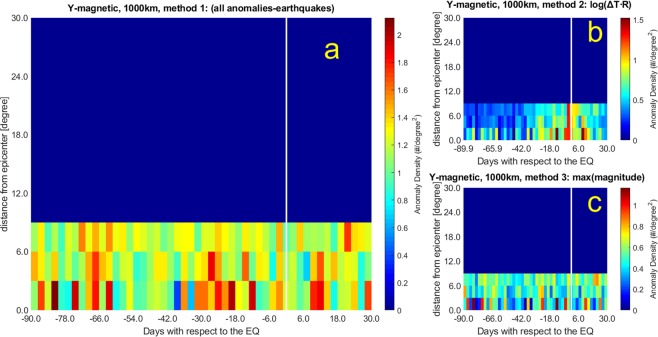
The study of the preparation phase of large earthquakes is essential to understand the physical processes involved, and potentially useful also to develop a future reliable short-term warning system. Here we analyse electron density and magnetic field data measured by Swarm three-satellite constellation for 4.7 years, to look for possible in-situ ionospheric precursors of large earthquakes to study the interactions between the lithosphere and the above atmosphere and ionosphere, in what is called the Lithosphere-Atmosphere-Ionosphere Coupling (LAIC). We define these anomalies statistically in the whole space-time interval of interest and use a Worldwide Statistical Correlation (WSC) analysis through a superposed epoch approach to study the possible relation with the earthquakes. We find some clear concentrations of electron density and magnetic anomalies from more than two months to some days before the earthquake occurrences. Such anomaly clustering is, in general, statistically significant with respect to homogeneous random simulations, supporting a LAIC during the preparation phase of earthquakes. By investigating different earthquake magnitude ranges, not only do we confirm the well-known Rikitake empirical law between ionospheric anomaly precursor time and earthquake magnitude, but we also give more reliability to the seismic source origin for many of the identified anomalies.
研究大地震的准备阶段对于理解其中涉及的物理过程至关重要,并且对于开发未来可靠的短期预警系统也可能有用。在此,我们分析了由Swarm三星编队测量的4.7年电子密度和磁场数据,以寻找大地震可能的电离层原位前兆,研究岩石圈与上层大气和电离层之间的相互作用,即所谓的岩石圈-大气-电离层耦合(LAIC)。我们在感兴趣的整个时空区间内对这些异常进行统计定义,并通过叠加时代方法使用全球统计相关性(WSC)分析来研究与地震的可能关系。我们发现,在地震发生前两个多月到几天的时间里,有一些明显的电子密度和磁异常集中区域。总体而言,相对于均匀随机模拟,这种异常聚类在统计上具有显著性,支持了地震准备阶段的岩石圈-大气-电离层耦合。通过研究不同的地震震级范围,我们不仅证实了电离层异常前兆时间与地震震级之间著名的利田经验定律,而且还为许多已识别异常的震源起源提供了更高的可信度。