Hefter Harald, Rosenthal Dietmar, Bigalke Hans, Moll Marek
Department of Neurology, Heinrich-Heine-Universitat Dusseldorf, Moorenstrasse 5, Düsseldorf, 40225, Germany.
Department of Neurology, Heinrich-Heine-Universitat Dusseldorf, Düsseldorf, Germany.
Ther Adv Neurol Disord. 2019 Dec 16;12:1756286419892078. doi: 10.1177/1756286419892078. eCollection 2019.
The aim of the study was to test the clinical relevance of neutralizing antibodies (NABs) in patients with cervical dystonia (CD) still responding to repeat injections with botulinum toxin type A (BoNT/A).
Enzyme-linked immunosorbent assay (ELISA)-test evidence from a cross-sectional study on 221 CD-patients with treatment durations of between 2 and 21 years and still responding to repeat BoNT/A-injections showed the presence of antibodies against BoNT/A in 39 patients. A mouse hemi-diaphragm (MHDA) confirmation test was performed in these 39 ELISA-positive patients, and demographic (age, sex, age at onset of CD) and treatment-related (duration of treatment, mean dose of the last 10 injections, TSUI-score, patient's subjective scoring of the treatment effect, patient's scoring of quality of life by means of the CDQ24-questionnaire) data from these 39 patients were compared with data from ELISA-negative patients. Paralysis time, the MHDA outcome measure, was correlated with clinical data.
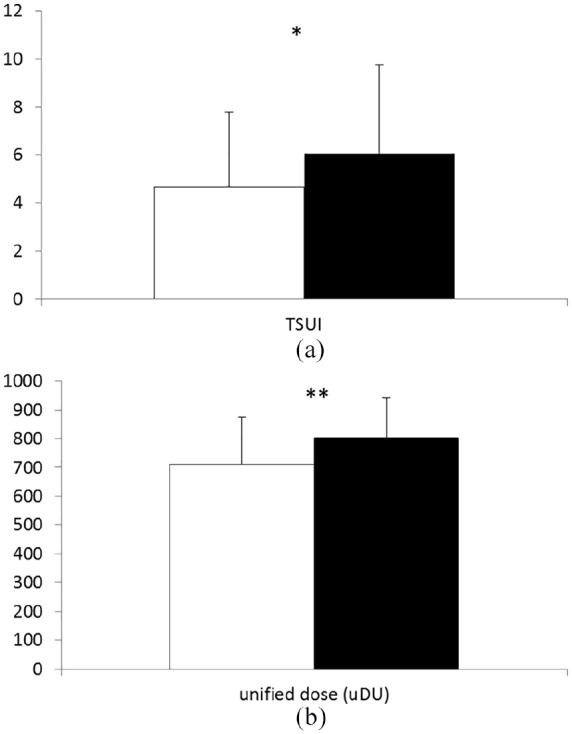
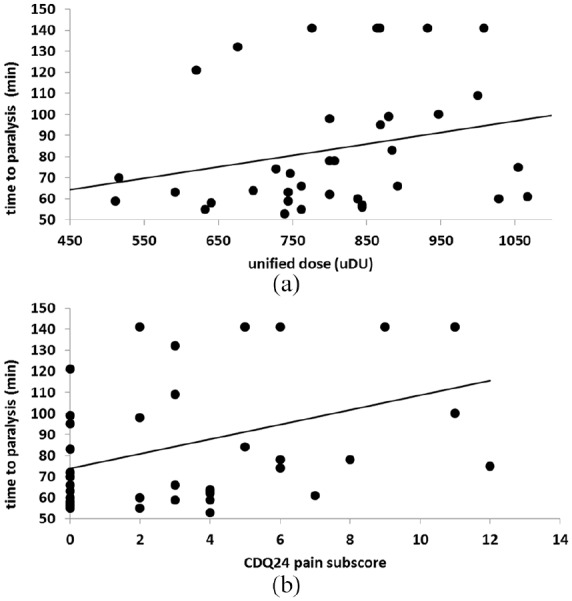
The ELISA-positive CD-patients had significantly higher TSUI-scores ( < 0.015), and had been treated for significant longer ( < 0.022) and with significantly higher doses ( < 0.001). Patient's rating of BoNT/A-treatment effect and quality of life tended to be worse in ELISA-positive compared with ELISA-negative patients. The paralysis time of ELISA-positive patients was significantly correlated with the mean dose of the last 10 injections ( < 0.027) and the pain subscore of the CDQ24 ( < 0.012).
Presence of NABs is clinically relevant in CD, leading to a significantly worse head position, therapy with significantly higher BoNT/A doses, and a correlation between the CDQ24 pain-subscore and antibody titers.
本研究的目的是检测在仍对重复注射A型肉毒毒素(BoNT/A)有反应的颈部肌张力障碍(CD)患者中,中和抗体(NABs)的临床相关性。
一项横断面研究对221例治疗时间在2至21年之间且仍对重复BoNT/A注射有反应的CD患者进行了酶联免疫吸附测定(ELISA)检测,结果显示39例患者存在抗BoNT/A抗体。对这39例ELISA阳性患者进行了小鼠半膈肌(MHDA)确认试验,并将这39例患者的人口统计学数据(年龄、性别、CD发病年龄)和治疗相关数据(治疗持续时间、最后10次注射的平均剂量、TSUI评分、患者对治疗效果的主观评分、患者通过CDQ24问卷对生活质量的评分)与ELISA阴性患者的数据进行比较。将MHDA结果指标麻痹时间与临床数据进行相关性分析。
ELISA阳性的CD患者TSUI评分显著更高(<0.015),治疗时间显著更长(<0.022),注射剂量显著更高(<0.001)。与ELISA阴性患者相比,ELISA阳性患者对BoNT/A治疗效果和生活质量的评分往往更差。ELISA阳性患者的麻痹时间与最后10次注射的平均剂量(<0.027)和CDQ24的疼痛子评分(<0.012)显著相关。
NABs的存在在CD中具有临床相关性,会导致头部位置明显更差、BoNT/A治疗剂量显著更高,且CDQ24疼痛子评分与抗体滴度之间存在相关性。