Department of Biochemistry, School of Medicine, Medical Sciences Campus, University of Puerto Rico, San Juan 00936, Puerto Rico.
Center for Environmental and Toxicological Research, San Juan 00936, Puerto Rico.
Int J Environ Res Public Health. 2019 Dec 30;17(1):264. doi: 10.3390/ijerph17010264.
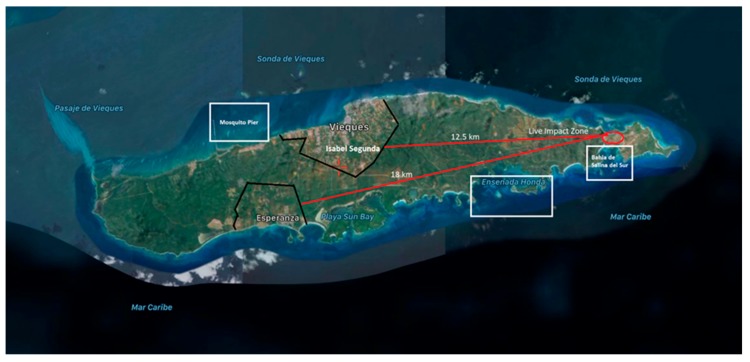
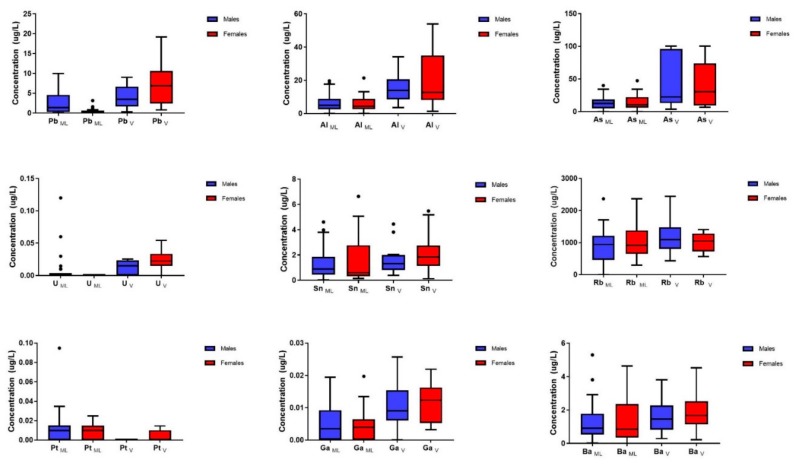
: The island of Vieques (a municipality of Puerto Rico) was used as a military practice range by the US Navy for more than 60 years. Many studies have reported the presence of toxic metals in soil samples taken from Vieques. The bombing range is only 18 km upwind from the Vieques residential area and inhalable resuspended particles resulting from bombing are known to reach the populated area. The current study reports for the first time, the presence of toxic metals' depuration profiles obtained from Vieques and Main Island Puerto Rico human subjects. : This study was designed to evaluate the distribution of toxic metals in a random population exposed to contaminants originating from military activities and comparing it to a non-exposed random population from Main Island Puerto Rico. : A total of 83 subjects studied; 32 were from Vieques and 51 were from Main Island Puerto Rico. A physician administrated chelation therapy to all subjects and collected urine samples during a 24-h period. A total of 20 trace elements associated with military activities were measured in urine by induced coupled plasma mass spectrometry (ICP-MS). The results were compared between both population samples. : Significant differences in the levels of eight trace elements associated with military practices were found between Vieques and Main Island Puerto Rico. Lead (Pb), aluminum (Al), uranium (U) ( < 0.001), arsenic (As), cadmium (Cd) ( = 0.02), and gadolinium (Gd) ( = 0.03) were significantly higher in Vieques while niobium (Nb) and platinum (Pt) levels ( < 0.006) were lower in the Vieques samples. : Higher concentrations of Pb, Al, As, Cd, Gd, and U were found in Vieques residents' urine samples compared to Main Island. Nonetheless, Pt and Ga were present in Main Island at higher concentrations than in Vieques. Although limited by its sample size, this report should set a basis for the importance of health assessment in these subjects exposed to military activities remnants throughout the years and further evaluation of their effects on the overall health of the population.
别克斯岛(波多黎各的一个自治市)曾被美国海军用作军事演习场超过 60 年。许多研究报告称,在别克斯岛采集的土壤样本中存在有毒金属。轰炸靶场距离别克斯居民区仅 18 公里顺风,爆炸产生的可吸入悬浮颗粒已知会到达人口稠密地区。本研究首次报告了从别克斯岛和波多黎各主岛的人体样本中获得的有毒金属净化情况。
本研究旨在评估暴露于源自军事活动的污染物的随机人群中有毒金属的分布,并将其与来自波多黎各主岛的非暴露随机人群进行比较。
共有 83 名受试者参与研究;32 名来自别克斯岛,51 名来自波多黎各主岛。一名医生对所有受试者进行螯合疗法,并在 24 小时内收集尿液样本。通过电感耦合等离子体质谱法(ICP-MS)共测量了与军事活动相关的 20 种微量元素。将两个人群样本的结果进行了比较。
别克斯岛和波多黎各主岛人群样本中,与军事实践相关的 8 种微量元素水平存在显著差异。铅(Pb)、铝(Al)、铀(U)(<0.001)、砷(As)、镉(Cd)(=0.02)和钆(Gd)(=0.03)的水平显著高于别克斯岛,而铌(Nb)和铂(Pt)水平(<0.006)则较低。
与波多黎各主岛相比,别克斯岛居民尿液样本中 Pb、Al、As、Cd、Gd 和 U 的浓度更高。然而,Pt 和 Ga 在波多黎各的浓度高于别克斯岛。尽管受样本量限制,但本报告应为评估多年来暴露于军事活动残留物的这些人群的健康状况以及进一步评估其对人口整体健康的影响奠定基础。