Bhat Aditya, Khanna Shaun, Chen Henry H, Lee Lina, Gan Gary C H, Negishi Kazuaki, MacIntyre C Raina, Nunes Maria Carmo P, Tan Timothy C
Department of Cardiology, Blacktown Hospital, Blacktown Road, Blacktown, NSW 2148, Australia.
Geriatric Medicine, Rehabilitation & Aged Care Services, Blacktown Hospital, Blacktown Road, Blacktown, NSW 2148, Australia.
Int J Cardiol Heart Vasc. 2019 Dec 26;26:100454. doi: 10.1016/j.ijcha.2019.100454. eCollection 2020 Feb.
Stroke is one of the leading causes of morbidity and mortality with a significant percentage classified as cryptogenic. Left atrial (LA) remodelling, a substrate for atrial fibrillation (AF) and stroke development, may play a role in identification of the aetiology of cryptogenic stroke. We aimed to examine LA function to gain mechanistic insights into the pathophysiology of cryptogenic stroke in young patients otherwise at low risk for cardiovascular disease.
Patients aged <60 years without traditional cardiovascular risk factors and who were diagnosed with ischaemic cryptogenic stroke or TIA were evaluated and compared to healthy controls and patients with paroxysmal AF with a CHADS-VA score of 0. Conventional and novel left ventricular (LV) and LA echocardiographic parameters between the three groups were assessed.
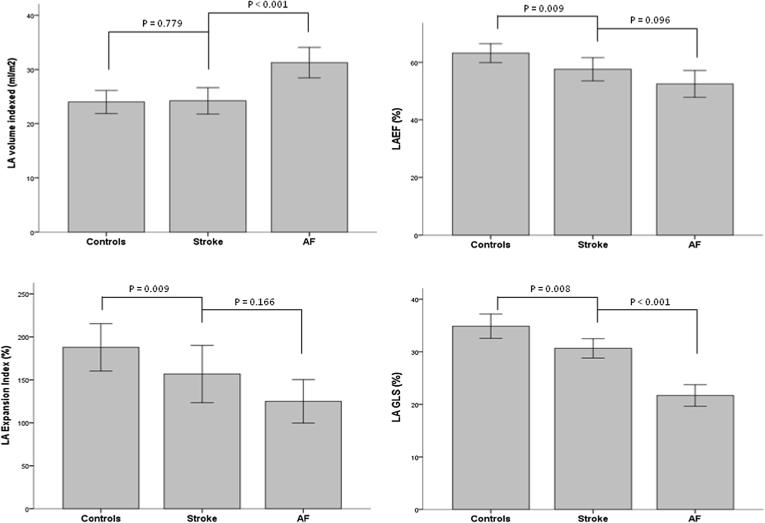
Each group consisted of thirty patients. There were no significant differences in LV parameters (LVEF, LV endoGLS) between groups. LA strain in stroke patients was significantly lower compared to the controls (median 33%; interquartile range (IQ) [32/39] vs 31 [27/34]; p = 0.008). LA strain was significantly lower in AF patients compared to stroke patients (median 21% [19/22] vs 31% [27/34]; p < 0.0001).
A stepwise reduction in measures of LA function was appreciated between controls, young stroke and paroxysmal AF groups. This may indicate dynamic LA remodelling occurring in the young stroke population and suggest a shared causal mechanism for stroke development in this group. LA strain may further refine the risk for cardioembolic stroke.
中风是发病和死亡的主要原因之一,其中很大一部分被归类为隐源性。左心房(LA)重塑是心房颤动(AF)和中风发展的基础,可能在隐源性中风病因的识别中起作用。我们旨在研究左心房功能,以深入了解年轻患者隐源性中风的病理生理学机制,这些患者原本心血管疾病风险较低。
对年龄<60岁、无传统心血管危险因素且被诊断为缺血性隐源性中风或短暂性脑缺血发作(TIA)的患者进行评估,并与健康对照组以及CHADS-VA评分为0的阵发性房颤患者进行比较。评估了三组之间传统和新型的左心室(LV)及左心房超声心动图参数。
每组有30名患者。各组之间左心室参数(左心室射血分数、左心室内膜下纵向应变)无显著差异。中风患者的左心房应变显著低于对照组(中位数33%;四分位间距(IQ)[32/39] 对比 31 [27/孔34];p = 0.008)。房颤患者的左心房应变显著低于中风患者(中位数21% [19/22] 对比 31% [27/34];p < 0.0001)。
在对照组、年轻中风组和阵发性房颤组之间,观察到左心房功能指标呈逐步降低。这可能表明年轻中风人群中发生了动态左心房重塑,并提示该组中风发展存在共同的因果机制。左心房应变可能进一步细化心源性栓塞性中风的风险。