Welsman Jo, Armstrong Neil
Children's Health and Exercise Research Centre, University of Exeter, Exeter, Devon, UK.
BMJ Open Sport Exerc Med. 2019 Dec 22;5(1):e000627. doi: 10.1136/bmjsem-2019-000627. eCollection 2019.
The 20 m shuttle run test (20mSRT) is used to estimate cardiorespiratory fitness (CRF) through the prediction of peak oxygen uptake ( ), but its validity as a measure of CRF during childhood and adolescence is questionable. This study examined the validity of the 20mSRT to predict peak .
Peak was measured during treadmill running. Log-linear regression was used to correct peak for body mass and sum of skinfolds plus age. Boys completed the 20mSRT under standardised conditions. Maximum speed (km/h) was used with age to predict peak using the equation developed by Léger . Validity was examined from linear regression methods and limits of agreement (LoA). Relationships between 20mSRT performance and allometrically adjusted peak , and predicted per cent fat were examined.
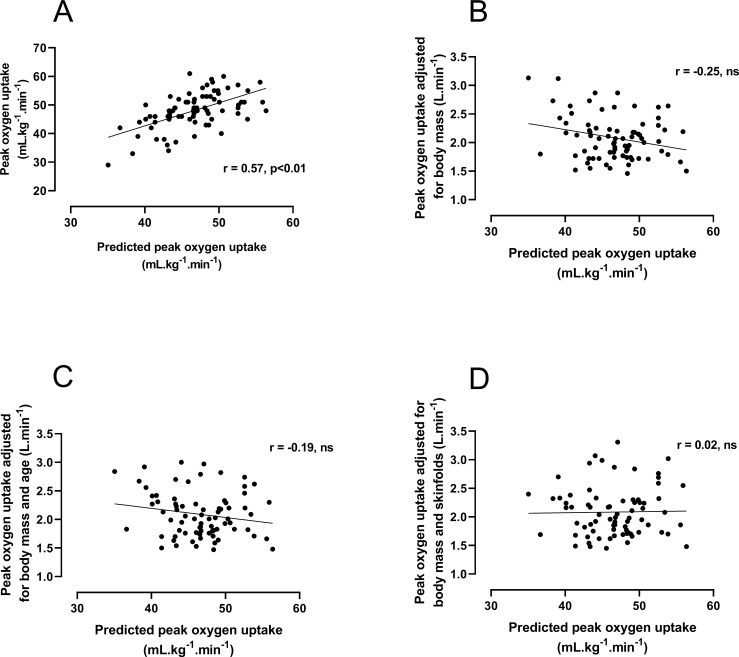
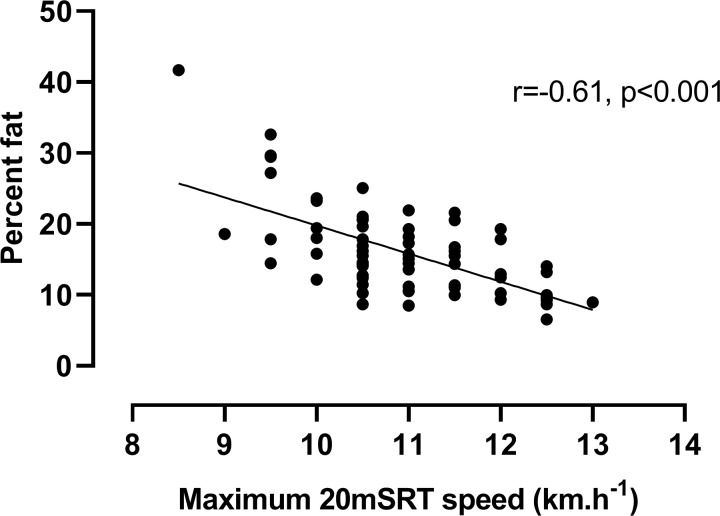
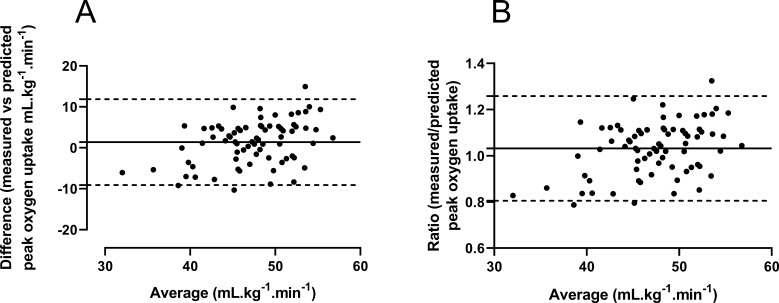
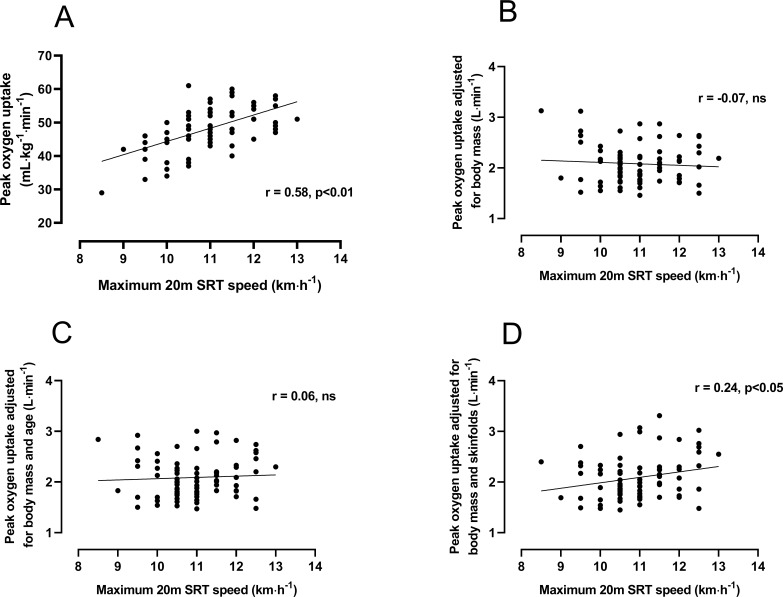
The sample comprised 76 boys aged 11-14 years. Predicted and measured mass-related peak (mL/kg/min) shared common variance of 32%. LoA revealed that measured peak ranged from 15% below to 25% above predicted peak . There were no significant relationships (p>0.05) between predicted peak and measured peak adjusted for mass, age and skinfold thicknesses. Adjusted for body mass and age, peak was not significantly related (p>0.05) to 20mSRT final speed but a weak, statistically significant (r=0.24, p<0.05) relationship was found with peak adjusted for mass and fatness. Predicted per cent fat was negatively correlated with 20mSRT speed (r=-0.61, p<0.001).
The 20mSRT reflects fatness rather than CRF and has poor validity grounded in its flawed estimation and interpretation of peak in mL/kg/min.
20米穿梭跑测试(20mSRT)通过预测最大摄氧量( )来评估心肺适能(CRF),但其作为儿童和青少年时期CRF测量指标的有效性存在疑问。本研究检验了20mSRT预测最大 的有效性。
在跑步机跑步过程中测量最大 。采用对数线性回归对最大 进行体重、皮褶厚度总和与年龄的校正。男孩们在标准化条件下完成20mSRT。使用勒热尔(Léger)开发的公式,将最大速度(千米/小时)与年龄相结合来预测最大 。通过线性回归方法和一致性界限(LoA)检验有效性。研究了20mSRT表现与经异速生长调整的最大 以及预测体脂百分比之间的关系。
样本包括76名11 - 14岁的男孩。预测的和测量的与体重相关的最大 (毫升/千克/分钟)的共同方差为32%。LoA显示,测量的最大 比预测的最大 低15%至高25%。经体重、年龄和皮褶厚度调整后,预测的最大 与测量的最大 之间无显著关系(p>0.05)。经体重和年龄调整后,最大 与20mSRT最终速度无显著关系(p>0.05),但与经体重和肥胖调整后的最大 存在微弱的统计学显著关系(r = 0.24,p<0.05)。预测的体脂百分比与20mSRT速度呈负相关(r = -0.61,p<0.001)。
20mSRT反映的是肥胖程度而非CRF,并且由于其对以毫升/千克/分钟为单位的最大 的估计和解释存在缺陷,其有效性较差。