Department of Paediatrics, Level 2 Children's Hospital, John Radcliffe Hospital, Oxford, United Kingdom.
Centre for Movement, Occupational and Rehabilitation Sciences (MOReS), Faculty of Health and Life Sciences, Oxford Brookes University, Oxford, United Kingdom.
Pediatrics. 2022 Jul 1;150(1). doi: 10.1542/peds.2021-056003.
There is no clear guidance on the intensity and duration of physical activity (PA) that adolescents require to maximise cardiorespiratory fitness (CRF). We aimed to determine the strength of associations between each PA intensity and CRF, independently of other intensities, and the PA duration at each intensity associated with maximal CRF.
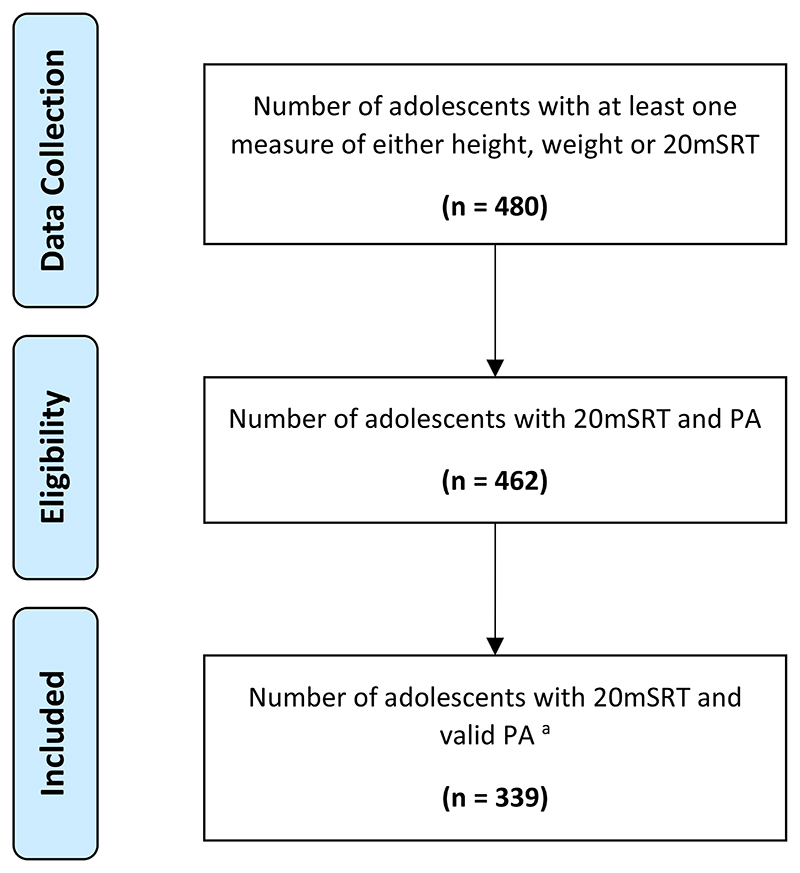
PA and CRF were assessed in 339 adolescents aged 13 to 14 years by wrist-worn accelerometers and 20-m shuttle runs, respectively. Partial regression modeling was used to construct residualized PA variables at each PA intensity that were uncorrelated with each other. Moving average models were optimally fitted to determine relationships between residualized PA variables and CRF. Threshold regression models determined the duration of PA above which CRF improvement was minimal.
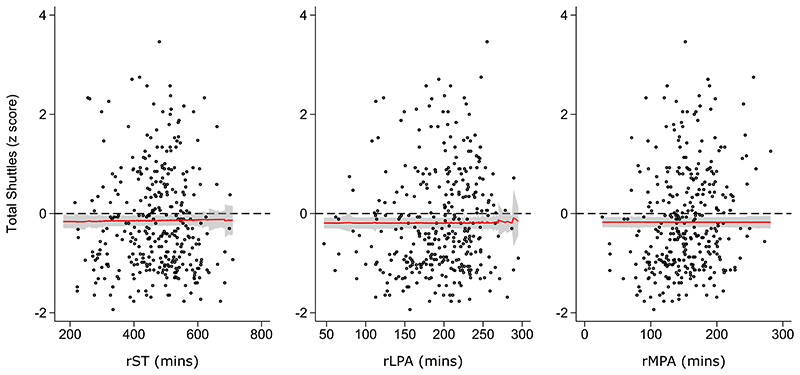
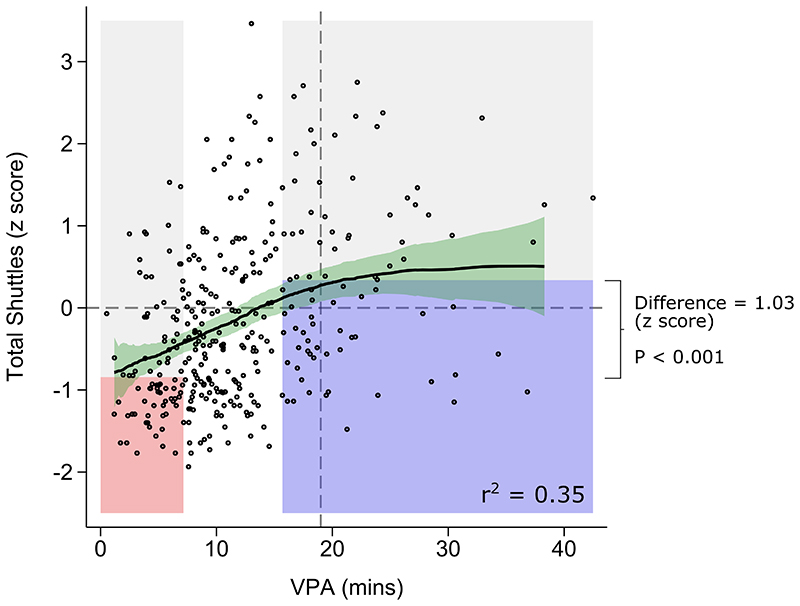
Greater vigorous PA (VPA) was associated with better CRF until about 20 minutes of daily VPA, when the relationship plateaued. Moderate and light PA, and sedentary time were not associated with CRF in partial models. Adolescents performing 14 (range 12-17) minutes of daily VPA had median CRF. Participants in the upper quartile of VPA had 1.03 z-scores higher CRF than those in the lowest quartile (95% confidence interval: 0.75 to 1.30).
Our data suggest that 20 minutes of daily VPA may be best for maximizing CRF in adolescence. As moderate-to-vigorous PA guidelines can be satisfied by only undertaking moderate PA, with no apparent independent benefit, we suggest that future guidelines focus on VPA alone, simplifying public health messaging.
目前尚不清楚青少年需要多大强度和多长时间的身体活动(PA)才能最大限度地提高心肺适能(CRF)。本研究旨在确定每种 PA 强度与 CRF 之间的关联强度,同时独立于其他强度,以及与最大 CRF 相关的每种 PA 强度的持续时间。
通过佩戴在手腕上的加速度计和 20 米穿梭跑分别评估了 339 名 13 至 14 岁青少年的 PA 和 CRF。使用偏最小二乘回归模型构建了相互之间不相关的每个 PA 强度的剩余 PA 变量。最佳拟合移动平均模型以确定剩余 PA 变量与 CRF 之间的关系。阈值回归模型确定了 PA 持续时间,超过该时间,CRF 改善最小。
较大强度的 PA(VPA)与更好的 CRF 相关,直到每天 20 分钟的 VPA 左右,此时关系趋于平稳。中度和轻度 PA 以及久坐时间在偏模型中与 CRF 无关。每天进行 14 分钟(范围 12-17 分钟)VPA 的青少年具有中位数 CRF。VPA 处于上四分位的参与者比处于最低四分位的参与者具有更高的 CRF(z 分数为 1.03;95%置信区间:0.75 至 1.30)。
我们的数据表明,每天 20 分钟的 VPA 可能是青少年提高 CRF 的最佳选择。由于仅进行中等强度的 PA 就可以满足中等至高强度的 PA 指南,并且没有明显的独立益处,因此我们建议未来的指南仅关注 VPA,简化公共卫生信息传递。