Roy Sukanya, Glaser Shannon, Chakraborty Sanjukta
Department of Medical Physiology, Texas A&M Health Science Center College of Medicine, Bryan, TX, United States.
Front Med (Lausanne). 2019 Dec 18;6:293. doi: 10.3389/fmed.2019.00293. eCollection 2019.
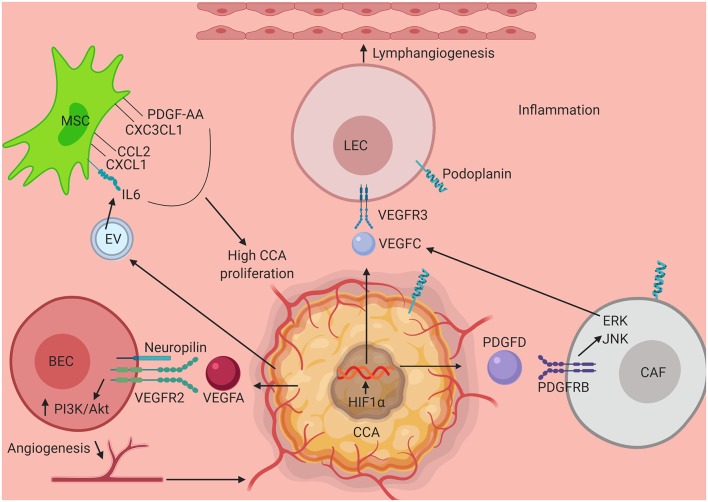
Cholangiocarcinoma (CCA), or cancer of the biliary epithelium is a relatively rare but aggressive form of biliary duct cancer which has a 5-year survival rate post metastasis of 2%. Although a number of risk factors are established for CCA growth and progression, a careful evaluation of the existing literature on CCA reveals that an inflammatory environment near the biliary tree is the most common causal link between the risk factors and the development of CCA. The fact that inflammation predisposes affected individuals to CCA is further bolstered by multiple observations where the presence and maintenance of an inflammatory microenvironment at the site of the primary tumor plays a significant role in the development and metastasis of CCA. In addition, mechanisms activating the tumor vasculature and enhancing angiogenesis and lymphangiogenesis significantly contribute to CCA aggressiveness and metastasis. This review aims to address the role of an inflammatory microenvironment-CCA crosstalk and will present the basic concepts, observations, and current perspectives from recent research studies in the field of tumor stroma of CCA.
胆管癌(CCA),即胆管上皮癌,是一种相对罕见但侵袭性较强的胆管癌,转移后的5年生存率为2%。尽管已经确定了许多与CCA生长和进展相关的危险因素,但对现有CCA文献的仔细评估表明,胆管树附近的炎症环境是危险因素与CCA发生之间最常见的因果联系。炎症使受影响个体易患CCA这一事实,在多项观察中得到了进一步支持,即原发性肿瘤部位炎症微环境的存在和维持在CCA的发生和转移中起重要作用。此外,激活肿瘤血管并增强血管生成和淋巴管生成的机制显著促进了CCA的侵袭性和转移。本综述旨在探讨炎症微环境与CCA相互作用的作用,并将介绍CCA肿瘤基质领域近期研究的基本概念、观察结果和当前观点。