Dong Xiaocheng Charlie
Center for Diabetes and Metabolic Diseases, Department of Biochemistry and Molecular Biology, Indiana University School of Medicine, Indianapolis, IN, United States.
Front Med (Lausanne). 2019 Dec 17;6:304. doi: 10.3389/fmed.2019.00304. eCollection 2019.
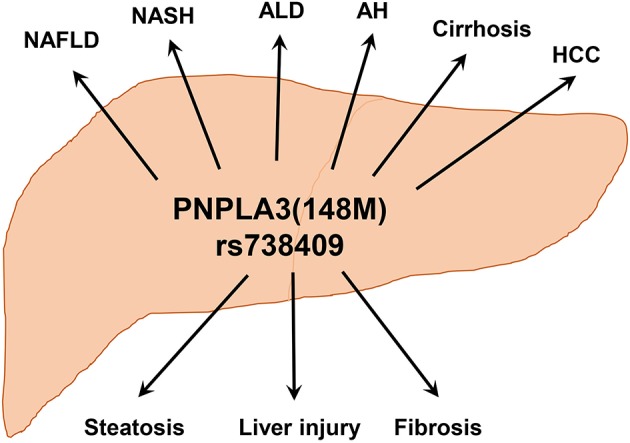
Patatin-like phospholipase domain-containing protein 3 (PNPLA3) is a lipid droplet-associated protein that has been shown to have hydrolase activity toward triglycerides and retinyl esters. The first evidence of PNPLA3 being associated with fatty liver disease was revealed by a genome-wide association study (GWAS) of Hispanic, African American, and European American individuals in the Dallas Heart Study back in 2008. Since then, numerous GWAS reports have shown that PNPLA3 rs738409[G] (148M) variant is associated with hepatic triglyceride accumulation (steatosis), inflammation, fibrosis, cirrhosis, and even hepatocellular carcinoma regardless of etiologies including alcohol- or obesity-related and others. The frequency of PNPLA3(148M) variant ranges from 17% in African Americans, 23% in European Americans, to 49% in Hispanics in the Dallas Heart Study. Due to high prevalence of obesity and alcohol consumption in modern societies, the PNPLA3(148M) gene variant and environment interaction poses a serious concern for public health, especially chronic liver diseases including alcohol-related liver disease (ALD) and nonalcoholic fatty liver disease (NAFLD). Therefore, PNPLA3(148M) variant is a potential therapeutic target for chronic liver disease in the rs738409 allele carriers. Currently, there is no approved drug specifically targeting the PNPLA3(148M) variant yet. With additional mechanistic studies, novel therapeutic strategies are expected to be developed for the treatment of the PNPLA3(148M) variant-associated chronic liver diseases in the near future.
含帕他丁样磷脂酶结构域蛋白3(PNPLA3)是一种与脂滴相关的蛋白质,已被证明对甘油三酯和视黄酯具有水解酶活性。2008年达拉斯心脏研究中对西班牙裔、非裔美国人和欧裔美国人进行的全基因组关联研究(GWAS)首次揭示了PNPLA3与脂肪肝疾病相关的证据。从那时起,大量GWAS报告表明,PNPLA3 rs738409[G](148M)变体与肝甘油三酯蓄积(脂肪变性)、炎症、纤维化、肝硬化,甚至肝细胞癌相关,无论病因是酒精相关、肥胖相关还是其他。在达拉斯心脏研究中,PNPLA3(148M)变体的频率在非裔美国人中为17%,在欧裔美国人中为23%,在西班牙裔中为49%。由于现代社会中肥胖和酒精消费的高患病率,PNPLA3(148M)基因变体与环境的相互作用对公众健康,尤其是包括酒精性肝病(ALD)和非酒精性脂肪性肝病(NAFLD)在内的慢性肝病构成了严重担忧。因此,PNPLA3(148M)变体是rs738409等位基因携带者慢性肝病的潜在治疗靶点。目前,尚无专门针对PNPLA3(148M)变体的获批药物。随着更多机制研究的开展,预计在不久的将来会开发出针对与PNPLA3(148M)变体相关的慢性肝病的新型治疗策略。