
微米至亚毫米尺度下,金属有机框架的灵活性可通过晶体尺寸调节以实现高效二甲苯异构体分离。
Flexibility of Metal-Organic Framework Tunable by Crystal Size at the Micrometer to Submillimeter Scale for Efficient Xylene Isomer Separation.
作者信息
Yang Xiao, Zhou Hao-Long, He Chun-Ting, Mo Zong-Wen, Ye Jia-Wen, Chen Xiao-Ming, Zhang Jie-Peng
机构信息
MOE Key Laboratory of Bioinorganic and Synthetic Chemistry, School of Chemistry, Sun Yat-Sen University, Guangzhou 510275, China.
出版信息
Research (Wash D C). 2019 Oct 17;2019:9463719. doi: 10.34133/2019/9463719. eCollection 2019.
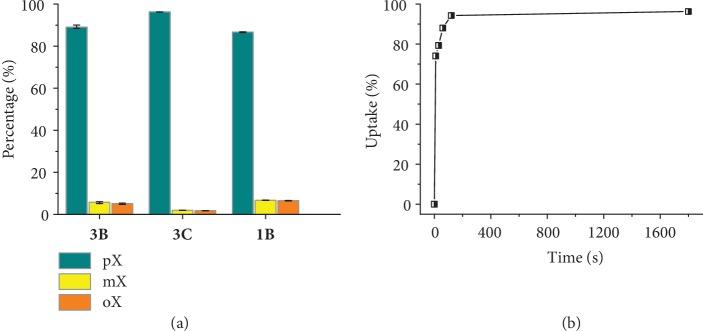
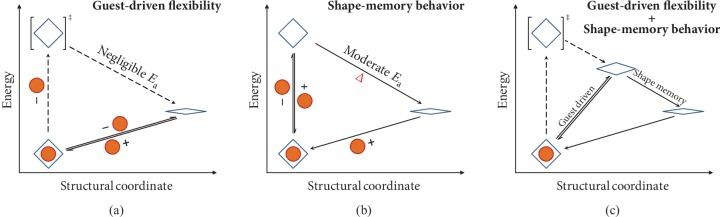
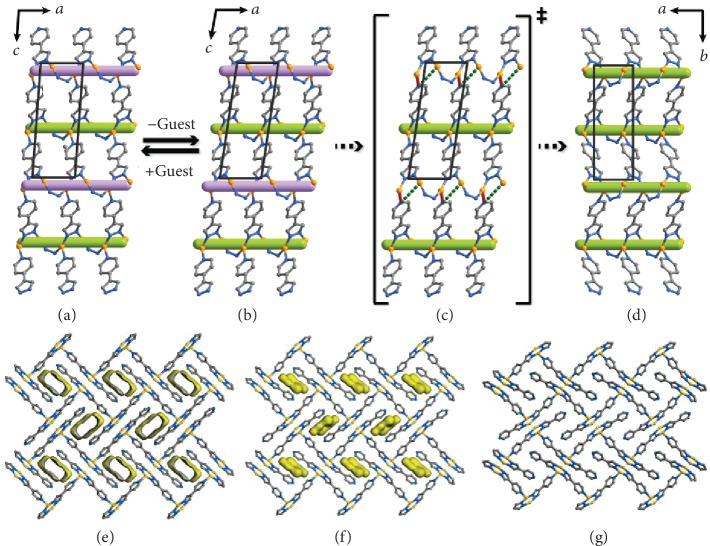
Understanding, controlling, and utilizing the flexibility of adsorbents are of great importance and difficulty. Analogous with conventional solid materials, downsizing to the nanoscale is emerging as a possible strategy for controlling the flexibility of porous coordination polymers (or metal-organic frameworks). We report a unique flexibility controllable by crystal size at the micrometer to submillimeter scale. Template removal transforms [Cu(pypz)]·0.5-xylene (MAF-36, Hpypz = 4-(1-pyrazol-4-yl)pyridine) with one-dimensional channels to -[Cu(pypz)] with discrete small cavities, and further heating gives a nonporous isomer -[Cu(pypz)]. Both isomers can adsorb -xylene to give [Cu(pypz)]·0.5-xylene, meaning the coexistence of guest-driven flexibility and shape-memory behavior. The phase transition temperature from -[Cu(pypz)] to -[Cu(pypz)] decreased from ~270°C to ~150°C by increasing the crystal size from the micrometer to the submillimeter scale, ca. 2-3 orders larger than those of other size-dependent behaviors. Single-crystal X-ray diffraction showed coordination bond reconstitution and chirality inversion mechanisms for the phase transition, which provides a sufficiently high energy barrier to stabilize the metastable phase without the need of downsizing to the nanoscale. By virtue of the crystalline molecular imprinting and gate-opening effects, -[Cu(pypz)] and -[Cu(pypz)] show unprecedentedly high -xylene selectivities of 16 and 51, respectively, as well as ultrafast adsorption kinetics (<2 minutes), for xylene isomers.
理解、控制和利用吸附剂的柔韧性具有重大意义且颇具难度。与传统固体材料类似,将尺寸缩小至纳米级正成为控制多孔配位聚合物(或金属有机框架)柔韧性的一种可行策略。我们报道了一种在微米至亚毫米尺度上可通过晶体尺寸控制的独特柔韧性。去除模板将具有一维通道的[Cu(pypz)]·0.5-二甲苯(MAF-36,Hpypz = 4-(1-吡唑-4-基)吡啶)转变为具有离散小空腔的-[Cu(pypz)],进一步加热则得到无孔异构体-[Cu(pypz)]。两种异构体均可吸附二甲苯形成[Cu(pypz)]·0.5-二甲苯,这意味着客体驱动的柔韧性和形状记忆行为共存。通过将晶体尺寸从微米级增大至亚毫米级,-[Cu(pypz)]到-[Cu(pypz)]的相变温度从约270°C降至约150°C,比其他尺寸依赖性行为的变化大2 - 3个数量级。单晶X射线衍射表明了相变的配位键重构和手性反转机制,该机制提供了足够高的能垒来稳定亚稳相,而无需缩小至纳米级。借助晶体分子印迹和门控效应,-[Cu(pypz)]和-[Cu(pypz)]对二甲苯异构体分别展现出前所未有的高选择性,分别为16和51,以及超快的吸附动力学(<2分钟)。

 Zotero 插件